
Spire Health
Winter 2015AcquiredRemote patient monitoring for lung disease patients.
Pressure-test this opportunity
Explore the risks and possibilities with a prompt for ChatGPT, Claude, or your agent.
Remote patient monitoring for lung disease patients.
Explore the risks and possibilities with a prompt for ChatGPT, Claude, or your agent.
Spire Health began in 2013 as a Stanford-born consumer wellness company selling a clip-on breathing tracker called the Spire Stone, then spent five years chasing a consumer market it never captured before pivoting to B2B remote patient monitoring for respiratory disease. The company raised $48.1M across four rounds, earned FDA clearance for its monitoring system in 2020, and published clinical data showing a 65% reduction in hospital admissions for COPD patients — yet was acquired by Wellinks in September 2024 in a non-cash transaction that valued the technology, not the company.[12][20]
The core failure was structural: Spire spent its formative years and early capital building a consumer wellness wearable in a market that was consolidating around Apple and Fitbit, then pivoted to a clinically validated B2B business that required hospital sales cycles, regulatory work, and capital intensity that its funding trajectory — a $38M Series B in 2021 followed by nothing — could not sustain. The company's own clinical success became its undoing: the COPD study that proved the product's value arrived in March 2023, just as the company was running out of runway and cycling through its third CEO in three years.[17][16]
The Wellinks acquisition was a salvage operation. Gilde Healthcare, Spire's majority investor, placed its partner Rich Wilmot on Wellinks' board as part of the deal — a signal that the investor was preserving the asset's value rather than betting on its standalone future.[21]
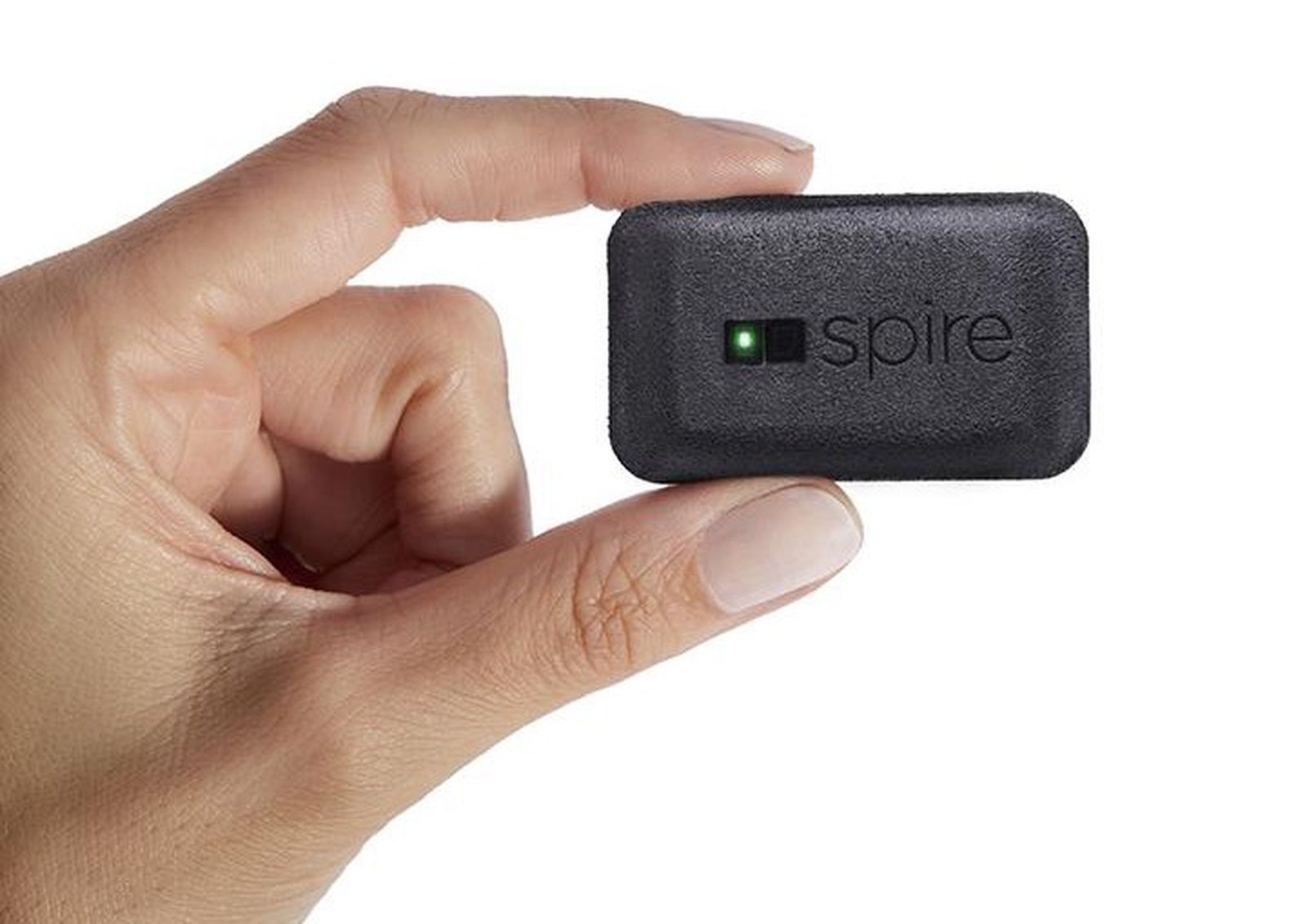

Image 1 / 2
Spire was founded in 2013 by Jonathan Palley, Neema Moraveji (Ph.D.), and Ben Yule, based on research conducted at Stanford University's Calming Technology Lab.[0] Moraveji, who holds a Ph.D. from Stanford, had spent years studying how technology could measure and influence physiological states like stress and focus. The founding team's mission was to make mindfulness measurable — to take the abstract concept of "calm" and turn it into a quantifiable, trackable signal.
The company entered Y Combinator's Winter 2015 batch, with a team of 52 and headquarters in San Francisco.[1] Its seed round closed on March 22, 2015, with Y Combinator participating.[30] The company was also backed by Rock Health and Stanford StartX, giving it credibility in both the consumer wellness and digital health worlds.[28]
The first product, Spire Stone, was a clip-on breathing tracker that measured respiratory patterns to infer stress and focus states. It grossed more than $8 million in sales — respectable for a niche wellness gadget, but a rounding error in a market where Fitbit was selling millions of devices per quarter.[2] A Stanford study presented at the Anxiety and Depression Association of America conference in February 2017 showed that Spire Stone use resulted in 37% more calm- and 25% more focus-related breathing patterns among LinkedIn employees — but this was a corporate wellness pilot, not a scalable business model.[3]
Palley articulated the company's consumer-era vision in November 2017: "To bring the (wearable) industry forward we had to make the wearable disappear."[6] That insight — that the device should be invisible — would eventually define the company's clinical pivot, but in 2017 it was still aimed at consumers.
The company's legal entity, SPIRE, INC., was incorporated on December 31, 2013, and had 40 employees as of December 31, 2020.[30]
Spire's product evolution tells the story of a company that iterated its way from consumer gadget to clinical device. The first product, Spire Stone, was a small clip-on device that attached to clothing and measured breathing patterns to infer stress, focus, and calm states. It launched with a consumer app in June 2016 that used predictive analytics to deliver insights to users.[0]
The second-generation product, Health Tag, launched in November 2017, was a more ambitious piece of hardware. It was a clothing-adhered wearable with a ~2-year battery life that was washer/dryer safe, sold in packs of 3 ($99), 8 ($199), and 15 ($299).[4] The device used proprietary respiratory sensors that measured the full motion of every breath 24/7, providing a waveform that Palley described as "kind of like an ECG for breathing."[29] The battery lasted up to 1.5 years, and the device was machine-washable and dryer-safe — a design choice aimed at solving the compliance problem that plagues wearables.[34]
The Health Tag launched in Apple retail stores in the U.S., U.K., and China in September 2018, sold as a 3-pack for $129, 6-pack for $229, and 8-pack for $299.[5] This was a distribution win — Apple retail placement is notoriously difficult to secure — but it was still a consumer product competing for attention in a market increasingly dominated by smartwatches.
The pivot to B2B remote patient monitoring came in 2019. The company rebranded as "Spire Health" and refocused on respiratory disease, applying its respiratory monitoring technology to clinical care.[7] By March 2019, Spire had deployed over 150,000 units of Spire Stone and Health Tag combined, and had trained machine learning models on billions of respiratory data points.[8]
The clinical product was the Spire Health Remote Patient Monitoring System, which received FDA 510(k) clearance (K192952) on June 5, 2020 as a Class II device for monitoring pulse rate, respiratory rate, sleep/wake behavior, and activity in adults.[11] The system used a Home Hub that was cellular-based (no Wi-Fi needed) and automatically synced data via Bluetooth from the Health Tags.[35] The program was covered by all Medicare plans as a Part B service, and required zero patient engagement once the device was attached to clothing.[29]
The clinical design was the product's core innovation: by making the sensor passive and invisible, Spire solved the adherence problem that kills most remote monitoring programs. The COPD study published in March 2023 found mean device adherence of 88.6% ± 1.1% of days with at least 8 hours of wear time — a figure that would be extraordinary for any consumer wearable, let alone one worn by elderly COPD patients.[18]
Spire's target customer shifted dramatically over its lifetime. In the consumer era, the target was health-conscious individuals interested in stress management and mindfulness — the same demographic that bought early Fitbits and Jawbone trackers. The Stanford study with LinkedIn employees suggested a corporate wellness angle, but this never became a core business.[3]
After the pivot, the target customer became pulmonologists and health systems treating COPD patients. Palley described the population bluntly: "You've got a population that is sick, elderly and not very tech savvy. And the reality is that traditional monitoring and wearable devices have not worked well in this group of patients, for obvious reasons."[10] The YC company page states that Spire Remote Patient Monitoring is used by pulmonologists and patients throughout the United States.[27]
The market for respiratory remote patient monitoring is substantial. COPD impacts 14.2 million Americans and costs the U.S. healthcare system $24 billion annually; CHF impacts 6.5 million and costs $49 billion.[36] Combined, these two conditions affect 20.7 million Americans and cost $73 billion annually. The Medicare Part B reimbursement pathway for RPM provides a clear revenue model — but it also means selling to health systems with long procurement cycles and demanding clinical evidence requirements.
Spire's competitive position must be analyzed along two distinct eras. In the consumer era (2015-2019), Spire competed against Fitbit, Jawbone, and eventually the Apple Watch. This was a structurally unwinnable fight: Apple and Fitbit had distribution, brand recognition, and the ability to bundle health tracking into devices consumers already wanted for other reasons. A clip-on breathing tracker was a feature, not a product — and the market treated it that way.
In the B2B era (2019-2024), Spire's competition shifted to other remote patient monitoring companies. The most direct competitor was Spry Health, which received FDA clearance for its Loop wearable for at-home COPD monitoring around the same time.[9] The competitive landscape also included larger players like ResMed and Philips, which had established relationships with health systems and respiratory care infrastructure.
Spire's differentiation was its passive, clothing-adhered form factor. Competitors required patients to wear a wristband or chest strap — a compliance challenge for elderly COPD patients. Spire's Health Tag, by contrast, was invisible and required zero engagement. The 88.6% adherence rate in the COPD study was the proof point.[18]
But this differentiation created a structural problem: Spire was competing on product depth in a market where incumbents had distribution advantages. ResMed and Philips already had sales forces calling on pulmonologists; Spire had to build those relationships from scratch. The company's technology was superior on the compliance dimension, but compliance is only one axis of a hospital procurement decision.
Spire's business model evolved with its product. In the consumer era, the model was straightforward hardware sales: sell Spire Stone or Health Tag packs to individuals, with the app as a free companion. The $8M+ in gross sales from Spire Stone demonstrates the model worked at small scale, but the unit economics of consumer hardware — manufacturing costs, retail margins, returns, and customer acquisition — made it difficult to scale without massive volume.[2]
The B2B model was more promising but more capital-intensive. Spire's remote patient monitoring was covered by Medicare Part B, meaning health systems could bill Medicare for the monitoring service.[29] The company's revenue model was likely a combination of device sales to health systems and per-patient-per-month monitoring fees — though Spire never disclosed its revenue or pricing publicly.
The absence of revenue data is itself a signal. A company with strong commercial traction typically shares metrics in funding announcements or press releases. Spire's announcements focused on clinical outcomes and regulatory milestones, not revenue growth. The $38M Series B in July 2021 was the last disclosed funding round, and the company was acquired three years later in a non-cash transaction.[13][20]
Inference from available data: with $48.1M raised and 40 employees as of December 2020, Spire's annual burn was likely in the $8-12M range in its later years — a pace that would exhaust the Series B in roughly three to four years.[12][30] The timeline from Series B (July 2021) to acquisition (September 2024) is roughly 38 months — consistent with a company that ran out of runway and accepted a non-cash exit rather than shutting down.
Spire's traction data is a study in contrasts. The consumer era produced meaningful but not transformative numbers: $8M+ in gross sales from Spire Stone, and a Stanford study showing 37% more calm- and 25% more focus-related breathing patterns among LinkedIn employees.[2][3] By March 2019, the company had deployed over 150,000 units combined.[8]
The clinical era produced the company's strongest evidence. The COPD study, published in the International Journal of COPD in March 2023, showed a 65% reduction in hospital admissions in COPD patients using the Spire RPM system, with all-cause hospitalizations per patient per year dropping from 1.09 to 0.38 (P<0.001). Cardiopulmonary-specific admissions decreased 64% (0.70 to 0.25, P<0.001).[17][18] Device adherence was 88.6% ± 1.1% of days with at least 8 hours of wear time.[18]
These are strong clinical outcomes. But the study had only 100+ participants, and Spire never disclosed the number of paying health systems or patients under active monitoring.[9] The YC page's claim that sensors have been worn by more than 150,000 people is a cumulative deployment figure, not a measure of active commercial accounts.[27]
Spire's founding thesis — that mindfulness could be made measurable and sold as a consumer product — never achieved product-market fit. The Spire Stone grossed $8M+, which sounds respectable until you consider that the company was founded in 2013, entered YC in 2015, and was still iterating on consumer hardware in 2018.[2] Five years of consumer focus produced a product that was a niche wellness gadget in a market that was consolidating around Apple Watch and Fitbit.
The company's own pivot rationale acknowledged this failure. Palley's framing — "To bring the (wearable) industry forward we had to make the wearable disappear" — was a design insight, not a market insight.[6] The consumer market didn't care about invisible wearables; it cared about the Apple Watch's notifications, apps, and brand. Spire was competing on a dimension — passive, invisible sensing — that consumers weren't asking for.
The structural problem was that Spire was building a feature that incumbents could absorb. Apple added respiratory rate tracking to the Apple Watch in watchOS 8 (2021). Fitbit added stress management scores. The consumer wearable market was winner-take-most, and Spire was not the winner.
The B2B pivot was strategically sound. The COPD population is large (14.2M Americans), expensive ($24B annually), and underserved by existing monitoring technology.[36] The passive form factor solved a real compliance problem. The FDA clearance and the 65% hospital admission reduction were genuine achievements.
But the pivot came late — 2019, six years after founding — and the funding trajectory didn't match the capital requirements of the new business. B2B healthcare sales require long sales cycles, clinical evidence generation, regulatory work, and a sales force with hospital relationships. Spire's Series A came in April 2020, and its Series B of $38M in July 2021.[31][13] After that, nothing.
The Series B was led by Gilde Healthcare, a European healthcare investor, along with "a leading global medtech strategic partner."[13] The fact that the strategic partner remained unnamed in the announcement is telling — it suggests the partner was not ready to commit publicly, and it never converted into an acquisition or additional funding.
Spire had three CEOs in three years: Jonathan Palley (founder) until at least July 2021, Chris Raanes by July 2021, and Michael J. Doyle from November 2022 to July 2024.[15][16] The rapid succession suggests governance instability — likely a board that was losing confidence in the company's trajectory and searching for a leader who could accelerate commercial traction.
Doyle's quote upon the COPD study publication is revealing: "Results such as these are the reason I recently joined Spire as its new CEO. Our clients want to live in the comfort of their homes and avoid frequent trips to the emergency room or hospital."[19] He joined in November 2022, the study published in March 2023, and he left in July 2024 — a tenure of 21 months. The clinical validation arrived on his watch, but it wasn't enough to secure additional funding or a better exit.
Co-founder Neema Moraveji stayed as Chief Science Officer until March 2025 — after the acquisition — which suggests continuity in the science but also a lack of fresh leadership at the top.[25]
The Wellinks acquisition on September 30, 2024, was structured as a non-cash transaction.[20] This means Spire's shareholders received equity in Wellinks, not cash. For a company that raised $48.1M, this is a fire-sale outcome — the investors were salvaging whatever value remained rather than realizing a return.
The governance signals confirm this interpretation. Rich Wilmot, Partner at Gilde Healthcare (Spire's majority investor), joined the Wellinks board as part of the deal.[21] Gilde was protecting its position in the combined entity, not celebrating a successful exit. Wellinks' framing — "Predictive Patient Care" — positioned the acquisition as a technology acquisition, not a business combination.[22]
The non-obvious structural mechanism in Spire's failure is the gap between clinical validation and commercial infrastructure. Spire did the hard scientific work — FDA clearance, peer-reviewed studies, real clinical outcomes — but it never built the commercial engine to monetize that validation. The company's YC page claims its sensors have been worn by 150,000+ people, but that's a cumulative hardware deployment figure, not a measure of active revenue-generating patients.[27]
The counter-narrative is worth considering: was Spire simply too early? The RPM market has grown significantly since 2020, and Wellinks raised $10M in 2026 to expand the Spire RPM system into CHF — suggesting the technology has real value.[23] But "too early" is a generous framing. Spire had 11 years and $48.1M to build a sustainable business. The market need was real, the clinical evidence was strong, and the company still couldn't achieve standalone viability. The problem wasn't timing; it was the combination of a late pivot, insufficient capital for the B2B sales cycle, and governance instability that eroded investor confidence.
Wellinks CEO Stacie Bratcher's post-acquisition quote captures what Spire's technology was worth: "By uniting these companies, we are creating something entirely novel — Predictive Patient Care. Wellinks will now be able to passively monitor cardiopulmonary patients while leveraging machine learning to predict potential complications, often before the patient experiences symptoms."[22] The technology was the prize. The company was not.
The consumer wellness wearable market was structurally unwinnable for a startup. Spire spent 2013-2019 building consumer hardware in a market that consolidated around Apple and Fitbit. Apple absorbed respiratory tracking into the Apple Watch, and Fitbit added stress management scores — turning Spire's core differentiator into a feature of products consumers already owned. A startup cannot out-distribute Apple; it must find a market where distribution is less concentrated.
A pivot is only as good as the capital that funds it. Spire's B2B pivot was strategically sound, but it came after five years of consumer focus and required a different capital profile — longer sales cycles, clinical evidence generation, and hospital relationships. The $38M Series B in July 2021 was the last round, and it wasn't enough to build the commercial engine the new business required. The company ran out of runway roughly 38 months later.
Clinical validation is necessary but not sufficient. Spire published a peer-reviewed study showing a 65% reduction in hospital admissions and achieved 88.6% device adherence — exceptional clinical outcomes.[17][18] But clinical evidence doesn't sell itself. The company never disclosed revenue or the number of paying health systems, and the non-cash acquisition suggests commercial traction was insufficient to justify a cash exit.
CEO churn is a leading indicator of governance distress. Three CEOs in three years (Palley → Raanes → Doyle) signaled to the market that the board was searching for a solution that the company's fundamentals couldn't provide.[15][16] When a board cycles through leadership, it's usually because the business model, not the CEO, is the problem.
A non-cash acquisition is a salvage operation, not an exit. Spire raised $48.1M and was acquired for equity in a private company.[12][20] The investor's partner joining the acquirer's board is the clearest signal that the deal was about preserving asset value, not realizing returns.