
The Athletic
Summer 2016AcquiredSubscription sports media.
Pressure-test this opportunity
Explore the risks and possibilities with a prompt for ChatGPT, Claude, or your agent.
Subscription sports media.
Explore the risks and possibilities with a prompt for ChatGPT, Claude, or your agent.
The Athletic remains a paid sports publication owned by The New York Times. Its acquisition closed on February 1, 2022, for approximately $550 million in cash. Calling it a dead startup confuses the end of an independent company with the end of its product.[3]
The founders built demand for reporting that free scores and highlights could not replace. The business also carried a large recurring newsroom bill. NYT estimated 2021 operating losses of about $55 million on approximately $65 million in revenue.[3] Acquisition gave that reporting a second economic role: attracting and retaining readers across a broader subscription bundle.
Later results qualify the diagnosis. The Athletic reached positive adjusted operating profit under NYT ownership, but that measure includes allocated bundle revenue and excludes some expenses. Since the third quarter of 2025, NYT has reported one consolidated segment. Public filings therefore cannot establish The Athletic's current standalone profit or cash generation.[13][14]
Alex Mather and Adam Hansmann founded The Athletic in January 2016 after working together at Strava. They applied a consumer subscription model to devoted sports fans.[2] Their 2018 YC interview described frustration with deteriorating digital sports journalism and a plan to hire reporters whom readers trusted. The same joint interview recalled medical problems, uncertain growth and difficulty convincing investors before YC's S16 program.[1]
Their advantage required spending. Recruiting journalists could give a new publication credibility before its own brand was established. Readers followed people who knew their teams; those reporters needed salaries, editors and time to develop sources. The founders treated editorial talent as the product's foundation rather than reducing reporting to cheap aggregation.
In their joint acquisition statement, Mather and Hansmann described an ambition to become “the sports page for every city in the world.”[2] That ambition explains both the breadth readers valued and the organizational cost of delivering it.
The Athletic organized reporting around teams, leagues, locations and writers. It combined beat coverage, analysis and interviews with audio and other formats. Its 2021 partnership announcement described more than 400 full-time writers and over 100 podcasts, demonstrating the scale of editorial production before the sale.[6]
One subscription combined cross-city, national and college coverage. Mather called these readers “super bundlers.”[5]
Under NYT, the publication gained additional routes to an audience. Yahoo announced a free women's sports destination in October 2024 that would carry written, audio and video material from both publishers.[17] EA's October 2025 announcement put Athletic articles and short videos in its sports app, linking readers to full articles and providing coverage alongside FC 26.[12] Distribution now includes other companies' products as well as The Athletic's own subscription.
Commercial work also widened. Google's partnership funded more women's basketball and soccer coverage. Nike commissioned rapid social videos from the 2024 US Olympic track-and-field trials. Paramount+ sponsored Connections: Sports Edition, connecting sports journalism with a repeat-play game and advertiser rewards.[9][10][11] These are distinct mechanisms: newsroom support, branded production and game sponsorship.
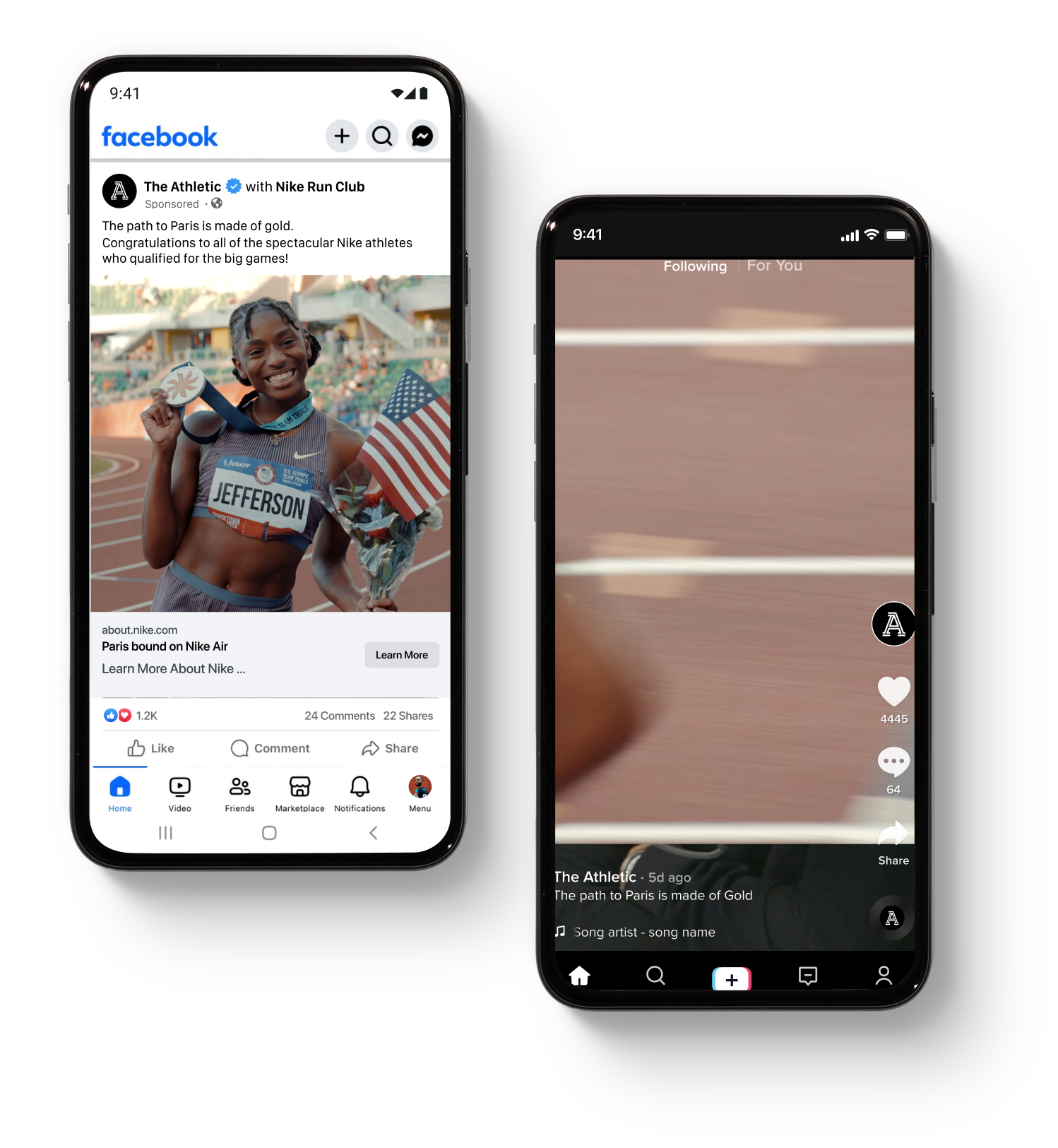
Image 1 / 1
The original customer was a committed fan seeking expertise beyond free news recaps. The breadth of coverage let the same subscription serve several interests. Readers' willingness to pay is supported by subscription growth; it does not establish that every local desk or the whole company earned a profit.
Current substitutes serve different jobs. ESPN Select and Unlimited combine live events, highlights and on-demand programming, with bundle options alongside Disney+ and Hulu.[16] Yahoo's free women's sports hub offers another route to Athletic reporting.[17] Local papers, specialist newsletters, team sites and podcasts compete for reading time, while broadcasts compete for a fan's entertainment budget. A live-game package and a beat-reporting subscription overlap in audience without supplying identical coverage.
NYT's current help documentation lists personalized reporting, scoreboards and subscriber newsletters, accessible through the web, Athletic mobile apps and the NYT News app. Athletic access is included in All Access and Home Delivery subscriptions, while a direct subscription remains available.[15] Bundle access should not be counted as evidence that every eligible reader actively uses or separately pays for sports journalism.
Subscriptions initially financed the reporting network, supplemented by outside capital. The BetMGM deal also shows that commercial partnerships existed before NYT ownership. The sale expanded the available advertising, licensing and subscription distribution rather than introducing every commercial channel from scratch.[6]
The accounting boundary matters. NYT's Q2 2025 segment disclosure allocated 10 percent of bundle subscription revenue to The Athletic, along with 10 percent of associated product, marketing and subscriber-service expenses. The allocation reflected management's assessment of relative value. Adjusted profit excluded expenses including depreciation and amortization.[13] It measures a contribution within the parent organization; it is neither cash flow nor a clean test of an independent sports publisher.
For 2023, Athletic revenue was $131.271 million, including $100.448 million from subscriptions and $27.945 million from advertising. Its $31.430 million adjusted operating loss improved from $41.118 million in 2022; the 2022 results cover the period from acquisition in February. Year-end 2023's 4.65 million digital subscribers with access included bundle subscribers, unlike the earlier standalone count.[7]
In Q2 2025, revenue reached $54.038 million and adjusted operating profit reached $5.788 million. Advertising grew much faster than subscription revenue year over year. Total operating costs were $54.849 million, including $6.599 million in depreciation and amortization. Revenue less those total costs was a $0.811 million operating loss, despite positive adjusted profit.[13] That difference is an expense-accounting distinction, not evidence of cash losses. NYT's consolidated cash flow cannot identify Athletic-only cash generation.
The Athletic's independent expansion carried financial pressure, but the acquisition was a sale of a continuing product. A permanent failure verdict exceeds the evidence. The more useful question is why a newsroom with demonstrated demand could become worth more inside another publisher.
A local reporting network has costs that software distribution alone cannot remove. Adding teams improves the reader's choice but requires additional reporting capacity. Hiring ahead of subscriber growth can produce company-wide losses even when some mature markets cover their own costs. The public numbers do not isolate each market's contribution or prove that every expansion was unprofitable.
NYT bought a product that could recruit readers beyond general news, give existing readers another reason to retain a bundle, and support advertising and licensing. These channels allow the same reporting to earn revenue through several relationships. Positive adjusted results after acquisition are consistent with that strategy, although accounting allocations prevent attributing the improvement entirely to standalone subscriber demand.
Other explanations remain plausible. A narrower independent Athletic might have reduced coverage, increased prices or developed advertising faster. The evidence does not show that those options were impossible. It does show that the buyer explicitly planned a multiyear investment rather than requiring immediate profit.[2] The transaction exchanged some independence for access to distribution, capital and complementary products.
For a rebuild, copying a large newsroom would reproduce its staffing burden. SignalStand's narrower operating-intelligence concept requires a separate test: do clubs and academies pay for verified deadlines and opportunities that they cannot reliably assemble themselves? Consumer sports subscriptions and advertiser case studies establish neither that demand nor its proposed pricing.