
Twitch
Winter 2007AcquiredA global community creating the future of live entertainment.
Pressure-test this opportunity
Explore the risks and possibilities with a prompt for ChatGPT, Claude, or your agent.
A global community creating the future of live entertainment.
Explore the risks and possibilities with a prompt for ChatGPT, Claude, or your agent.
Twitch grew from Justin.tv's gaming section into a live gathering place for players, spectators, and game publishers. It launched in June 2011. Amazon agreed to acquire it for approximately $970 million in August 2014 and completed the purchase that September. Twitch continues as an Amazon subsidiary.[2][13][1]
Its early advantage came from making gaming broadcasts easier to produce, find, and earn from. Console integrations supplied creators; esports supplied recurring events; chat gave viewers a reason to participate. The acquisition was a successful exit. The later challenge is sustaining that community while paying for live delivery and creator income.
Emmett Shear's 2023 account places the beginning in October 2006, when he, Justin Kan, and Michael Seibel drove from New York to San Francisco. Kyle Vogt joined three months later during MIT's externship week. They started with a continuous reality show about Kan, then opened the service to other broadcasters. Shear recalled: “I thought I’d start my real startup once that happened”.[1]
Kan's earlier account traces the experiment through Kiko, the calendar startup he and Shear had built.[3] The important change was what the platform let them observe. In a 2015 interview, Kan recalled Justin.tv reaching roughly 30 million monthly unique visitors while growth stalled. Gaming was still a small category. He remembered Shear's preference: “This is the only content that I actually like on our site.”[4]
That recollection needs two qualifications. First, Twitch was not the team's only experiment. Kan said they pursued Seibel's mobile-video idea, Socialcam, alongside gaming. Second, traffic and profit did not establish a repeatable business. Seibel later recalled Justin.tv earning about $8 million in revenue and $1 million in profit around 2010, while struggling to grow and reliably monetize copyrighted broadcasts. These are retrospective founder figures, not audited Twitch financials.[5]
The company had already built live video and chat. Gaming gave that infrastructure a community with repeat use and more dependable monetization. The founders' accounts support that distinction more directly than a story about inventing a new video technology.
A creator broadcasts gameplay, often with commentary and a camera feed. Viewers choose a game or channel and watch alongside a live chat. Organizing streams around games helps a spectator find relevant activity; recurring creators give that spectator a reason to return. The audience can react while the game is unfolding.
Twitch invested in the supply side of this experience. Its 2013 funding announcement lists mobile and Xbox 360 apps, Call of Duty: Black Ops II integration, and announced Xbox One and PlayStation 4 partnerships. It names Microsoft, Valve, Sony, Ubisoft, EA, Activision Blizzard, and Riot among industry partners.[9] These integrations reduced the distance between playing and broadcasting. They also placed Twitch inside products that gamers already used.
The 2014 mobile development kit extended capture, microphone and camera input, archiving, chat, and related-broadcast discovery to mobile games.[10] This was a developer distribution strategy: a game could bring its players into Twitch without requiring Twitch to acquire each broadcaster separately.
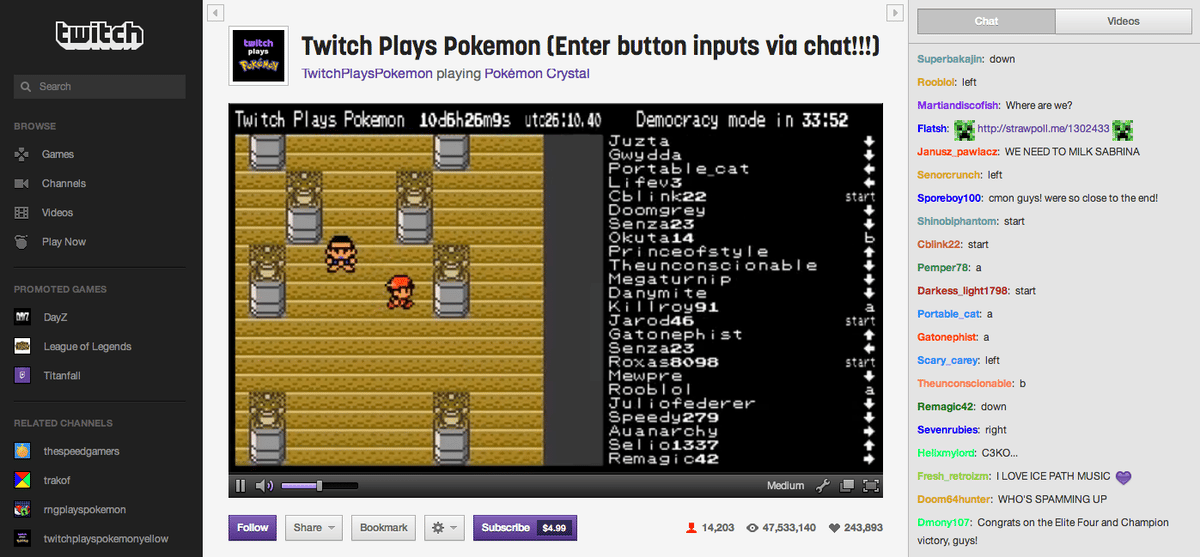
The audience also shaped the product. Twitch Plays Pokémon let viewers send game commands through chat. TIME reported that a regular user built it. Participation could become the broadcast itself.[16]
Individual broadcasters and spectators formed the core market. Publishers, tournament organizers, conventions, charities, and advertisers joined around the same activity. Twitch reported that charities had raised more than $3 million through the service by early 2013.[8]
The named partnerships explain how this audience developed. The three-year E3 agreement began with the 2014 show and placed the Twitch feed across the convention's online presence and venue. Twitch also named PAX East, PAX Prime, C2E2, New York Comic Con, BAFTA, and EGX London as streaming partners.[11] These relationships supplied concentrated viewing occasions and reasons to know Twitch existed.
ESL's expanded agreement made Twitch its exclusive Western broadcaster, with worldwide content and marketing collaboration. Twitch said IEM Katowice 2014 reached 643,000 concurrent Western viewers across all games.[12] This was event distribution, with contractual commitments behind it, rather than organic growth alone.
The evidence supports rapid audience growth, but no reliable dollar estimate for the early market. Twitch reported more than 28 million unique viewers in February 2013 and more than 45 million monthly viewers that September.[8][9] Amazon's announcement reported more than 55 million unique visitors, 1 million broadcasters, and 15 billion minutes watched in July 2014.[2]
These company-reported figures describe different periods and measures. They establish scale without revealing creator concentration, cohort retention, or gross margins. AWS later reported 1.3 trillion minutes watched in 2021, showing that the audience persisted well beyond the acquisition.[15]
Streaming capability was available elsewhere. TIME reported that Ustream supported PlayStation 4 broadcasting and YouTube was expanding live tools.[16] Twitch's advantage was the combination of relevant programming, creators, and spectators in one place. A viewer could find a game; a creator could find people who already cared about it.
This is an interpretation of the product and partnership record. The sources do not isolate the effect of chat, integrations, exclusive rights, or gaming-market growth. They show that Twitch worked on all four. Treating any single feature as the explanation would hide that coordinated effort.
Twitch earned from advertising and viewer subscriptions. TIME reported channel subscriptions at roughly $4.99 per month in 2014, with advertisers including Samsung, Unilever, and Mountain Dew.[16] Twitch Turbo offered an ad-free option. Its 2013 policy limited repeated pre-rolls and let partners schedule commercial breaks of up to three minutes.[14] Revenue design had to protect the viewing experience as well as sell inventory.
Live delivery created a continuous cost obligation. AWS's engineering history describes large third-party delivery bills, followed by Twitch building private networking and data-center operations. By 2022, that network carried more than 98% of Twitch traffic.[15] Lower latency and cost control served the same product: chat and video had to stay close enough for interaction.
Reliable pre-acquisition Twitch revenue, burn, creator acquisition costs, and gross margins remain unavailable here. Seibel's Justin.tv figures describe the predecessor company. Neither those figures nor the purchase price establishes Twitch's stand-alone profitability.
Twitch's announcements show growth on both sides of the platform. Its February 2013 release reported more than 600,000 broadcasters and more than 28 million unique viewers, averaging over 1.5 hours watched per day.[8] By July 2014, Amazon's announcement reported more than 1 million broadcasters.[2]
That supply did not come solely from individual discovery. Game integrations, convention feeds, and ESL events brought audiences together around recognizable programming. These are useful distribution mechanisms for a founder to study. The available data does not quantify which channel produced the most retained users.
The strongest lesson begins before Twitch. Justin.tv had a working platform, a large audience, and, in Seibel's account, profit. It still lacked repeatable growth and dependable monetization of its content. He described the technology as “Necessary, but not sufficient.”[5]
Gaming changed the match between that infrastructure and its users. A live match or skilled player's session has an unfolding outcome, commentary, and an audience that can return tomorrow. Game developers and event organizers also have reasons to distribute it. This explains why the category could support several connected growth paths rather than relying on another successful lifecasting show.
The founders did not discover this through aggregate traffic alone. They recognized a category, then made products and partnerships for it. The transferable lesson is to examine who returns, what they come for, and whether their behavior can support lawful, recurring revenue. A large audience and a functioning video stack cannot answer those questions.
Amazon's filing states that it acquired Twitch for its community and live-streaming experience.[13] Shear's acquisition letter promised to retain the office, employees, brand, and independence while gaining Amazon's resources.[18] Those statements support a community-preservation rationale. They do not prove what would have happened if Twitch had remained independent.
The announced $970 million and the filing's approximately $842 million refer to different transaction descriptions. Both sources specify adjustments for options and other items; the filing gives the completed transaction's figure. The evidence does not justify treating the difference as lost value or a failed deal.[2][13]
Twitch continued investing after the acquisition. In December 2014 it announced an agreement to acquire GoodGame Agency, adding esports talent, advertising, and sponsorship expertise.[19] Prime Gaming later connected channel subscriptions and games to Amazon's paid membership. Its 2020 announcement described more than 150 million Prime members, rather than that many new Twitch users.[20]
A valuable acquisition can coexist with operating problems. In January 2024, CEO Dan Clancy said Twitch's organization was larger than its current business required. He described staffing for an optimistic business several years ahead and announced just over 500 cuts.[22] That is an organizational explanation, not proof that delivery costs alone caused layoffs.
South Korea provides more direct delivery evidence. Twitch said network fees remained about ten times those in most countries after experiments with peer-to-peer delivery and a 720p quality cap. It announced closure for February 27, 2024. Those are Twitch's claims; AP noted it did not supply detailed numbers supporting the comparison.[23][17] The regional exit demonstrates that audience demand cannot rescue a local cost structure that the operator cannot support.
A gaming category became a company because Twitch connected capture, programming, participation, and pay around the same users. The useful founder question is which small audience could support that whole system. Copying its video player would reproduce only one part.
Profit can fund another attempt without proving that the existing business can keep growing. Justin.tv gave the team time and infrastructure to test gaming and Socialcam. Its copyright and growth limits still required a change in audience and content.[5][4]
Cost discipline must follow the audience. Twitch's private network addressed delivery; its 2024 cuts addressed organizational size. A founder should distinguish those mechanisms before deciding whether to redesign the product, renegotiate delivery, or reduce headcount.
The present opportunity is narrower than recreating Twitch. Its 2025 roadmap addressed collaboration, clip sharing, mobile discovery, and sponsorships. In May 2026 it widened access to monetization tools while retaining payout eligibility requirements.[21][24] A new product must prove that a specific community will pay for a workflow it cannot get from those improving tools.