Overview
Vine made a short video easy to record, share, and watch repeatedly. Its six-second loops became a recognizable format for comedy, music, and everyday scenes. Twitter acquired the startup before its January 2013 public launch, then discontinued the original social product through a transition announced in 2016 and carried out in January 2017.[1][2][3][11]
The ending has several parts. Vine Camera retained recording and export after the social application ended. The website initially preserved videos, but X's current help page says the full archive has been unavailable since 2019. A later app called Divine describes itself as independent of Vine, Twitter, and X. Its restored clips do not make it the same company.[11][12][13]
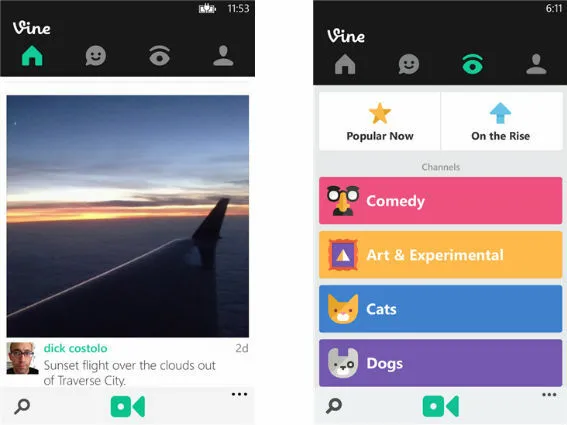
Image 1 / 1
Founding Story
The 2013 founder interview names Dom Hofmann, Rus Yusupov, and Colin Kroll. Hofmann described an early tool for joining shots together: “It crashed a lot”. Friends' use helped reveal the demand for sharing. Twitter's later SEC registration statement names the acquired company as Vine Labs, Inc.[4][3]
A June 2013 Stuff interview explains the choice of duration. Hofmann said the team tested several lengths, balancing the time required to create, download, and watch a clip. His conclusion was, “Six felt perfect. And it still does.” Repetition also mattered. The loop let viewers revisit a brief moment without pressing play again.[5]
These decisions worked together. Short capture reduced the amount a person needed to make, while a smooth loop gave a fragment more than one viewing. The result encouraged a specific kind of performance rather than compressing every existing video genre. A fixed duration can guide a community's style, but it also constrains what its members can publish.
Contemporary acquisition reporting in October 2012 described a pre-launch startup and an undisclosed purchase price. That account is useful for timing, while Twitter's own filing confirms the legal company name and acquisition. The filing groups several small acquisitions, so their combined consideration cannot establish Vine's individual price.[2][3]
Timeline
- October 9, 2012: Contemporary reporting described Twitter's acquisition of the pre-launch startup.[2]
- January 24, 2013: Twitter introduced Vine publicly as a free iPhone and iPod touch application.[1]
- February 2015: Twitter announced an agreement to acquire Niche, already a partner to Twitter and Vine.[7]
- January 2016: Twitter reported more than 200 million monthly viewers of Vine videos.[6]
- June 2016: Twitter described longer-video experiments and exploration of Vine creator monetization.[8]
- October 27, 2016: The team announced plans to discontinue the mobile application.[10]
- January 2017: The application transitioned to Vine Camera.[11]
- 2019: The full Vine archive ceased to be available, according to the present X support page.[12]
What They Built
Vine combined capture, editing, and social distribution in a phone application. Pressing the screen recorded a segment; releasing it stopped recording. Several segments could become one clip. Automatic looping made the ending part of the composition, rewarding a good transition back to the beginning.[4][5]
The launch announcement featured examples shared on Twitter, including music and an outdoor scene. Distribution could therefore reach people outside the Vine application. Sharing a clip was part of the experience from the start, although the reviewed sources do not show the incremental retention caused by a Twitter share.[1]
The discovery screen in the historical screenshot shows another job the service had to perform. Once people could create clips, viewers still needed to find something worth watching. Categories such as comedy and experimental art gave different forms a place. Their presence demonstrates product organization; it does not measure how much content each category attracted.
By June 2016, Twitter described a selected group of Vine creators attaching longer videos, making the original loop a preview of a larger story. This was a dated experiment, rather than proof that all Vine videos had adopted a new length. It shows the tension between the format's distinctive limit and creators' desire to do more.[8]
Market Position
Target Customers
Vine served both viewers and the people producing clips. A viewer could enjoy a loop with little commitment. A regular creator had different requirements: editing tools, discovery, moderation, audience growth, and ways to earn money. Meeting one group's needs did not automatically satisfy the other.
Original creator interviews in Mic described frustration with declining engagement, harassment, slow product changes, and limited communication with the company. Those are the experiences of named interviewees. They provide evidence of a strained supplier relationship without establishing that every creator shared the same reasons for leaving.[9]
Market Size
Twitter's January 2016 anniversary post claimed that Vine videos reached over 200 million people per month and generated 1.5 billion daily loops. A loop can be watched repeatedly, and a viewer can encounter a clip outside the app. Neither measure establishes 200 million logged-in monthly users or an equally large paying market.[6]
The breadth of viewing makes Vine's history harder to explain as simple lack of interest. Its challenge included retaining production and finding a viable place inside its owner's business. Broad reach is evidence of cultural demand, but revenue and long-term operating support require separate evidence.
Competition
Instagram was already a competitor during Hofmann's June 2013 interview, when it offered a longer video format inside its existing feed. The same interview records his argument for Vine's shorter constraint. A clear format difference could encourage distinctive work while still leaving creators able to publish on several platforms.[5]
Today, Divine offers six-second loops and restored clips on an open protocol. Its FAQ explicitly disclaims affiliation with the original company. In August 2026, it announced public access and a Taco Bell collaboration, which Taco Bell also confirmed. A new looping-video product therefore faces a current competitor aimed directly at this format.[13][14][15]
Divine introduced optional supporter memberships on October 6, 2026, at $6.99 monthly or $59.99 for a founding annual plan offered through 2026. Its FAQ still describes creator monetization as planned, while its August announcement lists creator tipping among recent features. Those pages differ in scope and freshness; this review did not verify creator payout operation.[16][13][14]
Business Model
Vine launched as a free app. Twitter later worked on the commercial relationship between creators and brands. Its February 2015 Niche announcement describes analytics and brand connections, including campaigns that became a television commercial. This gave creators a route to paid brand work.[1][7]
The June 2016 release says Vine was exploring Twitter's Amplify Open program. Exploration does not establish a broadly available, successful revenue-sharing system. The reviewed primary sources do not disclose Vine's standalone revenue, cost base, or profitability. Twitter's overall finances cannot fill those gaps.[8]
Mic reported that a group of prominent creators proposed paid commitments for regular original work, along with product improvements. The proposed deal did not proceed. The story helps explain why creators viewed themselves as essential to the service. It does not demonstrate that accepting the proposal would have produced a sustainable business.[9]
Outcome and evolution
The October 2016 message announced a coming discontinuation, while saying nothing changed immediately. The December update then set a January 17 transition date for Vine Camera and offered video downloads. The account's later description confirms that the transition occurred in January 2017. These records support a phased product ending rather than a one-day corporate disappearance.[10][11]
X's help page now distinguishes remaining individual content from the unavailable full archive. Divine separately restores some archived public videos and offers a process for former creators to claim accounts. Its present FAQ says only part of the original library was preserved. The continued circulation of clips therefore does not establish that the original service is operating.[12][13]
As reviewed October 23, 2026, the original network remains retired. Vine achieved a distinctive creative format and substantial viewing. Creator interviews describe dissatisfaction with the platform relationship, while primary releases show commercial and product experiments continuing close to the closure decision. The available evidence does not identify one change that would certainly have prevented that decision.
Key Lessons
- Vine's duration and loop shaped what people made. The constraint was useful because capture, viewing, and sharing worked together.
- Monthly viewers and loop counts measured reach. They did not establish a healthy creator business or standalone profit.
- Creators supplied an important part of the product. Their needs included moderation, tools, communication, and income beyond audience size.
- A camera, a social network, and an archive solve different jobs. Keeping one available did not preserve the others.
- Later projects can carry forward a format without continuing the original company. Divine makes that separation explicit.