
Watto AI
Summer 2023AcquiredAI-powered McKinsey-quality reports in seconds
Pressure-test this opportunity
Explore the risks and possibilities with a prompt for ChatGPT, Claude, or your agent.
AI-powered McKinsey-quality reports in seconds
Explore the risks and possibilities with a prompt for ChatGPT, Claude, or your agent.
Watto AI was a Seattle-based AI startup founded in July 2023 by Rishabh Panwar, Ishita Bhandari, and Suryansh Soni under the legal entity Tensai Technologies, Inc.[1][2] The company graduated from Y Combinator's Summer 2023 batch with a product that used large language models to generate structured business documents — PRDs, GTM strategies, white papers — targeting Product Managers who, the founders argued, spent 40% of their working hours on content creation.[3]
The company's core product was commoditized before it could scale. Watto launched in mid-2023 precisely as Notion, Atlassian, Microsoft, and Google were embedding AI writing assistants natively into the tools PMs already used — eroding the willingness-to-pay for a standalone point solution. The team pivoted to AI voice assistants for restaurants and healthcare clinics, but could not raise a follow-on round and was ultimately acquired.
Both Rishabh Panwar and Ishita Bhandari now work at Salesforce on AI voice agent products, including the Agentforce Voice platform.[4][5] The outcome is consistent with an acqui-hire: Salesforce absorbed the team's voice AI expertise, and no public acquisition announcement was made. Y Combinator's company page lists Watto AI's status as "Acquired."[6]

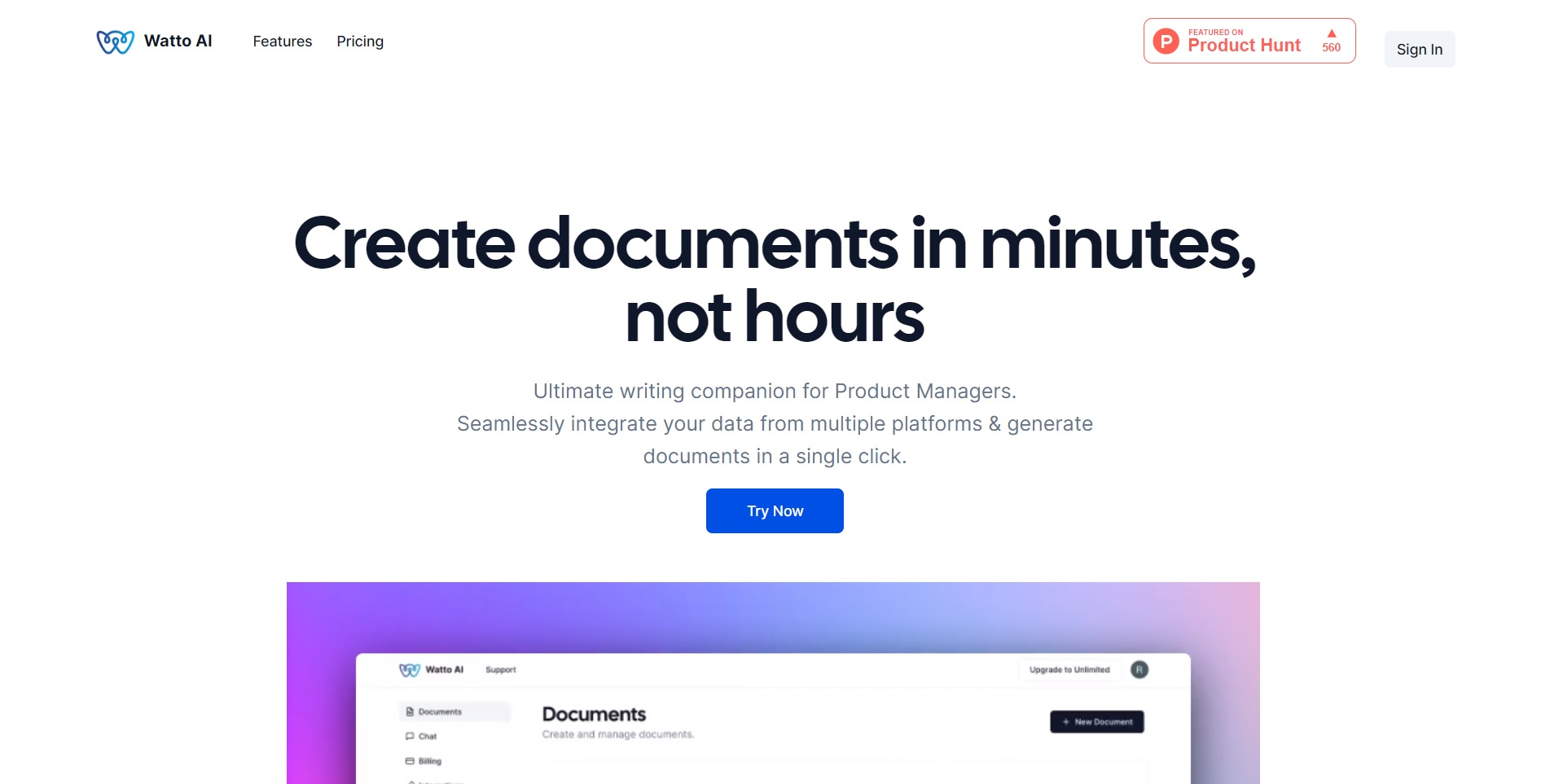
Image 1 / 2
Watto AI was not a company born from a cold insight. The three founders — Rishabh Panwar, Ishita Bhandari, and Suryansh Soni — had known each other for roughly a decade before incorporating in July 2023, having previously worked on multiple projects and at least one startup together in India.[7] That shared history reduced a risk that kills many early-stage companies before product-market fit is ever tested: co-founder conflict.
The team's technical credentials were solid. Panwar holds a Master of Science in Information Technology with a software engineering focus from Carnegie Mellon University and previously worked as a full-stack Android engineer at Wish.[8][9] Bhandari is a University of Washington iSchool alumna with over seven years of software development experience at StubHub and DoorDash — and notably, she had already founded a company before Watto: Wordly, an award-winning vocabulary app for non-native English speakers built during her undergraduate years.[10][11] Soni, the CTO, is also a UW alumnus with a parallel background at StubHub and DoorDash.[12]
The founding insight came from direct professional experience. The team had watched Product Managers — one of the most document-intensive roles in any tech organization — spend enormous portions of their week writing artifacts that followed predictable structures: product requirements documents, go-to-market strategies, launch communications, competitive analyses. The founders quantified this as 40% of PM work hours consumed by content creation.[3] The hypothesis was that LLMs, properly scaffolded with PM-specific templates and connected to the tools PMs already used, could compress that time dramatically.
The initial vision was horizontal within the PM persona: a single platform that could generate any PM document type, learn from a team's prior work, and integrate deeply enough into existing workflows that it became indispensable. The founders described their proprietary LLMs as capable of "fine-tuning and learning over time" to become a team's "star performer."[13]
YC acceptance in Summer 2023 validated the concept enough to build. The team remained at three people throughout the company's entire existence — no additional hires were made at any point.[14] Whether this was a deliberate lean-team philosophy or a reflection of the company's inability to raise capital beyond the YC check is unclear from available data, but the outcome was the same: a three-person team attempting to build, sell, and support a product in a market that was moving faster than they could.
Watto AI's original product was a structured document generation platform built specifically for Product Managers. The core workflow was straightforward: a user selected a document type from a library of PM-specific templates — product requirements documents, go-to-market strategies, competitive analyses, launch communications, white papers — and the system used LLMs to generate a complete, formatted draft in seconds.[21]
What separated Watto from a generic ChatGPT prompt was the integration layer. The product connected to over 20 tools in the standard PM stack: Google Suite, Notion, Confluence, Salesforce, Figma, Jira, Slack, and Microsoft's productivity suite.[22] The idea was that Watto could pull context from existing work — Jira tickets, Figma designs, Slack threads — and use that context to generate documents that were specific to a team's actual product, not generic boilerplate. This was a meaningful product decision: it positioned Watto as a workflow tool rather than a writing assistant, which theoretically made it stickier.
The product also included an AI Co-Pilot feature for inline editing: users could highlight text and ask the system to rephrase, summarize, or extract action items without leaving the document.[23] The founders described the underlying models as capable of fine-tuning on a team's prior documents over time, learning house style and terminology to produce outputs that felt authored rather than generated.[13] Whether this fine-tuning was technically implemented at the depth implied by the marketing language, or whether it was a retrieval-augmented generation approach dressed up as model customization, is not verifiable from public sources.

Pricing was structured as freemium: five free document generations, then a paid subscription starting at approximately $5/month, with annual plans marketed as costing under $1/day.[24][25] This price point — roughly $30–60/year for an individual — was consistent with a product-led growth strategy targeting individual PMs rather than enterprise procurement.
After the pivot, the product transformed entirely. The new Watto was a no-code AI voice bot builder targeting small and medium businesses in restaurants and healthcare.[26] Users could configure voice agents for specific workflows: taking restaurant orders over the phone, handling 24/7 customer support inquiries, conducting mystery shopping calls, or qualifying inbound leads.[27] The no-code framing meant the target buyer was an SMB operator, not a developer — a complete inversion of the original PM-focused ICP.
The two products shared a legal entity (Tensai Technologies, Inc.) and a founding team, but almost nothing else. Different customer segment, different use case, different distribution motion, different competitive landscape.
The original product targeted Product Managers at technology companies, with specific claims of users from Meta and Uber.[28] The ICP was a mid-to-senior PM at a company large enough to have standardized document formats but small enough that individual PMs were still writing those documents themselves — a profile that fits growth-stage tech companies more than large enterprises, where document creation is often delegated or templated at the organizational level.
After the pivot, the target customer shifted to SMB operators in two verticals: restaurants and healthcare clinics. These buyers share a common characteristic — high inbound call volume, limited staff bandwidth, and tolerance for automated voice interactions in specific contexts (order-taking, appointment scheduling, basic support). The ICP shift was total: from knowledge workers with laptops to operators managing physical locations.
The PM productivity tools market is real but difficult to size precisely. The broader "AI writing assistant" category was estimated at several billion dollars in addressable revenue by 2023, but that figure aggregates everything from consumer grammar tools to enterprise content platforms. The PM-specific slice — tools that generate structured technical documents — is a narrower wedge. Watto's sub-$60/year pricing implied the team was targeting individual adoption rather than enterprise contracts, which caps the revenue potential per customer significantly.
The voice AI market for SMBs, where Watto pivoted, was larger and faster-growing. Restaurant and healthcare automation represented a genuine unmet need: the National Restaurant Association estimated that a meaningful percentage of restaurant calls go unanswered during peak hours, and healthcare clinics face similar overflow problems. The market was also less saturated in 2023–2024 than the AI writing space, which may have motivated the pivot.
Watto's document generation product competed on a dimension where incumbents held a structural advantage: distribution. The company's 20+ integrations were built on top of Notion, Confluence, Jira, and Microsoft — the exact platforms that were simultaneously building AI writing features natively. This is the defining competitive dynamic of the 2023 AI writing market: every major productivity platform treated AI-assisted writing as a table-stakes feature to retain existing subscribers, not a standalone product to monetize separately.
Notion AI launched in November 2022 and was broadly available by early 2023.[29] Atlassian Intelligence (Confluence's AI layer) entered public beta in 2023. Microsoft Copilot for Microsoft 365 launched in November 2023. Google Workspace's Duet AI (later Gemini for Workspace) was available in beta throughout 2023. Each of these products offered AI document drafting inside tools that enterprise buyers already paid for — meaning the marginal cost of the AI writing feature, from the buyer's perspective, was zero.
Watto's differentiation argument — model customization and team-specific fine-tuning — was theoretically sound but practically difficult to demonstrate in a sales cycle. A PM evaluating Watto against Notion AI faces a simple question: is Watto's output quality meaningfully better than what I already have, and is it worth a separate subscription and a security review? In 2023, for most buyers, the answer was no. The founders acknowledged this directly: they cited enterprise AI committees and internal security reviews as the primary friction slowing adoption.[18]
In the voice AI space post-pivot, the competitive landscape was different but not easier. Competitors included Bland AI, Retell AI, Vapi, and a growing number of vertical-specific voice automation tools. Salesforce's own Agentforce Voice platform — where Panwar now works — was under development during this period, suggesting Salesforce was building in the same direction Watto was pivoting toward.
Watto AI's original revenue model was subscription-based, with a freemium entry point of five free document generations and paid plans starting at approximately $5/month.[24][25] The annual plan was marketed as under $1/day, implying a ceiling of roughly $300–365/year for the highest tier. No enterprise pricing tier or per-seat pricing structure was publicly disclosed, which suggests the team was pursuing individual PM adoption rather than top-down enterprise sales.
The company never disclosed revenue figures publicly. Getlatka.com reports $330K in revenue for Watto AI as of 2025, but this figure is low-confidence — Getlatka's methodology relies on founder-reported data and estimates, and it is unclear whether this figure reflects the document generation product, the voice product, or a combined total across both phases.[30] It should be treated as directional at best.
With $500K in total disclosed funding from YC alone and a three-person team,[15][14] the implied burn rate was low. A three-person team in Seattle (not San Francisco) could plausibly operate for 18–24 months on $500K if salaries were modest — consistent with the timeline from founding in July 2023 to the apparent acquisition in 2024–2025. The absence of any follow-on funding round is itself a signal: the document generation product did not produce the growth metrics — user counts, revenue trajectory, or retention curves — that would have attracted a Series A investor in the 2023–2024 environment.
CB Insights lists a convertible note as Watto's latest funding instrument,[31] which may indicate a small bridge round or the structure of the acqui-hire transaction itself. The details are undisclosed.
Watto AI's disclosed traction metrics were limited and largely self-reported. At the time of the YC launch, the company reported 250+ waitlisted users — a pre-launch metric that measures interest, not retention or revenue.[16] The Product Hunt launch received a 4.9 rating from 22 reviews,[17] which is a positive signal for early adopter sentiment but a small sample. The company was featured on a Times Square billboard by Brex at the end of the YC program[19] — a marketing milestone that reflects YC cohort participation rather than product traction.
The founders cited self-reported efficiency gains: beta users were described as 25% more efficient week-over-week, and PMs from Meta and Uber were cited as recovering 10 hours per week using the product.[28] These figures are low-confidence — they originate from founder marketing materials with no independent verification, no sample size disclosed, and no methodology described. They are consistent with what a motivated early adopter might report, not necessarily what a representative user would experience.
No DAU/MAU data, churn rates, or revenue figures for the document generation product were ever publicly disclosed. The Getlatka $330K revenue estimate is directionally interesting but methodologically unreliable. The absence of any revenue disclosure in founder interviews, press coverage, or YC materials is itself informative: companies with strong early revenue typically lead with that number.
The most important factor in Watto AI's failure was structural, not operational. The company built a standalone AI document generation tool in a market where the dominant distribution channels — Notion, Confluence, Microsoft 365, Google Workspace — were simultaneously building the same feature natively for their existing subscriber bases.
This dynamic played out on a specific timeline. Notion AI was broadly available by early 2023, before Watto even launched.[29] Atlassian Intelligence entered public beta during 2023. Microsoft Copilot for Microsoft 365 launched in November 2023 — two months after Watto graduated from YC. By the time Watto was attempting its first enterprise sales conversations in late 2023, every major platform a PM used daily had an AI writing assistant built in.
The founders' response was to lean into integrations — building connectors to 20+ platforms to position Watto as a cross-tool synthesis layer rather than a single-platform writing assistant.[22] This was a reasonable strategic response, but it had a fatal flaw: it required buyers to adopt a new tool, go through a security review, and pay an additional subscription for a capability that was increasingly available for free inside tools they already used. The founders acknowledged this friction directly at YC Demo Day graduation: "AI is progressing at breakneck speed, with companies scrambling to build internal AI committees and security teams."[18] The security review problem was not a temporary obstacle — it was a structural moat protecting incumbents, who had already cleared those reviews.
The sub-$1/day pricing is consistent with a team that recognized willingness-to-pay was low. When a product's best competitive response to platform encroachment is to lower prices, the margin structure becomes untenable before scale is achieved.
Watto's primary moat argument was model customization: proprietary LLMs that would "fine-tune and learn over time" to become a team's institutional memory.[13] This is a theoretically defensible position — a model trained on a specific team's documents, terminology, and style would produce better outputs than a generic assistant. But this moat requires two things that Watto could not demonstrate in its sales cycle: a large corpus of team-specific data (which requires significant adoption first) and a measurable quality gap versus incumbent tools (which requires time to accumulate and benchmark).
In practice, a PM evaluating Watto in late 2023 could not experience the fine-tuned model — they would experience the base model, which competed directly with Notion AI and Microsoft Copilot on output quality. The data flywheel moat was a future-state argument, not a present-state demonstration. No third-party assessment of Watto's model quality versus incumbents was ever published, and the company never disclosed metrics that would substantiate the claim.
There is a revealing detail in the GeekWire post-graduation interview. When asked about their smartest move, the founders described using Watto themselves to "synthesize client meetings and public information to build hyper-personalized game plans for every prospect."[32] This is a sales intelligence use case — not a PM document generation use case. The founders had found a high-value application of their own product that was different from the application they were selling.
This is a classic signal of product-market fit misalignment: the highest-value use case isn't the marketed one. A product that excels at synthesizing meeting notes and public data for personalized outreach is a sales enablement tool, not a PM productivity tool. These are different buyers, different workflows, different price points, and different competitive landscapes. The team appears not to have pursued this signal aggressively enough to test whether it represented a more defensible market position.
The decision to pivot from PM document generation to AI voice assistants for restaurants and healthcare was strategically rational. Voice AI for SMBs faced less incumbent pressure in 2023–2024 than AI writing for knowledge workers. The use cases — restaurant order-taking, healthcare appointment scheduling, 24/7 support — were workflow-critical rather than workflow-adjacent, which theoretically supports higher willingness-to-pay and lower churn.
But the pivot represented a complete restart of customer discovery. The team's accumulated knowledge of PM workflows, document structures, and enterprise buying behavior was largely irrelevant to SMB restaurant operators. The go-to-market motion changed from product-led growth (individual PM adoption) to direct sales (SMB operator outreach). The competitive landscape changed entirely. And the team remained at three people throughout — meaning the pivot was executed without additional resources.[14]
No traction data for the voice product was ever publicly disclosed. The exact pivot date is unknown, which makes it impossible to assess how long the team ran the voice product before the acquisition. The outcome — both founders at Salesforce working on Agentforce Voice[4] — validates the pivot direction. It does not validate the standalone company's ability to scale it.
The absence of a follow-on funding round is the clearest indicator of the company's trajectory. Watto raised $500K from YC and, based on available data, nothing more.[15] In the 2023–2024 environment, AI startups with genuine traction were raising seed extensions and Series A rounds. The silence is informative. The YC "Acquired" status, combined with both founders landing at Salesforce in roles directly aligned with Watto's post-pivot work, is consistent with an acqui-hire structure: Salesforce acquired the team and potentially the IP, the standalone entity was wound down, and no public announcement was made — a pattern typical of acqui-hires where NDA terms govern disclosure.[33]
Building integrations into a platform is not the same as building a moat against that platform. Watto's 20+ integrations with Notion, Confluence, Jira, and Microsoft were designed to embed the product in PM workflows. Instead, they signaled to those platforms exactly which features their users valued — and each of those platforms had the distribution, trust, and existing billing relationships to build those features natively. Watto's integration strategy accelerated its own commoditization timeline.
A differentiation claim that requires scale to prove cannot close the first hundred customers. Watto's core moat argument — that its LLMs would fine-tune on team-specific data over time — was a future-state promise, not a present-state demonstration. In a market where buyers could compare Watto's output to Notion AI's output in a five-minute trial, the fine-tuning argument was untestable. The team needed a differentiation that was visible on day one, not after months of adoption.
When founders discover their product's best use case internally, that signal deserves a dedicated pivot test. The Watto team's "smartest move" was using their own product for sales intelligence — synthesizing meeting notes and public data for personalized prospect outreach. This is a different product, a different buyer, and a different competitive landscape than PM document generation. Watto never publicly tested whether this use case represented a more defensible market. The lesson is not generic ("listen to customers") but specific: Watto had evidence of a high-value use case in its own hands and did not pursue it as a standalone hypothesis.
Pricing at under $1/day in a market where the core feature is becoming a free add-on is a signal, not a strategy. Watto's sub-$30/month pricing reflected a real market constraint: buyers were not willing to pay enterprise prices for AI writing when Notion AI and Microsoft Copilot were included in subscriptions they already held. The team's response was to lower the price floor rather than find a buyer segment with higher willingness-to-pay (e.g., the sales intelligence use case, or enterprise teams with specific compliance requirements around document generation). Low pricing extended runway but did not resolve the structural problem.
The voice AI pivot was directionally correct but arrived at the right destination via the wrong vehicle. Watto's post-pivot work on AI voice agents for SMBs was validated by Salesforce's acquisition of the team for its Agentforce Voice platform. The market need was real. But a three-person team, operating on a single $500K check, pivoting from a knowledge-worker tool to an SMB voice platform, could not accumulate the customer base, revenue, or technical differentiation needed to raise a follow-on round independently. The pivot was right; the capitalization was not sufficient to execute it as a standalone company.