Overview
WireOver was a Cambridge, Massachusetts-based startup that built a peer-to-peer desktop application for sending large files securely and for free.Founded in 2011 and backed by Y Combinator's Winter 2012 batch, Bessemer Venture Partners, and .406 Ventures, the company spent nearly two years in development before publicly launching in January 2014.
Its core thesis was that Dropbox, Google Drive, and SkyDrive had solved small-file transfers but left large-file transfers — think 200 GB video files or terabyte-scale datasets — as an expensive, unsolved problem.WireOver's answer was a freemium P2P desktop app: free unlimited transfers for everyone, end-to-end encryption for $10 per month.
The thesis was technically coherent but commercially fragile.The free tier gave away the product's primary value, the paid tier required a security use case that most users didn't have, and cloud incumbents were simultaneously expanding their storage limits downward in price. WireOver shut down quietly around 2015, leaving no post-mortem, no acquisition, and no public explanation. [1][2]

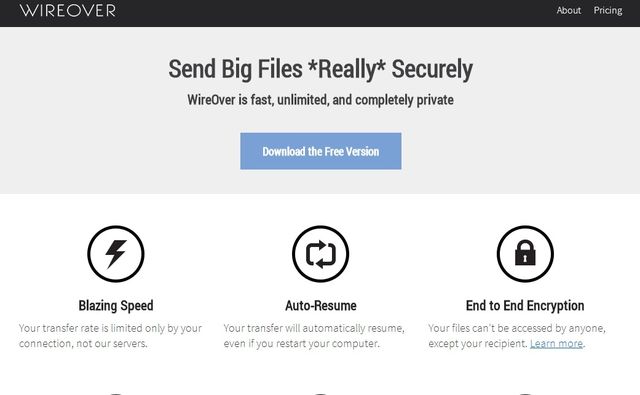
Image 1 / 2
Founding Story
Trenton Ashburn is an unconventional founder for a file-transfer startup. He graduated from Brown University in 2000 with a Bachelor of Science spanning Computer Science, Finance, and Neuroscience — a combination that reflects intellectual range more than domain specialization. [3] After Brown, he spent several years building computational models for quantitative hedge funds, then stepped away from finance entirely to pursue semi-professional cycling before returning to technology. [4] Neither chapter of his career gave him direct exposure to enterprise file transfer, media workflows, or security infrastructure — the domains where WireOver would eventually compete.
The founding motivation was personal frustration, not market research. A Hacker News post from March 2012 captured it directly: "WireOver was born out of sheer annoyance, because it's ridiculous that sending files over WANs and LANs is still such a pain." [5] Ashburn's own framing at the January 2014 launch was consistent: "With Dropbox, Google Drive, and Skydrive, sending small and medium-size files is pretty much solved but it's a pain to send big files securely." [6] The problem was real. The question was whether it was large enough, and whether WireOver's solution was the right one.
Ashburn co-founded the company with a second founder named Amit, whose full last name has not been publicly confirmed. The Y Combinator company profile describes Amit as a Boston-based software engineer who began his career writing interactive chemistry simulation tools in the late 1990s and later worked on software for dispatching trucks and preventing adolescent substance abuse — a varied background that suggests strong general engineering ability but no specific expertise in file transfer protocols or enterprise security. [7]
The two entered Y Combinator's Winter 2012 batch, receiving the standard YC investment plus the $150,000 Start Fund convertible note backed by Andreessen Horowitz, SV Angel, and Yuri Milner. [8] By the time of the January 2014 public launch, WireOver had grown to a four-person team. [9] The company was headquartered in Cambridge, Massachusetts, proximate to Boston's academic and enterprise technology ecosystem, though there is no documented evidence that this location was chosen for strategic reasons.
Timeline
-
2000 — Trenton Ashburn graduates from Brown University with a BS in Computer Science, Finance, and Neuroscience. [3]
-
2011 — WireOver founded by Trenton Ashburn in Cambridge, MA. [10]
-
January 2012 — WireOver enters Y Combinator's Winter 2012 batch, receiving YC investment plus the $150K Start Fund convertible note from a16z, SV Angel, and Yuri Milner. [8]
-
March 2012 — WireOver posts a Show HN titled "Free Unlimited Private File Sending (Beta)," making its first public appearance. Commenters immediately raise trust concerns about downloading an app from an unknown splash page. [11]
- March 2012 — A companion HN thread captures WireOver's founding motivation: "born out of sheer annoyance, because it's ridiculous that sending files over WANs and LANs is still such a pain." [5]
-
August 2012 — WireOver closes its last recorded funding round — a seed investment from Bessemer Venture Partners, .406 Ventures, and angel Hayes Metzger. No further funding rounds are recorded. [10]
-
January 2014 — WireOver emerges from stealth with a public launch covered by TechCrunch under the headline "Protect Yourself From The NSA With WireOver's Encrypted File Sharing." The product is a Python-based desktop app for Windows and Mac offering free unlimited P2P file transfer, with a $10/month Pro tier for end-to-end encryption and a $40/month enterprise tier. [12]
-
~2015 — WireOver winds down, based on Trenton Ashburn's career profile listing his tenure as Founder from 2011 to 2015. No shutdown announcement or post-mortem is published. [13]
-
2018 — Trenton Ashburn founds Grok, his next venture after WireOver. [3]
-
2020 — Trenton Ashburn co-founds Simpact, where he serves as CEO. [3]
What They Built
WireOver was a desktop application for Windows and Mac that let users send files of any size — including 200 GB video files or terabyte-scale datasets — directly to another person, for free. [14][15] The core mechanic was peer-to-peer transfer: files moved directly from one machine to another without being uploaded to a cloud server first.
The user experience was designed to be minimal. Users installed the app, which placed an icon in the system tray. To send a file, they opened the app from the taskbar, dragged the file onto the transfer window, and typed the recipient's email address. The recipient received an email notification and, once they had the app installed, the transfer began. The interface was intentionally small — a compact window rather than a full application — designed to stay out of the way.

The underlying architecture had a practical fallback: when a direct P2P connection was not possible — due to firewalls, NAT configurations, or network restrictions — files were routed through WireOver's own servers. Critically, the files were not stored on those servers; they passed through in transit only. [16] This relay-without-storage design was central to the company's privacy positioning.
The product was built on a Python-based desktop client, which the team arrived at after building and discarding multiple failed prototypes. [17] The two-year development period between the YC batch (early 2012) and the public launch (January 2014) reflects the difficulty of building reliable large-file P2P transfer across heterogeneous network environments.
WireOver offered three tiers. The free tier provided unlimited file transfers of any size with no encryption beyond standard transport security. The Pro tier, at $10 per month, added end-to-end encryption where WireOver held no decryption keys — only the recipient could open the files. [18] An enterprise tier was available at $40 per month, though the specific enterprise-only features beyond the Pro tier are not documented. [19]
The security architecture included cryptographic fingerprint verification, allowing users to confirm the recipient's machine identity and protect against man-in-the-middle attacks. [20] Ashburn described the philosophy as: "The approach we're going for is 'Trust No One'." [21] This zero-knowledge framing — where even WireOver itself could not access the contents of encrypted transfers — was the product's primary differentiator from cloud storage alternatives.
What distinguished WireOver from cloud storage incumbents was cost at scale: sending a 200 GB file on Dropbox, Google Drive, or SkyDrive would require purchasing substantial storage, potentially costing hundreds of dollars per year. WireOver sent the same file for free. [15] What distinguished it from browser-based transfer tools like WeTransfer was the absence of file size limits and the availability of genuine end-to-end encryption. The tradeoff was the installation requirement: both sender and recipient needed the desktop app.
Market Position
Target Customers
WireOver's stated target was anyone who needed to send large files that cloud storage services handled poorly or expensively. In practice, the documented customer base was narrow. Known clients included Grooveshark, the music streaming service, and Lightswitch — both small, digitally native companies rather than large enterprises. [22] Ashburn noted at launch that some early users had previously shipped physical hard drives and USB drives via FedEx to move large files — a workflow common in media production, post-production, and broadcast. [23] This suggests the company's most natural buyers were in creative industries: video editors, music producers, and broadcast engineers moving raw footage and high-resolution assets.
The January 2014 TechCrunch launch leaned heavily into post-Snowden NSA surveillance anxiety as a marketing hook. [12] This framing targeted a second potential customer segment: privacy-conscious professionals and organizations — journalists, lawyers, healthcare providers — who needed verifiable end-to-end encryption. However, these two segments have different buying behaviors. Creative professionals care primarily about speed and file size limits; privacy-focused buyers care about auditability, compliance, and vendor trust. WireOver's product addressed both, but its marketing conflated them.
Market Size
The large-file transfer market in 2014 was real but fragmented. At the high end, enterprise-grade solutions from Aspera (acquired by IBM in 2014) and Signiant served media and entertainment companies with managed file transfer infrastructure priced in the tens of thousands of dollars annually. At the consumer end, WeTransfer offered free browser-based transfers up to 2 GB, with a Pro tier at $10 per month for 10 GB. WireOver positioned itself between these poles: consumer-simple, enterprise-capable, with no file size ceiling.
The total addressable market for large-file transfer was difficult to bound precisely because the problem was being simultaneously absorbed by adjacent markets. Cloud storage providers were expanding capacity and reducing per-GB costs throughout 2012–2015. Google Drive launched in April 2012 with 5 GB free. Dropbox expanded its free tier. The market WireOver was targeting was actively shrinking as incumbents moved downmarket.
Competition
WireOver's competitive landscape had three distinct layers. First, cloud storage incumbents — Dropbox, Google Drive, Microsoft SkyDrive — which Ashburn explicitly acknowledged had solved small and medium file transfers. [6] These companies were expanding their free storage tiers throughout WireOver's operational life, compressing the cost advantage WireOver offered for large files. Second, browser-based transfer tools like WeTransfer, which required no installation but imposed file size limits (2 GB on the free tier in 2014). WeTransfer's no-install model gave it a structural adoption advantage over WireOver for casual users. Third, enterprise managed file transfer (MFT) vendors — Aspera, Signiant, Globalscape — which served media and entertainment companies with high-throughput, high-reliability transfer infrastructure. These vendors had established sales relationships, compliance certifications, and support organizations that WireOver could not match at seed scale.
WireOver's P2P architecture gave it a genuine technical advantage for large files: transfers did not require uploading to a cloud intermediary, so speed was limited only by the sender's and recipient's connection speeds. But this advantage was invisible to most users and required both parties to install software to realize it.
Business Model
WireOver operated a freemium model with three tiers. The free tier offered unlimited file transfers of any size with no end-to-end encryption — the core value proposition, available to all users at no cost. The Pro tier, priced at $10 per month, added end-to-end encryption with zero-knowledge key management, meaning WireOver held no decryption keys. [18] An enterprise tier was priced at $40 per month, though its specific feature differentiation from Pro is not documented. [19]
The structural problem with this model was that the free tier gave away the feature most users actually wanted — large file transfer at no cost — while the paid tier required users to have a specific security need that most did not. Converting a free user to a $10/month Pro subscriber required convincing them that encryption was worth paying for, in a market where most file transfer tools offered no encryption at all and users had not yet been conditioned to pay for it. No conversion rate data is publicly available. Total funding of approximately $270K was recorded by Tracxn, though this figure likely understates the actual total given the Bessemer and .406 Ventures involvement. [24]
Traction
No user growth, download, or revenue metrics are publicly available for any period of WireOver's operation. The available traction signals are qualitative and limited.
Known paying or active clients at the time of the January 2014 launch included Grooveshark and Lightswitch. [22] Both were small companies, not enterprise anchors. Ashburn reported that some early users had switched to WireOver from shipping physical hard drives via FedEx — a signal that the product was solving a genuine workflow problem for a subset of users, but not evidence of scale. [23]
The March 2012 Show HN post generated community discussion but also immediate skepticism. One commenter wrote: "Why would anyone download and install an app from a simple splash page like this? It could be anything." [11] This trust concern — raised publicly within weeks of the YC batch — foreshadowed a persistent adoption friction that the product never fully resolved. The January 2014 TechCrunch coverage provided a credibility signal that the 2012 splash page lacked, but by that point the company had already consumed most of its runway.
Third-party software review sites gave WireOver favorable ratings at launch — FindMySoft awarded it a 5/5 "Essential" rating in April 2014 — but these reviews reflect product quality assessments, not user adoption data.
Post-Mortem
WireOver shut down around 2015 with no public announcement, no acquisition, and no founder post-mortem. [1][2][25] The silence itself is informative: companies that find a path to acquisition or a meaningful pivot tend to announce it. The absence of any exit record suggests WireOver simply exhausted its runway. The failure had multiple contributing causes, but they were not independent — they compounded each other.
The Free Tier Gave Away the Product
The most structurally damaging decision WireOver made was pricing. The free tier offered unlimited file transfers of any size — the exact feature that differentiated WireOver from every incumbent. A user who needed to send a 50 GB video file could do so for free, indefinitely, without ever having a reason to pay $10 per month for the Pro tier.
The Pro tier's value proposition was end-to-end encryption with zero-knowledge key management. [18] This is a compelling feature for a specific buyer: a journalist protecting a source, a lawyer sending privileged documents, a healthcare provider handling patient data. But it is not a feature that most users who need to send large files will pay for. The creative professionals sending raw video footage — the segment most naturally aligned with WireOver's large-file capability — were not primarily motivated by encryption. They were motivated by speed and cost. WireOver gave them both for free.
The enterprise tier at $40 per month was the only pricing tier that could have generated meaningful revenue, but no documentation exists of enterprise-specific features that would justify the premium over the $10 Pro tier. Without a clear enterprise value proposition — compliance certifications, audit logs, centralized user management, SLA guarantees — the $40 tier had no natural buyer.
No conversion rate data is available, but the structural logic suggests it was low. The team did not publicly address this pricing problem before shutting down.
The Two-Sided Installation Requirement Created Structural Adoption Friction
WireOver required both the sender and the recipient to install a desktop application. This is a classic cold-start problem for a communication tool: the product has zero value to a sender whose recipient has not installed the software.
Browser-based competitors like WeTransfer solved this asymmetry elegantly: the sender used the web interface, and the recipient received a download link they could access in any browser with no installation required. WeTransfer's free tier was limited to 2 GB per transfer — far below WireOver's unlimited ceiling — but for the majority of file transfer use cases, 2 GB was sufficient. WeTransfer's frictionless recipient experience gave it a structural adoption advantage that WireOver's superior large-file capability could not overcome for casual users.
The March 2012 Show HN comments captured this friction early. A commenter wrote: "Why would anyone download and install an app from a simple splash page like this? It could be anything." [11] The team's response was to build credibility through the TechCrunch launch in January 2014 and the YC brand. [12] This helped with the sender side — users who had read about WireOver and chose to install it. It did not solve the recipient side, where the installation requirement remained a barrier regardless of how credible the sender found the product.
The 18-Month Development Gap Consumed Runway Before Launch
WireOver entered YC's Winter 2012 batch in January 2012. Its last recorded funding round closed in August 2012. [10] Its public launch did not occur until January 2014 — 18 months after the final funding event. The team spent this period building and discarding multiple failed prototypes before settling on the Python-based desktop client. [17]
This timeline means WireOver entered the market with approximately one year of runway remaining after its public launch, assuming the seed round provided 30–36 months of operating capital for a four-person team. [9] One year is not enough time to iterate on a freemium consumer product, identify a conversion-optimized pricing model, build enterprise sales relationships, and demonstrate the growth metrics required to raise a Series A.
The large-file transfer market was also moving during those 18 months. Google Drive launched in April 2012. Microsoft SkyDrive expanded its free storage tier. WeTransfer grew its user base. By the time WireOver launched publicly, the competitive environment was more crowded than it had been when the company entered YC.
The Snowden Marketing Angle Was Timely but Narrow
WireOver's January 2014 launch was framed explicitly around NSA surveillance anxiety. The TechCrunch headline read: "Protect Yourself From The NSA With WireOver's Encrypted File Sharing." [12] The Snowden revelations had broken in June 2013, and privacy-focused products were receiving significant press attention in the months that followed.
The timing was tactically sound for press coverage. It was strategically narrow for user acquisition. The set of users who (a) needed to send large files, (b) were sufficiently concerned about NSA surveillance to change their file transfer behavior, and (c) were willing to install a desktop application to do so was small. Privacy-motivated buyers in enterprise contexts — the segment most likely to pay for the Pro or enterprise tiers — typically require compliance certifications, vendor security audits, and procurement processes that a four-person seed-stage startup cannot support.
The marketing angle also positioned WireOver as a privacy product rather than a productivity product. This framing may have deterred mainstream enterprise buyers who needed large-file transfer capability but did not want to signal to their IT departments that they were using a tool marketed as a way to evade government surveillance.
No Follow-On Capital and No Documented Path to Series A
WireOver's last funding round closed in August 2012. [10] No Series A or follow-on institutional round is recorded. The company operated for approximately 2.5 years after its final funding event without raising additional capital. [13]
Bessemer Venture Partners and .406 Ventures are credible institutional investors with the capacity to lead or participate in a Series A. Their decision not to follow on — or the company's failure to raise from any source — is the clearest external signal that WireOver did not demonstrate the growth metrics required to justify additional investment. No investor statements about the decision are publicly available.
The combination of a freemium model with low conversion incentives, a two-sided installation barrier, an 18-month pre-launch development period, and a narrow privacy-focused marketing angle left WireOver without a credible path to the revenue or user growth numbers that would have supported a Series A. The company wound down quietly, approximately one year after its public launch.
Key Lessons
-
Freemium models require a paid tier that solves a meaningfully different problem, not just a better version of the free tier. WireOver's free tier gave users unlimited large-file transfer — the core value proposition. The $10/month Pro tier added encryption, which is a different use case, not an upgrade of the same use case. Users who needed large file transfer had no financial incentive to upgrade. A more defensible model would have gated file size, transfer speed, or number of recipients behind the paid tier, creating a natural conversion path as users hit limits.
-
Two-sided communication tools need an asymmetric onboarding model to overcome the cold-start problem. WireOver required both sender and recipient to install a desktop app. Browser-based competitors like WeTransfer required installation only from the sender. Any file transfer product competing with browser-based alternatives needs a zero-friction recipient experience — a web-based download link, a browser extension, or a mobile app — to avoid the adoption barrier that killed WireOver's network effect before it could form.
-
An 18-month pre-launch development period is a strategic liability in a market with well-funded incumbents. WireOver spent the period between its YC batch (January 2012) and its public launch (January 2014) building and discarding prototypes. During that same period, Google Drive launched, Dropbox expanded, and WeTransfer grew. Launching earlier with a narrower feature set — even a version that only worked on fast LANs — would have generated user feedback, conversion data, and potentially a growth story that could have supported a Series A before the runway was exhausted.
-
Privacy as a primary marketing angle is a narrow acquisition channel for a productivity tool. The Snowden-era framing generated press coverage but targeted a small segment of users who were both privacy-motivated and willing to change their file transfer behavior. Productivity tools grow through workflow integration and word-of-mouth within professional communities. WireOver's natural growth channel was media and creative professionals who shipped hard drives — a segment that cares about speed and cost, not NSA surveillance. Marketing to that segment's actual pain points might have produced broader adoption.
-
Institutional seed investors not following on is a leading indicator of product-market fit failure. Bessemer Venture Partners and .406 Ventures invested at seed and did not follow on. These firms have the capital and the incentive to double down on portfolio companies that are working. Their silence is evidence that WireOver's post-launch metrics — whatever they were — did not meet the threshold for continued investment.
Sources
- Crunchbase – WireOver company profile
- YCDB – WireOver company entry
- Clay.earth – Trenton Ashburn profile
- TechCrunch – "Protect Yourself From The NSA With WireOver's Encrypted File Sharing" (January 17, 2014)
- Hacker News – WireOver companion discussion thread (March 2012)
- Hacker News – Show HN: Free Unlimited Private File Sending (Beta) (March 2012)
- Y Combinator – WireOver company profile
- Tracxn – WireOver company profile
- Apollo.io – Trenton Ashburn career profile
- Malavida – WireOver 110 Beta software review
- FindMySoft – WireOver review (April 2014)