Overview
The original Yik Yak made nearby strangers into a campus audience. Users could contribute without building a follower list or attaching a persistent public identity. That combination produced local conversation, useful information and serious moderation problems. Its later shift toward stable identities also weakened a feature some students valued most.[1][19]
The founders announced a wind-down on April 28, 2017. Square hired several employees and licensed some intellectual property. New owners later bought redevelopment rights and launched another Yik Yak in 2021. Those events connect the brand's history, but they do not establish uninterrupted operation of the original company.[3][4][5]
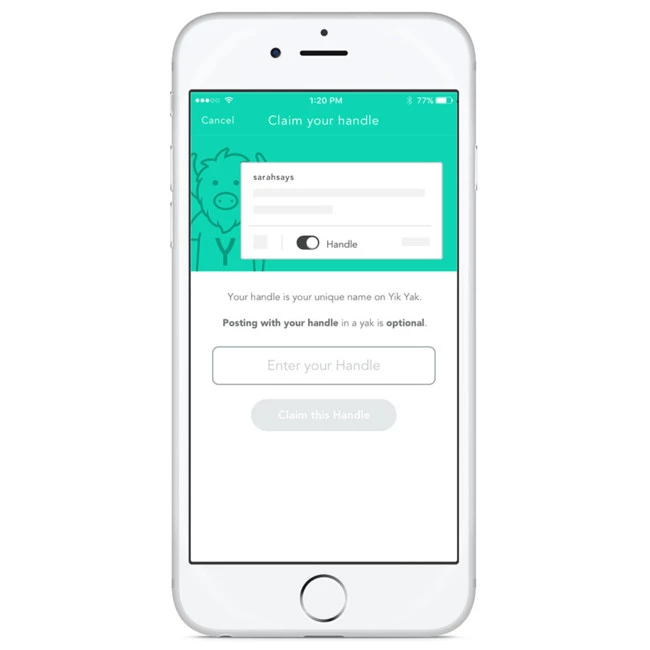
Image 1 / 1
Founding Story
Yik Yak began in 2013 around Furman University. Tyler Droll and Brooks Buffington became its public leaders. The founding record also includes Douglas Warstler: his lawyer filed an ownership suit in 2014, and Forbes reported a 2016 settlement statement recognizing him as a co-founder. The settlement terms were undisclosed; the allegations are not findings of misconduct.[6][7]
In an October 2014 interview, Droll said: “We wanted to capture the experience of college on campus.” He pointed to established anonymous campus Twitter accounts, whose small number of authors attracted large audiences. Buffington described the alternative: “I don’t have to be following you on Twitter”. Local proximity supplied the audience that other networks required people to assemble.[1]
Timeline
- 2013: The original app begins connecting nearby users.[3]
- 2014–2015: Campus tours support expansion; the University of Florida develops a local news experiment called Swamp Juice.[8][9]
- 2016: Handles move from optional to required and later become optional again. Researchers document user resistance and declining activity at their study site.[2][10]
- April 2017: Square reaches its employment and licensing agreement. The founders announce the app's coming wind-down.[4][3]
- 2021: New Yik Yak, Inc. announces its relaunch after buying redevelopment rights that February.[5]
- 2023: Sidechat acquires the later Yik Yak. Its current FAQ identifies shared ownership under Flower Ave LLC.[11]
What They Built
The core was a feed organized around place. Users posted short messages, replied and voted. The design removed the need to follow the right people before seeing a campus discussion. Geographic reach varied by feature and period; a single radius should not be treated as a permanent specification.[1][19]
Peek exposed selected feeds elsewhere, while My Herd let people remain connected to a chosen community when away. These features addressed different problems: discovery outside one's immediate location and continuity with an established group. Photo posting and changing navigation added further complexity. Designer Casey Labatt Simon's first-person account distinguishes tested prototypes from an Android redesign that actually shipped.[12][13]
Swamp Juice tested an institutional use beyond student chatter. UF journalism students curated local items, accepted submissions and watched community votes. The college's April 2015 announcement described about 20 pieces daily. It was a concrete distribution experiment, not evidence of a mature publisher revenue business.[9]
Market Position
Target Customers
College students were the main audience. The founders described campus alerts, lost-and-found items, jokes and support. A concentrated campus provided enough shared context to make a stranger's post relevant. A quiet feed outside that context could lose much of its value.[1]
Distribution included physical work. The Aggie documented an October 2014 UC Davis tour stop with a mascot and free merchandise. The founders' farewell also recalled campus tours and branded socks. These activities helped make participation visible to nearby peers, who supplied the content.[8][3]
Market Size
Campus counts and download popularity measure reach differently from recurring activity. No reconciled company-wide active-user series, revenue base or retention cohort was verified here. A local network can look large across many campuses while individual communities become too quiet to retain users.
Competition
The original product competed for attention with established social feeds and other anonymous services. Its distinctive offer was immediate local conversation without a follower graph. Today the Yik Yak brand itself remains active, alongside Sidechat. Their current ownership and product pages make a generic claim that this category is vacant untenable.[1][11][14]
Business Model
In 2014, Droll described local business advertising as a possible later direction. That was a proposal, not established ad revenue. Global Venturing later reported $73.5 million raised, including a large Sequoia-led round. Public reports vary on totals and round sizes; no audited financing ledger or profitable advertising model was verified.[1][15]
Former product executive Benjamin Tseng lists partnerships with UF, MTV, Comedy Central and Bleacher Report. UF's announcement documents its experiment. In a later interview, UF's Matt Sheehan also described a Bleacher Report Peek feed during the NCAA tournament. MTV and Comedy Central campaign details remain unverified.[16][20]
Traction
The strongest directly documented small-scale example is Swamp Juice's publishing activity. The broader company attracted financing and visible campus adoption, but those facts cannot establish paid demand. The university researchers' September 2016–March 2017 fieldwork collected 7,497 posts and 39,140 replies at one site. Their observations are useful for local mechanisms, not a representative measurement of every campus.[9][2]
Outcome and evolution
Harassment and threats were material problems, but they are insufficient as a complete explanation of the outcome. The field study found valuable peer support alongside harmful use. It also recorded anger after persistent identities became compulsory and a local activity rebound after the reversal. The study supports the conclusion that identity changes damaged a valued experience; it does not prove that keeping the old design would have produced a sustainable company.[2]
Anonymity also had limits. NYU researchers demonstrated ways to infer users' locations. Public identity, operational data collection and protection from identification were different properties. Removing names from a screen never guaranteed all three.[17]
The April 28 farewell said the app would wind down over the following week. Its surviving mirror's October publication date is not the original announcement date. Square's filing specifies a $1 million employment and non-exclusive licensing arrangement, rather than purchase of the whole company. A later Square filing describes the agreements as completed.[3][4][18]
The brand's 2021 return belongs to a new operating identity. Its announcement explicitly calls the owners New Yik Yak, Inc. and names a rights purchase. Sidechat's current FAQ confirms the subsequent 2023 acquisition and distinct apps under shared ownership. These later products should be linked to the original record without inheriting its founding date or operating history automatically.[5][11]
Key Lessons
- Yik Yak supplied a local audience without a follower list. A campus's shared context made that audience useful.
- Mandatory persistent identity changed the participation cost. The field study links that change with backlash, without proving anonymity alone could sustain the business.
- Campus tours and Swamp Juice created local activity in different ways. Each community still needed enough continuing contributions to remain useful.
- Peer anonymity did not prevent location inference. Product promises must distinguish visible identity from data retained or inferred.
- The original wind-down, Square licensing deal, and successor rights purchase were separate transactions. Their prices and outcomes should remain separate.
Sources
- Founder interview
- University field study of the decline
- Preserved founder farewell
- Square 2017 proxy statement
- 2021 successor launch announcement
- Warstler counsel announcement of lawsuit
- Reported settlement recognition
- UC Davis campus tour reporting
- UF Swamp Juice announcement
- March 2016 optional handles
- Current Sidechat FAQ
- Academic account of Peek and My Herd
- Original designer account
- Current Yik Yak FAQ
- Contemporaneous funding report
- Former product executive CV
- NYU location inference research
- Square 2018 completed-transaction disclosure
- CHI 2017 interview study
- UF director interview on publishing partnerships
- March 2016 optional-handle screenshot