
Zenefits
Winter 2013AcquiredHR for small businesses: onboarding, payroll and benefits.
Pressure-test this opportunity
Explore the risks and possibilities with a prompt for ChatGPT, Claude, or your agent.
HR for small businesses: onboarding, payroll and benefits.
Explore the risks and possibilities with a prompt for ChatGPT, Claude, or your agent.
Zenefits joined YC's Winter 2013 batch with an HR platform for small businesses. Parker Conrad and Laks Srini combined employee administration with benefits work in one interface. The company later passed through a licensing and investor-disclosure crisis, continued operating, and was acquired by TriNet in February 2022.[1][2]
The original subsidy joined two businesses: employers received basic software free, while insurers paid commissions when Zenefits became their broker. Software could distribute quickly; insurance transactions required qualified people and state-specific authority. The failure mechanism was allowing the transaction to outrun the checks that made it lawful, then giving investors an incomplete account of that exposure.
Conrad and Srini built around a recurring administrative problem: a hire or departure changes employee records, payroll and benefits together. A shared record could reduce repeated entry across those systems. YC's profile describes benefits, payroll, onboarding and talent management in one application.[1]
Early customer adoption was real, although the figures were company-reported. In January 2014, Zenefits reported over 500 businesses and 5,000 employees.[3] By June, it reported over 2,000 businesses and 50,000 employees.[4] Employer accounts and workers served are different measures; neither establishes retention or profitability.
The employer did not need to buy insurance to find administrative software useful. That gave Zenefits a distribution path before the brokerage sale. It also meant product adoption could grow faster than the licensed workforce needed to service it.
Zenefits presented HR and benefits tasks through a shared employee record. Its later product connected HR, benefits, employee engagement, payroll, and time and attendance. TriNet's acquisition announcement described this as a software offering for SMBs, extending its services beyond a professional employer organization, or PEO, arrangement.[2]
An employer could coordinate a worker's start date, administrative information and enrollment through the same platform. The interface could make the workflow simpler without changing who was permitted to sell insurance. A software account, a passed exam and an issued producer license were different prerequisites.
The early dashboard made the breadth visible: employee administration and payroll sat beside medical, dental, vision and other benefits. It sold coordination across systems, rather than a single isolated form.
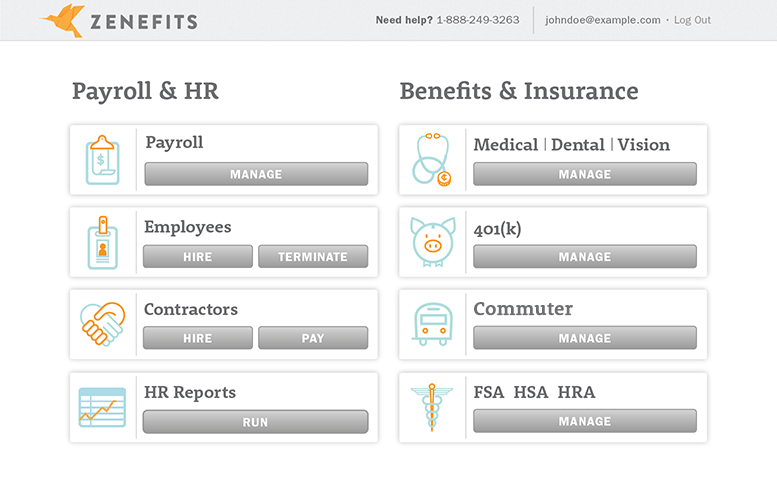
Image 1 / 1
The product also evolved into an app ecosystem. An October 2016 joint announcement described Expensify as one of Z2’s initial 17 apps. Their integration synchronized employee records and approval workflows, with accountant education and events as a distribution channel. This was an announced partnership, not evidence of customer adoption or renewal.[15]
Zenefits targeted small and midsize employers seeking simpler HR administration. Its reported adoption supports the presence of a customer problem. It does not prove every customer used brokerage, or that each customer's commissions covered the cost of software and service.
The product also crossed a contested distribution boundary. Utah challenged the free-software arrangement as an insurance rebate in 2014.[9] That dispute concerned the subsidy's treatment; it was separate from later findings about unlicensed transactions and deficient investor disclosures.
Current competitors already join software and qualified service. Gusto advertises licensed benefits advisors, employee enrollment and payroll-linked administration. TriNet HR Plus offers benefits workflows, broker choice and an Employee Navigator integration. Its carrier data exchange is advertised for groups with 50 or more employees. A smaller rebuild cannot assume the integrated workflow or broker choice is an unserved category.[10][11]
The SEC records that commissions exceeded 90% of revenue from January 2013 through June 2015. Its order describes policies requiring licenses but transactions occurring before licenses were issued. A CRM closing gate arrived in June 2015; account managers' nonresident-license requirement followed in December.[5]
This created a mismatch between the acquisition engine and fulfillment capacity. Free software attracted employer accounts. Turning those accounts into commission revenue needed a lawful brokerage operation across the customer's jurisdictions. A license policy in a handbook could not stop a sale unless the operating workflow enforced it.
TriNet's 2022 filing reports $223 million total consideration payable, including closing adjustments, and a $209 million accounting purchase price after excluding $14 million of unvested stock consideration treated as employment-related expense. These measures describe the acquisition transaction. They cannot be compared mechanically with a 2015 preferred-share valuation to calculate investor losses.[12]
TriNet said the combined business reached roughly 23,000 SMBs and over 600,000 workers at closing. Those were combined figures, not Zenefits' standalone customer count.[2]
The SEC's settled findings concern negligent disclosure of licensing gaps and Conrad's training-timer macro. The order also records a June 2016 investor settlement implying a roughly $2 billion valuation. Respondents accepted the SEC order without admitting or denying its findings; this was not a criminal conviction.[5]
California separately assessed $3 million for licensing violations and $4 million for circumventing education requirements, plus $160,000 in investigation expenses. Half the $7 million penalties were suspended subject to continued compliance. The department credited self-reporting, retraining and automated checks that restricted insurance solicitation and sales to licensed individuals.[7]
The operational lesson is narrower than saying hypergrowth always fails. A credential must authorize the relevant action in the relevant jurisdiction when it occurs. Checking only a new hire or a final approval leaves renewals, account servicing and later changes exposed. Investor reporting adds a second requirement: statements about controls must match what those controls actually enforce.
The countercase is the surviving product. TriNet purchased the business years after the crisis. Its current support path still identifies the former Zenefits platform, while HR Plus combines technology and expert service. Those pages establish product and support continuity, not unchanged contracts, standalone profitability or availability of every former software-only plan.[8][11]
Conrad later founded Rippling, a separate company; its own published founder interview discusses his Zenefits departure. That sequel does not reverse the settled findings or make Rippling a continuation of Zenefits.[13]