Overview
ZestMoney made installment credit available at checkout without requiring a credit card. Founded in India in 2015, it connected shoppers, merchants, and lenders. Its distribution could grow faster than the financial relationships needed to keep loans flowing. That dependence helps explain why a useful checkout platform could survive while its original independent business failed.[1]
Management announced a wind-down in December 2023. DMI acquired the platform and exclusive brand rights the following January. A reviewed October 2026 website still advertises ZestMoney credit services. This is a distressed transition with continuing product assets, rather than evidence that the brand permanently disappeared.[2][3][4]
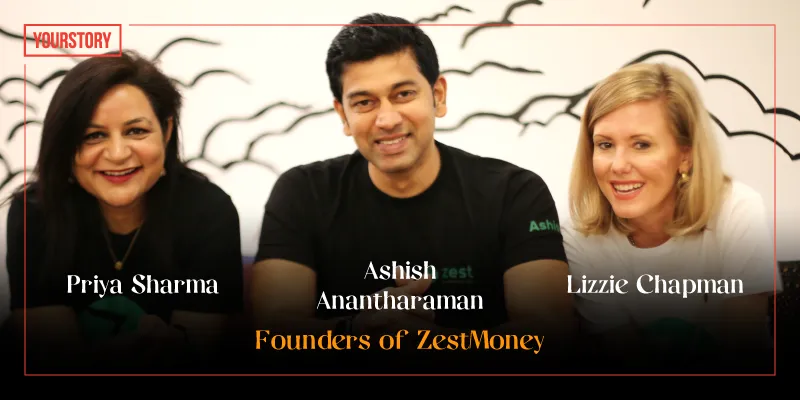
Image 1 / 1
Founding Story
Lizzie Chapman, Priya Sharma, and Ashish Anantharaman worked together through Wonga before starting ZestMoney. Chapman had worked at Goldman Sachs, the Wellcome Trust, and DBS India. She told RBL Bank that India's expanding digital economy needed credit distribution beyond physical branches. In its May 2021 interview, Chapman said: “at the end of 2015, we all got together and launched”. The transcript's interviewer also mentions 2013; Chapman's own account and the investor's founding record support 2015.[5][1]
Anantharaman brought experience in software and underwriting systems, including Microsoft, Swiss Re, and Wonga. His January 2022 YourStory interview described working with Chapman and Sharma at Wonga. He explained the product's intended change: “We were bringing the concept of BNPL online.” BNPL means buy now, pay later. Existing installment lending already served the market; the founders wanted a digital checkout experience.[6]
The insight concerned access and convenience. A shopper without a credit card could still qualify for a loan from a participating financial institution. That required more than a new payment button. Someone had to assess the borrower, supply capital, disclose terms, collect repayments, and manage complaints.
Timeline
- 2015: Chapman, Sharma, and Anantharaman founded ZestMoney.[1]
- September 2021: Zip agreed to invest USD50 million through the Singapore holding company, subject to conditions.[1]
- April 2023: PhonePe CEO Sameer Nigam publicly explained why acquisition due diligence had failed its standard.[7]
- May–December 2023: The founders departed; replacement management later announced a wind-down.[2]
- January 17, 2024: DMI announced acquisition of the platform and exclusive use of the brands.[3]
- October 2026 review: Public pages still promote installment credit and identify a DMI company in the service terms.[4][8]
What They Built
The current public journey has three stages: download the app and complete a profile, provide identity records and set up repayment, then use an approved credit facility at participating stores. The homepage advertises payment periods of three, six, nine, or twelve months. Its zero-interest qualification applies to selected offerings or Pay-in-3; it should not be read as a universal promise.[4]
The core experience joined credit approval to a purchase. Distribution through merchants placed financing where shoppers already chose goods. Historical coverage describes both online checkout and physical stores, with a registered customer base rather than a count of active borrowers.[6]
The January 2024 acquirer described more than 80,000 merchants, naming Amazon, Flipkart, Myntra, MakeMyTrip, Nykaa, and electronics retailers. These names document the platform's reported reach at acquisition. They do not prove that every merchant or loan offer remains available today.[3]
Market Position
Target Customers
The original proposition served shoppers with limited access to conventional credit cards and merchants seeking additional purchases. Lenders were another necessary customer or counterparty. An attractive borrower interface could not compensate for a lender deciding the portfolio or partnership no longer met its requirements.
Market Size
Zip's September 2021 announcement reported 11 million registered users, more than 10,000 online merchants, and 75,000 physical points of presence. These are historical platform measures, not audited active-loan counts. Its market forecasts were forecasts made in 2021; they do not establish the realized 2026 market.[1]
A checkout-finance opportunity depends on approved demand, financing cost, credit losses, servicing costs, and merchant economics. A large population without credit cards is insufficient to estimate profitable lending volume.
Competition
Anantharaman named Bajaj Finserv as an existing offline installment-finance competitor. ZestMoney's proposed advantage was bringing the experience online. Established lenders could bring capital, risk records, and retail relationships; digital platforms could compete on checkout placement and convenience.[6]
The current ZestMoney site remains a direct alternative to a new checkout lender. Rebuilding the same consumer flow would require competing against the surviving asset, alongside the financial and regulatory work required to originate loans.[4]
Business Model
Inc42 reported merchant-integration revenue and direct-selling fees from lenders. For the year ending March 31, 2022, it reported INR138.4 crore in operating revenue, INR145 crore in total revenue, and an INR398.8 crore loss. Those measures remain distinct. The original financial filing was not recovered in this review, so these are attributed financial reports rather than independently re-audited accounts.[9]
The figures show why growing distribution alone could not establish sustainable economics. They do not isolate the cost of credit losses from acquisition, staff, technology, or other spending. The evidence supports a financing and operating constraint; it cannot assign a precise share of the collapse to each expense.
Traction
The 2021 Zip announcement paired a proposed USD50 million minority investment with a board seat and reserved approval rights. The financing announcement had conditions and an expected closing date; it was not itself proof of funds received. A later Zip financial report records its initial September 2021 investment and subsequent accounting treatment.[1][10]
TechCrunch reported a USD450 million former valuation and investor losses at sale.[11]
Outcome and evolution
PhonePe CEO Sameer Nigam discussed acquisition due diligence with Moneycontrol on April 4, 2023. He said: “it didn’t really meet our bar”. He also described an approximately USD18 million loan as a financial lifeline. This is a named buyer's explanation, without a public diligence report establishing every concern. The failed sale removed a possible exit while the original company needed financing.[7]
Mint subsequently reported the wind-down and attributed the loss of an Aditya Birla Finance partnership to an unnamed source. Neither the lender nor ZestMoney responded to that account. Treating regulation as the sole proven cause would go beyond the evidence.[2]
DMI's announcement confirms acquisition of the platform and brands, with DMI Finance becoming a preferred lender. The purchase price and investor recovery waterfall were not disclosed there. This gives a concrete counterpoint to a pure product-failure thesis: a financial buyer retained the checkout asset and supplied its own lending relationship.[3]
As of October 23, 2026, public terms name DMI Infotech Solutions Private Limited as the platform operator, while the homepage footer names Glimmer Technologies. The reviewed pages do not reconcile that legal-name difference. They establish continuing public service material, rather than a completed live loan or verified current approval availability.[8][4]
Key Lessons
- Distribution needs dependable funding. ZestMoney reached merchants through a convenient checkout flow, while its service still depended on lender relationships and available capital.
- Diligence can end a financing plan. PhonePe's stated concerns prevented a potential acquisition. A prospective buyer is not committed operating runway.
- Keep product value separate from investor return. DMI retained the platform and brands after the wind-down announcement. Useful assets can survive a poor outcome for the original financing structure.
- Track the responsible entity. Continuing websites and brands can cross ownership changes. Borrowers and partners need a clear operator, lender, repayment route, and support contact.
Sources
- Zip: September 2021 investment announcement
- Mint: December 2023 wind-down reporting
- DMI: January 2024 acquisition announcement
- ZestMoney: Current homepage, accessed October 23, 2026
- RBL Bank: Lizzie Chapman interview, May 2021
- YourStory: Ashish Anantharaman interview, January 2022
- Moneycontrol: PhonePe CEO interview, April 2023
- ZestMoney: Current service terms, accessed October 23, 2026
- Inc42: FY22 financial reporting
- Zip: Half-year financial report, December 2022
- TechCrunch: Distressed sale report
- Reserve Bank of India: Digital Lending Directions, May 8, 2025
- Perfios: InteGreat digital loan origination