Overview
Zipio — publicly known as Dealupa during its operational life — was a Y Combinator Winter 2012 company that built a search and ranking layer for the daily deals market.Founded by two former Google engineers in Seattle, the company aggregated deals from across the web, ranked them using a proprietary algorithm modeled on Google's PageRank, and personalized results using collaborative filtering and Facebook's social graph.The core thesis was elegant: the daily deals space was fragmented and noisy, and what it needed was not another deals publisher but a discovery infrastructure layer.
The company cycled through four names in roughly 18 months, reported strong early traction at Demo Day, and then went silent.It never raised a documented follow-on round.
The most likely cause of failure was not a product flaw but a category collapse: Dealupa entered the daily deals market at its precise peak and built its entire business model on an ecosystem — deal publishers, affiliate programs, crawlable inventory — that began contracting almost immediately after the company launched.When the supply side disappeared, so did Dealupa.

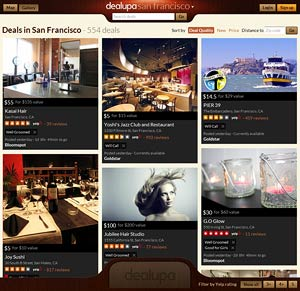
Image 1 / 2
Founding Story
Sanjay Mavinkurve and Vijay Boyapati met at Google, where both had built careers working on large-scale search and information systems. Mavinkurve held a B.A. and M.S. in computer science from Harvard and had worked on Google Maps for mobile devices before rotating through the Google X and Google+ teams. [1] His connection to the Harvard ecosystem ran deep: he had been one of the early engineers on HarvardConnection — the social network founded by the Winklevoss twins and Divya Narendra that predated Facebook — before graduating in 2003 and joining Google. [2] Boyapati, who attended The Australian National University, had been part of the engineering team that built Google News. [3] [4]
The two left Google in 2011 to found the company in Seattle — an unusual base for a YC-backed startup, suggesting neither founder was deeply embedded in the San Francisco startup ecosystem prior to the program. Their founding premise was explicit: the daily deals market was generating enormous consumer interest but was structurally broken as a discovery experience. Consumers had to visit Groupon, LivingSocial, and dozens of smaller publishers separately, with no way to compare or rank deals across the ecosystem. Mavinkurve framed the opportunity in terms of their shared professional identity: "search is in our blood." [5]
The company launched publicly in November 2011 under the name Deelio, positioning itself as a search and discovery platform for deals. [6] Within weeks it had rebranded to The Dealmix — only to encounter domain squatters, forcing yet another name change. [7] The company entered Y Combinator's Winter 2012 batch as Dealupa and used the three-month program to rebuild the product's visual design around a Pinterest-style cascading card interface. It would later rebrand one final time to Zipio — the name under which it is listed on YC's company directory — though no press coverage of that final rebrand exists.
What the founders brought to the problem was genuine technical depth in search and ranking systems. What they lacked was any documented background in commerce, retail, or local business — the domain they were entering. Their competitive advantage was algorithmic, not relational. That asymmetry would matter.
Timeline
- November 2011 — Company launches publicly as "Deelio," positioning as a search and discovery platform for deals targeting the daily deals market [6]
- November 2011 — Company briefly operates as "The Dealmix" but encounters domain squatters, forcing another rebrand [7]
- February 7, 2012 — Now operating as Dealupa, the company has expanded from Seattle to a nationwide product; early press coverage documents the geographic rollout [8]
- March 26, 2012 — Dealupa launches publicly under its new name with TechCrunch coverage; DealRank algorithm and Pinterest-style UI are announced; company discloses 700–800 deals per city vs. competitors [9]
- March 27, 2012 — Dealupa presents at YC W12 Demo Day at the Computer History Museum in Mountain View; reports 10,000+ subscribers and 20% week-on-week growth during the YC program [10]
- May 14, 2012 — Independent press coverage documents Dealupa's full technical architecture and competitive positioning; last known substantive press coverage of the company [11]
- 2012 (date unknown) — Company rebrands from Dealupa to Zipio; no press coverage of this rebrand exists [12]
- Post-2012 — Company goes silent; no follow-on funding, product updates, or public communications documented
- September 16, 2024 — dealupa.com domain confirmed taken over by an unrelated Thai-language website; company's web presence fully defunct [13]
What They Built
Dealupa was a deal aggregation and ranking engine. The core product had three layers: a web crawler that continuously scraped deal listings from publishers across the internet, a ranking algorithm called DealRank that sorted those deals by quality and relevance, and a personalization layer that tailored results to individual users. The result was a single destination where a consumer could find and compare deals from dozens of publishers without visiting each site individually.
The Crawler
The technical infrastructure was built on MySQL, Memcache, PHP, and jQuery, hosted on Rackspace with Amazon S3 storage. The crawling layer used Solr (an open-source search platform) and PhantomJS (a headless browser that could render JavaScript-heavy pages) running on Ubuntu 11.10. [11] This stack was competent and conventional for 2012 — nothing in the infrastructure itself represented a technical moat. The differentiation was in what the crawler fed into: the ranking algorithm.
DealRank
DealRank was the company's central innovation and its most direct expression of the founders' Google backgrounds. Explicitly modeled on PageRank, it combined multiple signals — deal popularity, user location, category preferences, and behavioral data — into a single quality score for each deal. [9] The analogy was straightforward: just as PageRank used link structure to identify authoritative web pages, DealRank used engagement signals to identify genuinely valuable deals rather than merely popular or heavily promoted ones. The algorithm was described as patent-pending at launch.
Personalization via Facebook
The third layer used collaborative filtering — the same technique behind Netflix and Amazon recommendations — combined with data from Facebook's API. Mavinkurve was careful to distinguish this from a simple social graph feature: "We're not interested in the personal social graph. We want to find similarities across a Facebook-wide graph based on preferences, tastes, and biographical info." [9] In practice, this meant the system could identify users with similar taste profiles across the entire Facebook user base and use their deal engagement behavior to improve recommendations for any given user.
The Interface
During the YC program, the team rebuilt the product's visual design around a Pinterest-style cascading card layout — a significant departure from the map-and-list UI that had characterized the original Deelio launch. Each card displayed a deal with its DealRank score, price, discount percentage, and category. Users could filter by location, category, and price range. The interface was designed for browsing rather than targeted search — a consumer experience closer to a personalized deal magazine than a search engine.
Scale Advantage
The product's most concrete competitive claim was inventory depth. At launch, Dealupa reported 700–800 deals per city, compared to approximately 30 for Groupon and approximately 154 for Yipit in San Francisco. [9] This was a genuine structural advantage of the aggregation model: because Dealupa crawled the entire deals ecosystem rather than sourcing deals directly, its inventory scaled with the ecosystem rather than with its own sales capacity.
Market Position
Target Customers
Dealupa's primary target was the daily deal consumer — someone already using Groupon, LivingSocial, or similar services who was frustrated by the fragmentation of the market. The product required no behavioral change beyond consolidating deal discovery into a single destination. Secondary targeting used Facebook data to reach users whose taste profiles matched high-engagement deal categories, suggesting an aspiration to expand beyond the existing daily deal consumer base into a broader discount-seeking audience.
The geographic rollout — Seattle first, then nationwide — was methodical and suggested the team understood that local deal density was a prerequisite for a useful product. A deal aggregator with thin inventory in any given city would fail the basic utility test regardless of how good its ranking algorithm was.
Market Size
The daily deals market was, at the moment of Dealupa's launch, one of the fastest-growing consumer internet categories in history. Groupon had gone public in November 2011 at a $12.7 billion valuation — the largest U.S. internet IPO since Google. LivingSocial had raised over $800 million in venture capital. Hundreds of vertical and regional deal publishers had launched in their wake. The total market was estimated at several billion dollars annually in gross merchandise value.
The aggregation layer above this market was the opportunity Dealupa was targeting. If the deals ecosystem was going to persist and grow, a ranking and discovery layer was a logical and potentially valuable infrastructure play. The problem was that the market size assumption embedded in this thesis — that the deals ecosystem would continue to grow — was wrong. Groupon's stock lost more than 75% of its value in the eight months following its IPO. The deals market did not grow; it contracted sharply, and it took the aggregation opportunity with it.
Competition
Dealupa identified two primary competitors: Yipit and Groupon. [14]
Yipit was the most direct analog — a deal aggregator that had launched in 2010 and raised venture capital on a similar thesis. Yipit's approach was more manual and editorial than Dealupa's algorithmic model, and its inventory depth (approximately 154 deals in San Francisco at the time of Dealupa's launch) was significantly lower than Dealupa's claimed 700–800. [9] Yipit's subsequent history is instructive: it eventually abandoned the deal aggregation business entirely and pivoted to retail data analytics for institutional investors — a complete category exit that confirms the aggregation model was not viable long-term.
Groupon was both a competitor and a dependency. As the dominant deal publisher, Groupon's inventory was a significant portion of what Dealupa was aggregating. Groupon's decline was therefore simultaneously a competitive development (weakening a rival) and a supply-side crisis (reducing crawlable inventory).
The broader competitive landscape included Dealmap (acquired by Google in 2011), DealChicken, and dozens of smaller regional aggregators. None of these survived the category collapse intact.
Business Model
Dealupa operated on a pure affiliate commission model. The company did not source deals itself and therefore required no sales force — a deliberate structural choice that kept the cost base minimal. When a user clicked through from Dealupa to a deal publisher and completed a purchase, Dealupa earned a commission of 10–15% of the transaction value. [10] Because the company had no deal sourcing costs, virtually all of this commission revenue was described as converting directly to profit.
The model was asset-light by design and elegant in theory. It aligned Dealupa's incentives with user satisfaction — the company only earned when users found deals compelling enough to purchase — and it scaled without proportional cost increases. The fatal structural flaw was its complete dependency on the upstream ecosystem. Dealupa's revenue was a function of (deal publisher affiliate programs) × (deal inventory volume) × (user conversion rate). All three variables were controlled by third parties, and all three contracted as the daily deals market declined. The company had no lever to pull when the supply side began to disappear.
Traction
At YC W12 Demo Day on March 27, 2012, Dealupa reported more than 10,000 subscribers and 20% week-on-week growth since entering the Y Combinator program three months earlier. [10] These were the only traction metrics the company ever disclosed publicly.
The 20% week-on-week growth figure, if sustained, would have implied extraordinary scale within months. A starting base of roughly 1,000 subscribers growing at 20% weekly would reach 10,000 in approximately 13 weeks — consistent with the three-month YC timeline. The metric is plausible but unverified, and the quality of the subscriber count is unclear: the figure is not broken down by active users, email subscribers, or registered accounts.
The geographic expansion strategy — starting in Seattle and expanding nationwide before Demo Day — was methodical and suggested disciplined execution. [8] The company had achieved national coverage within roughly three months of its initial Seattle launch.
No revenue figures, post-Demo Day subscriber counts, conversion rates, or geographic expansion milestones were ever disclosed. The traction story ends abruptly at Demo Day. The absence of any subsequent data point — positive or negative — is itself informative: companies that are growing share numbers, and companies that go quiet typically are not.
Post-Mortem
Dealupa's failure is best understood as a category failure rather than a product failure. The company built a technically coherent product, demonstrated early growth, and presented a structurally sound business model. What it could not survive was the collapse of the market it had been built to serve.
Primary Cause: The Daily Deals Market Collapsed Beneath the Product
Dealupa's entire value proposition — more deals, better ranked, personalized — was predicated on a growing and healthy daily deals ecosystem. The company launched in November 2011, the same month Groupon went public at a $12.7 billion valuation. By mid-2012, Groupon's stock had lost more than 75% of its value. LivingSocial began contracting. Hundreds of smaller deal publishers shut down or stopped running affiliate programs.
This was not a gradual decline that a nimble startup could navigate around. The daily deals market had been built on a structural flaw: merchants who ran deals typically lost money on the transactions and did not see sufficient repeat customer rates to justify the loss. As merchant dissatisfaction spread, deal quality declined, consumer interest followed, and publishers began shutting down. The contraction was rapid and broad.
For Dealupa, this meant three simultaneous crises. First, crawlable inventory shrank as publishers closed. Second, affiliate programs — the mechanism through which Dealupa earned revenue — were discontinued as publishers cut costs. Third, consumer interest in daily deals declined, reducing conversion rates even for the deals that remained. The company had no independent supply of deals, no direct merchant relationships, and no revenue stream that was insulated from the ecosystem's health. When the ecosystem contracted, Dealupa's business model became structurally unviable.
No founder statement or post-mortem addresses this directly. The connection between the market collapse and Dealupa's shutdown is inferred from timing and market context rather than confirmed by the founders.
Secondary Cause: No Documented Follow-On Funding
PitchBook lists Dealupa/Zipio's last funding type as Seed, with no Series A or follow-on round documented anywhere in the public record. [15] The company received the standard YC investment and seed funding, but no named investors, no funding amounts, and no subsequent rounds are on record.
The absence of a Series A is consistent with the market timing problem. Demo Day was March 27, 2012. By the summer of 2012, Groupon's stock collapse was front-page news and investor sentiment toward the daily deals category had turned sharply negative. A deal aggregator pitching for a Series A in mid-2012 would have been raising into a market where the category thesis had already been publicly discredited. Even strong Demo Day metrics — 10,000 subscribers, 20% weekly growth — would have been insufficient to overcome investor skepticism about the category's long-term viability.
There is no information on whether a Series A was attempted and failed, or whether the founders chose not to raise. The outcome — a quiet shutdown with no growth capital — is the same either way.
Tertiary Cause: The Final Rebrand Suggests a Failed Pivot
The company's evolution through four names — Deelio → The Dealmix → Dealupa → Zipio — is documented, but the final rebrand to Zipio is the most significant and least understood event in the company's history. [12] Unlike the earlier name changes, which were driven by domain squatters and branding refinements within the deals category, "Zipio" has no apparent connection to deals, search, or any identifiable product category.
The name change generated zero press coverage — a striking contrast to the TechCrunch coverage that accompanied each earlier iteration. This silence is consistent with two interpretations: either the rebrand happened very late in the company's life, when it no longer had the momentum to attract press attention, or it represented a pivot attempt that never reached public launch. The dealupa.com domain has since been taken over by an unrelated Thai-language website, confirming the company made no effort to preserve or redirect its brand. [13]
If Zipio represented a genuine product pivot — an attempt to apply the DealRank and personalization infrastructure to a different category — it failed before reaching public visibility. If it was simply a name change on a winding-down company, it represents the founders' last attempt to reframe the business before closing it.
Structural Weakness: Domain Expertise Gap
The founders' backgrounds were in search engineering at Google-scale systems. This was a genuine advantage for building DealRank and the crawling infrastructure. It was not an advantage for understanding the merchant side of the daily deals business, the economics of local commerce, or the structural reasons why deal publishers were struggling.
A team with deeper roots in retail or local business might have recognized earlier that the daily deals model had a fundamental merchant economics problem — and that any aggregation layer built on top of it would inherit that problem. The founders framed their competitive advantage as algorithmic ("search is in our blood") [5] without apparent awareness that the supply side of the market they were entering was structurally fragile. This is not a criticism of the founders' intelligence — the daily deals collapse surprised many sophisticated investors — but it is a pattern worth noting: technical founders building infrastructure layers on top of markets they do not deeply understand from the supply side.
Aftermath
Vijay Boyapati subsequently became prominent in the Bitcoin community, authoring "The Bullish Case for Bitcoin" — a significant career pivot away from the startup world. Sanjay Mavinkurve's post-Dealupa trajectory is not documented in the public record. No acquisition, acqui-hire, or sale of the DealRank IP has been recorded. The shutdown was silent and complete.
Key Lessons
-
Infrastructure plays inherit the structural risks of the ecosystems they serve. Dealupa's asset-light, no-sales-force model was elegant precisely because it sat above the deals ecosystem rather than inside it. But that position also meant the company had no ability to influence the ecosystem's health and no revenue stream that was insulated from its decline. When building an aggregation or infrastructure layer, the viability of the underlying market is not a background assumption — it is the primary business risk.
-
Category timing is a separate variable from product quality. Dealupa built a technically sophisticated product with genuine differentiation (DealRank, collaborative filtering, 700–800 deals per city vs. competitors' 30–154). [9] None of that differentiation mattered when the category itself collapsed. A better product in a dying market does not outperform a worse product in a growing one. Founders and investors evaluating infrastructure plays need to assess not just whether the product is differentiated but whether the underlying market has structural durability.
-
Repeated rebranding without public explanation is a signal of strategic uncertainty, not just marketing iteration. Four names in 18 months — Deelio, The Dealmix, Dealupa, Zipio — with the final rebrand generating zero press coverage suggests the company was searching for an identity that matched a product it had not yet found. The name churn was partly forced by external circumstances (domain squatters), but the final pivot to a name with no connection to the original category is a meaningful signal that the founding thesis had been abandoned before the company closed.
-
Domain expertise gaps matter most at the supply side. The founders' search engineering backgrounds were a genuine advantage for the demand-side product (ranking, personalization, discovery). They appear to have been a blind spot for understanding the supply-side economics of daily deals — specifically, the merchant dissatisfaction that was already undermining the category at the moment of launch. Technical founders entering commerce-adjacent markets should stress-test their supply-side assumptions with the same rigor they apply to their technical architecture.
-
The absence of post-Demo Day data is itself a data point. Dealupa's public traction story ends on March 27, 2012. Companies that are growing share numbers. The complete silence after Demo Day — no blog posts, no press releases, no funding announcements, no product updates — is consistent with a company that did not achieve the post-YC growth needed to raise a Series A and chose to wind down quietly rather than publicly.
Sources
- KillerStartups.com — "Ranking Deals with Dealupa" (May 14, 2012)
- TechCrunch — "Former Googlers Launch YC-Backed Dealupa: A PageRank For Daily Deals" (March 26, 2012)
- TechCrunch — "deel.io: Former Google Engineers Take On Dealmap With New Search And Discovery Platform For Deals" (November 3, 2011)
- Crunchbase — Vijay Boyapati profile
- TechCrunch — YC Demo Day Session 3 (March 27, 2012)
- Zillman.us — "Dealupa: Single Place for All the Daily Deals" (February 7, 2012)
- Y Combinator company directory — Zipio
- Crunchbase — Dealupa organization profile
- PitchBook — Zipio/Dealupa company profile
- dealupa.com — domain (now defunct, taken over by third party)
- TechCrunch — "Which Daily Deal Site Are You? This Flow Chart May Have The Answer" (November 2011)
- Internet Archive Wayback Machine — dealupa.com captures (2012)