
Airtrain AI
Summer 2022InactiveNo-code data curation for LLM fine-tuning and evaluation.
Pressure-test this opportunity
Turn this teardown into a decision-ready prompt for ChatGPT, Claude, or your agent.
No-code data curation for LLM fine-tuning and evaluation.
Turn this teardown into a decision-ready prompt for ChatGPT, Claude, or your agent.
If you only have a few minutes to spare, here’s what investors, operators, and founders should know about Airtrain AI (S22).
Airtrain AI was a San Francisco developer-tools company founded in 2022 by Emmanuel Turlay and accepted into Y Combinator's Summer 2022 batch. It began as Sematic, an open-source continuous machine-learning orchestrator, then shifted by November 2023 into a no-code platform for evaluating, fine-tuning, and organizing language-model data. YC now marks the company inactive.[1]
The final homepage, captured on April 1, 2025, said the team was joining Weights & Biases and that Airtrain's products would be sunset.[2] It did not explain why, describe an acquisition, or disclose a transaction structure, price, or terms. The evidence therefore supports a product shutdown and team transition, not an acquisition claim or a specific failure theory.
Turlay brought an unusually infrastructure-heavy background: particle-physics research at CERN, order and payment systems at Instacart, and machine-learning platform leadership at Cruise.[1] Sematic's founding team also included engineers Josh Bauer, Tudor Scurtu, Chance An, and Sash Nagarkar.[3] The team said its thesis grew from four years building ML infrastructure at Cruise.
Sematic addressed the gap between a local Python notebook and a dependable cloud pipeline. Its open-source framework let data scientists define work in Python, execute locally or on Kubernetes, and track artifacts, models, datasets, metrics, visualizations, and reproducibility metadata.[4] The original ambition was continuous machine learning with traceability, reproducibility, and observability.
On November 17, 2022, Sematic announced a $3 million seed round led by Race Capital, with participation from Y Combinator, Soma Capital, Leonis Capital, Fundament, and Pioneer Fund.[5] A contemporaneous release named Voxel as an early commercial customer and said the money would support hiring, a hosted cloud product, and open-source adoption.[6]
Sematic was the technical substrate. It ran Python-defined ML pipelines locally and on Kubernetes, preserved lineage and artifacts, and packaged cloud jobs. Airtrain reused that infrastructure for language-model workloads rather than abandoning it.
The first Airtrain experience compared open-source models on a customer's own data. Batch evaluations could contain up to 10,000 rows. Users selected models or supplied outputs, then evaluated them through LLM-assisted scoring, JSON-schema validation, standalone metrics, and benchmarks. Plain-English properties such as groundedness or politeness became judge criteria scored from one to ten, with distributions and row-level inspection for failure analysis.[12]
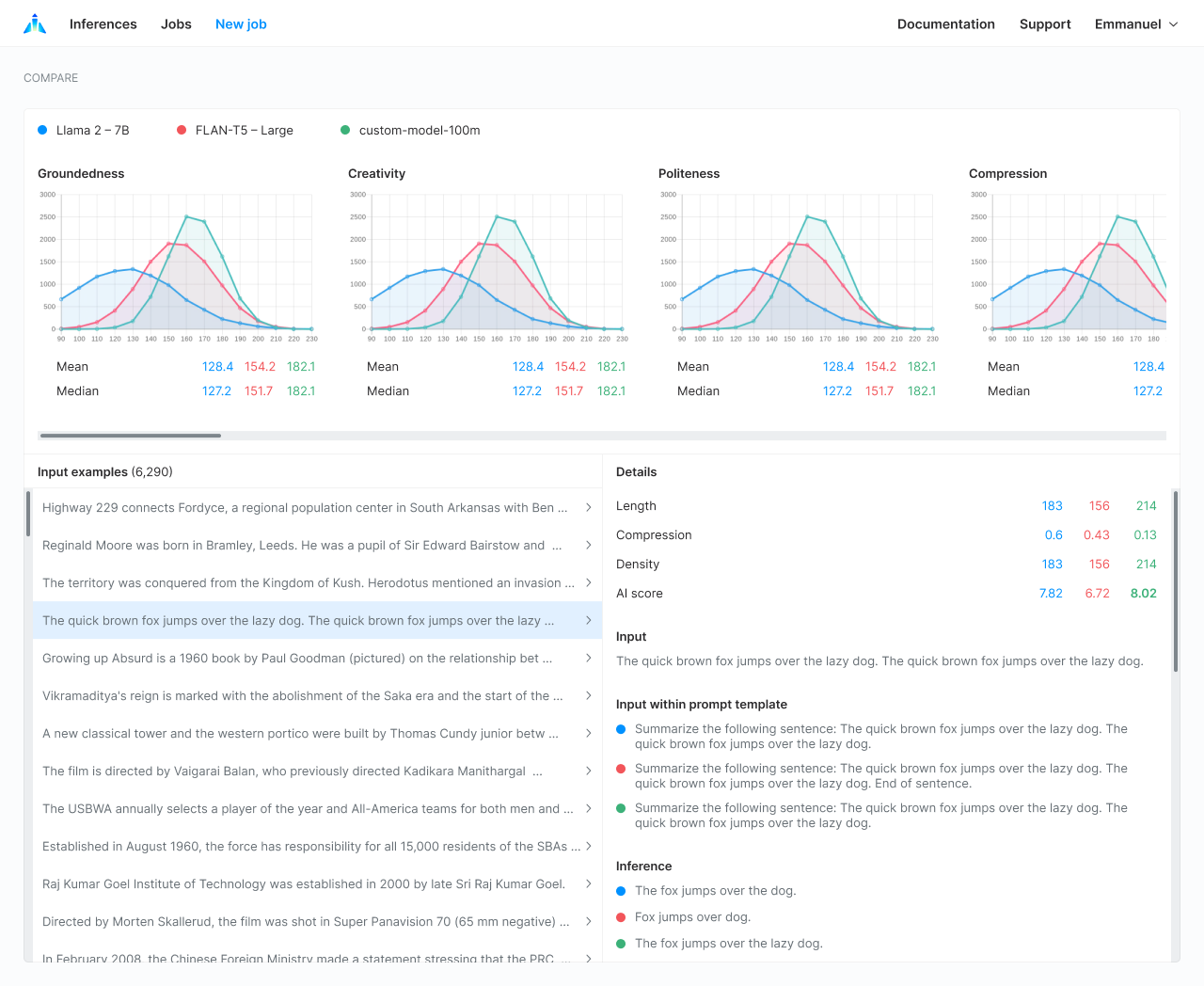

Image 1 / 2
The Playground compared open and proprietary models while exposing token counts, throughput, inference cost, and saved sessions. The broader platform added an embedding-based Dataset Explorer, semantic clustering, visualization, custom fine-tuning, and automatic classification and labeling from natural-language class definitions.[13][14]
Read the complete post-mortem, the rebuild playbook, and the exact reasons Airtrain AI is still worth studying now.