
FlowiseAI
Summer 2023AcquiredOpen source GenAI development platform
Pressure-test this opportunity
Explore the risks and possibilities with a prompt for ChatGPT, Claude, or your agent.
Open source GenAI development platform
Explore the risks and possibilities with a prompt for ChatGPT, Claude, or your agent.
FlowiseAI is an open-core visual platform for building and operating AI agents. Henry Heng and Chung Yau Ong founded it in 2023, released it on GitHub that April, and sold the company to Workday in a completed acquisition announced August 14, 2025.[1][2]
This was an acquisition success, not a failure. A weekend project used open-source distribution to reach tens of thousands of developers, then moved from a drag-and-drop LangChain layer into native orchestration, evaluations, and enterprise controls. Workday bought both technology and community. The standalone service remains live, while a separate Workday Flowise Agent Builder was announced with no current official proof of general availability or revenue.
YC identifies Heng and Ong as active founders. Heng had been a software engineer at Fidelity Investments. In February 2023, the pair were building with LangChain, Hugging Face, and adjacent frameworks and wanted faster prototypes, less repetitive code, and a way to see an entire LLM flow.[1] Their accessibility metaphor was LEGO: connect a document loader, embeddings, and a vector database while learning how the system worked.
Flowise began as a weekend project. Heng later recalled writing its first line of code on a train from Limerick to Dublin.[3] The repository appeared publicly in April, YC acceptance followed in June, and a pre-seed plus growth to five employees followed by September.[4]
The exact circumstances in which Heng and Ong met and their early division of responsibility were not found. The public record is clearer about product purpose than company formation.
Flowise launched as a drag-and-drop canvas for assembling LLM backends. Users connected models, prompts, document loaders, embeddings, vector stores, memory, and tools into flows, then deployed them without hand-writing all orchestration code.
The product expanded up-stack. Current documentation separates Assistant for beginner-friendly agents, Chatflow for single-agent and retrieval systems, and Agentflow for multi-agent orchestration.[9] Agentflow V2 introduced native nodes, an execution queue, shared Flow State, branching, loops, resumable human approvals, streaming updates, and MCP-connected tools.[10]
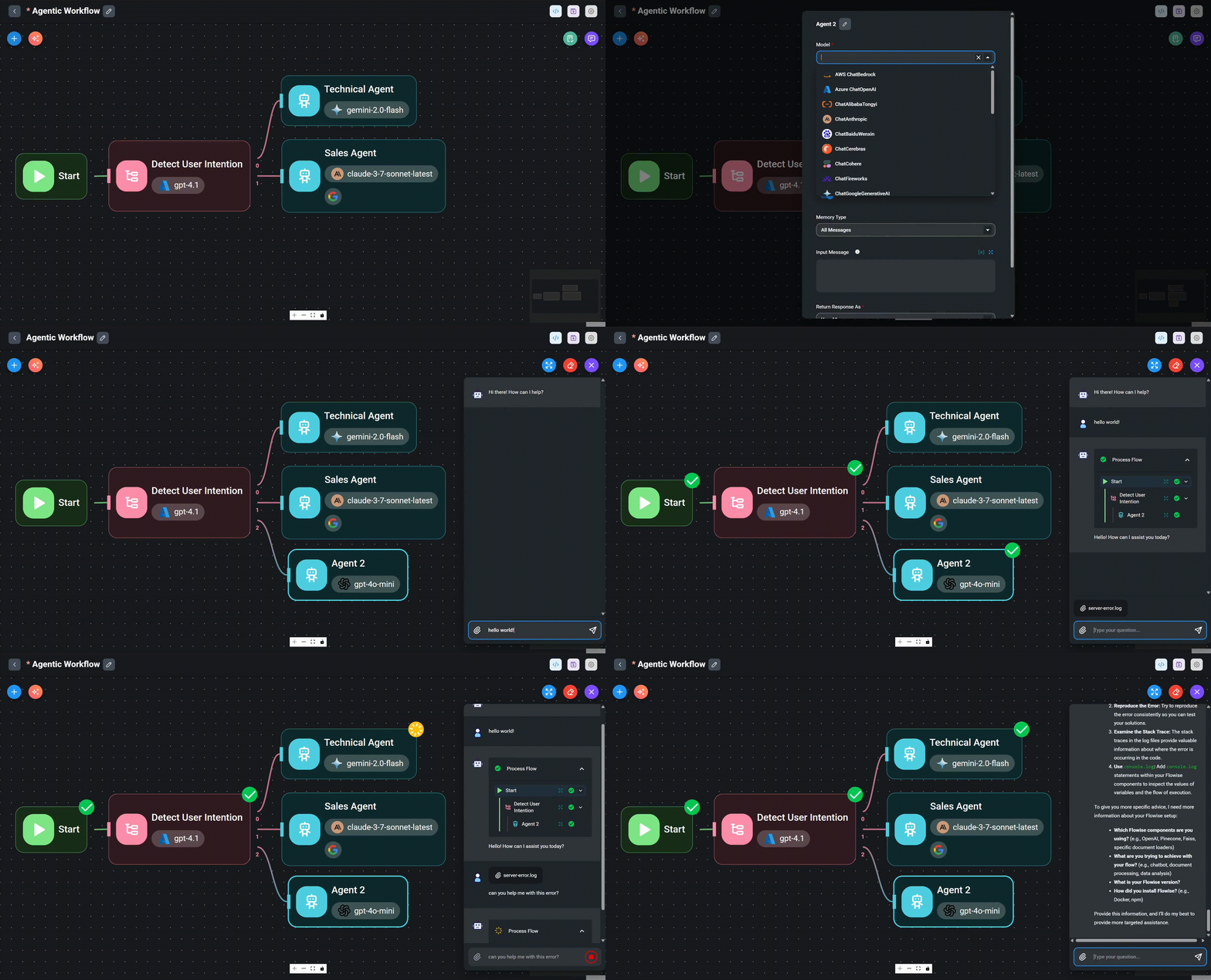
Flowise now spans more than 100 integrations, RAG, logs, tracing, evaluations, APIs, SDKs, embedded chat, air-gapped deployment, horizontal scaling, RBAC, and SSO. It offers managed cloud and self-hosting.[9] Most code is Apache 2.0, while the enterprise directory and designated files use a commercial license.[11]
Flowise began with people who wanted to learn and prototype AI applications without extensive code. It expanded toward development teams and enterprises that needed controlled deployment. Current testimonials name InsightSoftware, Thermo Fisher Scientific, BTS, Liverpool Hospital, and Publicis Groupe, but do not establish paid scope or contract value.[12]
No audited customer count, ARR, paid conversion, or market-share figure was found. Workday said Flowise had processed millions of chats and workflows and passed 42,000 GitHub stars at acquisition.[2] Those metrics show use, not revenue.
Dify overlaps across visual workflows, RAG, agents, model management, observability, cloud, and self-hosting.[13] Langflow competes as a visual agent builder with a much larger current GitHub star count.[14] n8n approaches from broader workflow automation and integrations.[15]
Flowise's advantage was not an exclusive model or framework. It combined visual accessibility, open-source distribution, self-hosting, and a path to enterprise governance. Workday added a large installed base in HR and finance.
Flowise monetizes hosting and enterprise controls around an open-source core. Current pricing is Free at $0, Starter at $35 monthly, Pro at $65 monthly plus $15 per extra user, and contact-sales Enterprise.[12] Paid packaging adds usage, storage, workspaces, roles, SSO, audit logs, on-premise deployment, support, and SLAs.
LinkedIn reports a $500,000 pre-seed, but no primary financing announcement confirms amount or terms.[16] A commercial database's $1 million 2024 revenue figure is explicitly estimated and unverified.[17]
Workday disclosed no purchase price, cash or stock mix, valuation, earn-out, retention package, or founder proceeds. Heng's plain announcement was: “We are joining Workday.”[3]
Open-source distribution was the strongest signal. Flowise rose from an April 2023 release to 19,000 stars by year-end and more than 42,000 at acquisition. By July 2026 the live repository showed 54,603 stars, 24,711 forks, same-day code activity, and current releases.[5]
The standalone lane survived under Workday terms with hosted signups, self-hosting, and enterprise packaging.[18] The Workday lane remains less certain: Workday announced Flowise Agent Builder for Workday Build and planned first-half 2026 availability, but no current official source found here confirms general availability, customer count, or revenue.
Flowise's acquisition rewards a clear sequence: accessible wedge, community distribution, then deeper product ownership.
The visual canvas made an emerging developer stack legible. Open source removed adoption friction, while npm and Docker made local trial easy. The community then supplied attention, integrations, feedback, and buyer proof that a five-person company could not purchase conventionally.
Flowise began around external LLM components but built native Agentflow execution, state, human checkpoints, evaluations, tracing, and enterprise controls. That did not eliminate fierce competition, but it made the company more than a diagramming layer.
Workday CTO Peter Bailis said, “By bringing Flowise into Workday and investing in its open-source foundation, we are empowering our customers and partners to build and deploy their own AI agents on Workday.” Heng added, “We built Flowise to make AI development easier for everyone—and our open-source community has been key to bringing that vision to life.”[2]
The two-lane outcome matters. Standalone Flowise is demonstrably live. Workday's embedded builder is announced but lacks current GA proof in this research. The deal's strategic logic is supported; transaction economics and integration revenue are not.