Overview
Bebo's early strength came from giving groups of friends a place they could make their own. It reached a large audience outside the United States and attracted a strategic buyer. Its later history shows why that achievement could not carry each new product: familiar branding, enthusiastic users, and a large sign-up count each needed a fresh test of repeat use.[1][2]
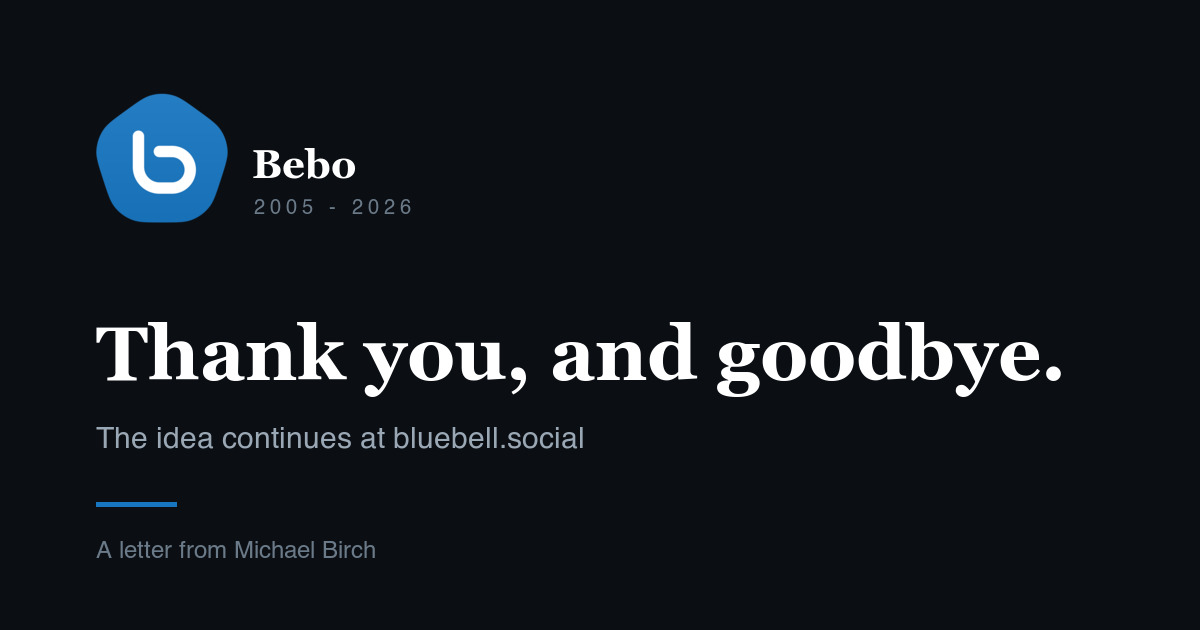
The story spans several businesses and products. AOL bought the original network in 2008 and sold its assets in 2010. The founders bought Bebo back through a bankruptcy auction in 2013. Experiments later produced streamer tools acquired by Twitch. By November 5, 2026, bebo.com displayed a closure letter from Michael Birch and directed visitors to his separate Bluebell project.[7][8][13]
A personal place spread through existing friendships
Michael and Xochi Birch started Bebo from their home in San Francisco in 2005. Profiles combined photos, blogs, messages, quizzes, and a Whiteboard where friends could draw. Skins and friend rankings gave users ways to display taste and relationships. These choices made another person's page a destination.[1][13]
The Guardian described Bebo spreading by word of mouth through schools and colleges in 2006.[19] TechCrunch reported Bebo overtook MySpace in UK weekly visits in August 2006, after launching its music section.[20]
Bebo's submission to Parliament reported over forty million members worldwide and 11.2 million UK users. It identified Britain, Ireland, New Zealand, and Australia among its principal markets, and described its core audience as aged sixteen to twenty-four. These were company statements; membership and active audience were different measures. The regional concentration suggests a useful distribution advantage: friends could find enough familiar people locally before the service became universal.[2]
The investor record also shows a successful early financing outcome. Balderton's March 2008 release said it supplied $15 million in May 2006 and expected approximately $140 million from selling its stake. The announced sale rewarded the founders and investor before the network's subsequent decline.[3]
Entertainment expanded the commercial proposition
Bebo developed professional programming alongside personal profiles. Its parliamentary submission named the interactive drama KateModern, the planned Sofia's Diary, and Endemol's The Gap Year. It reported over twenty-five million KateModern views. Open Media gave broadcasters access to the community. These programs supplied shared topics while creating opportunities for brand sponsorship.[2]
AOL's acquisition announcement described Open Media partners including CBS, MTV, BBC, Turner, and ESPN. Content partners retained their advertising revenue. The buyer also highlighted applications that developers could port from Facebook. Both choices reduced the effort outsiders needed to bring content or software to the network; they also meant outside participation alone could not establish Bebo's own profits.[4]
The young audience imposed operating responsibilities. Bebo told Parliament that profiles were private by default and described moderation, abuse reporting, education, and work led by safety specialist Rachel O'Connell. These were the company's stated practices, rather than an independent safety audit.[2]
AOL bought an integration strategy
The announced 2008 transaction was commonly described as $850 million. AOL's later accounting disclosure recorded completion on May 14 and acquisition consideration of $859.8 million, net of cash acquired. It included $7.8 million paid in early 2009. The announced deal value and accounting consideration use different measures.[1][5]
Joanna Shields would lead AOL's People Networks group, joining Bebo with AIM and ICQ. AOL proposed common identities, messaging integration, content cross-promotion, and advertising through Platform-A. Its press release presented the network as a way to combine audience relationships with its advertising business.[4]
That was an intelligible buyer thesis, but proposed integrations were not evidence of durable usage. Ofcom's 2010 report, using UKOM/Nielsen data, found Bebo's UK unique audience fell 60% between April 2009 and April 2010. Facebook's grew 31% during the same period. Bebo's remaining visitors still spent time there, but its total audience shrank.[6]
In June 2010, AOL disclosed the sale of substantially all Bebo assets to a Criterion Capital Partners affiliate. It expected a deferred tax benefit of $275 million to $325 million following the transaction. That was a tax measure, not the sale price. The filing did not disclose cash proceeds.[7]
Competition offers stronger measured evidence than a simple story of an unsuitable owner. AOL's integration plans did not prevent the decline, but the sources do not isolate the effects of execution, spending, or Facebook's growing network. Standalone Bebo revenue, profit, and user cohort records are unavailable here. Blaming a single feature or executive would exceed the evidence.
Buying the name back did not restore the network
The 2013 purchase followed Criterion's ownership and bankruptcy, rather than a direct reversal of AOL's sale. Michael Birch paid $1 million at auction. His later account describes the buyback as partly emotional and says the team experimented rather than restoring the old site.[8][1]
In December 2014, Bebo appeared as a messaging app with personalized cartoon avatars triggered by hashtags. The Irish Times also described drawing on messages. It reused the name while changing the central interaction and the competitive setting.[9]
Blab then tested live group video. In his August 2016 shutdown account, Shaan Puri reported 3.9 million total users, but only about 10% returned regularly. The average daily user spent over sixty-five minutes per day. That comparison used total registrations and a loosely defined regular-return measure, not a dated retention cohort.[10]
Puri described broadcasters attracting people intermittently, while friends gathered for longer but brought fewer newcomers. The team chose closure over a smaller product. Its ambition shaped that decision; this does not prove that every niche business was unviable. The live technology subsequently specialized for Twitch gamers.[10]
Twitch confirmed its June 2019 acquisition of people and IP for Twitch Rivals. TechCrunch's reported price was disputed.[11] The narrower streamer product gave a buyer a concrete use for the work. That outcome belongs alongside the unsuccessful social launches when assessing the experiments.[1]
The brand returned again; the present project is Bluebell
In January 2021, ITV reported an invitation-only beta for another Bebo social network, coded by Birch during lockdown. The announcement said old photos and data were unrecoverable. Nostalgia could bring visitors to an announcement, but the revived product could not supply their old social history.[12]
The current bebo.com letter says another attempt returned in spring 2026 and now is closed. Its author presents Bluebell as the next expression of the idea. The current domain therefore establishes a published founder message and referral; it does not establish that today's site operator is the original corporation or that Twitch owns Bluebell.[13]
On November 5, 2026, Bluebell described a combined private messenger and social space for direct messages, group chats, and a feed, without followers or an algorithm. Bebo's referral also promoted groups, trips, and events. Public pricing and a legal ownership chain linking all Bebo incarnations were not established. A general private-social rebuild would already overlap Birch's current proposition.[13][14]
The later gaming direction has mature substitutes too. Discord offers organized voice and video gatherings; Challonge lists free tournaments and communities, with Premier at $6.99 per month billed annually. Start.gg's January 2025 fee announcement specifies 6% on online paid registrations. An organizer discussion describes using Challonge for small weekly events and start.gg for larger ones. These tools make another broad tournament platform a weak starting point.[15][16][17][18]
A narrower experiment could help an existing weekly gaming group turn one good match into an agreed rematch. That is a proposed test, with payment and retention unproven. It should earn repeated organizer use before expanding into another social destination.
Timeline
- 2005: Michael and Xochi Birch launch Bebo in San Francisco.[1]
- 2006: The institutional financing supplies $15 million.[3]
- 2007–2008: Entertainment and partner applications expand the profile-based network.[2][4]
- May 2008: AOL completes its acquisition.[5]
- June 2010: AOL sells Bebo assets to a Criterion affiliate.[7]
- 2013–2016: The founders buy back Bebo; messaging and Blab experiments follow.[8][9][10]
- 2019: Twitch acquires the later business.[1]
- 2021: A private social-network beta is announced.[12]
- 2026: Bebo's current site announces closure and refers visitors to Bluebell.[13]
Sources
- Michael Birch, The Long Way Back to Friends, July 24, 2026
- Bebo memorandum to the UK Parliament, 2008
- Balderton Capital sale announcement, March 13, 2008
- AOL acquisition completion announcement, reproduced May 19, 2008
- AOL separation information, acquisition accounting note, 2009
- Ofcom Communications Market Report, August 19, 2010, pages 237–239
- AOL Form 8-K, June 17, 2010
- The Irish Times, Bebo buyback, July 2, 2013
- The Irish Times, messaging relaunch, December 18, 2014
- Shaan Puri, Blab shutdown account, August 13, 2016
- TechCrunch, Twitch acquisition, June 18, 2019
- ITV News, Bebo beta, January 29, 2021
- Bebo, current farewell letter, observed November 5, 2026
- Bluebell, current product description, observed November 5, 2026
- Discord, Stage channels, observed November 5, 2026
- Challonge, pricing, observed November 5, 2026
- Start.gg, January 2025 fee announcement, retrieved November 5, 2026
- Reddit, organizer discussion, observed November 5, 2026
- The Guardian, early social distribution, June 18, 2006
- TechCrunch, UK weekly visits, August 8, 2006