Overview
BigBasket made grocery shopping depend on a dependable basket: the right items, acceptable fresh produce, and a delivery that arrived when expected. Owning inventory gave it more control over those promises. It also required warehouses, purchasing, working capital, and local operating discipline. The app was the visible end of a much larger system.[1]
Tata Digital bought a majority stake in 2021. BigBasket continues to operate, now centered on quick delivery through bbnow. Its later challenge is adapting a supply chain built for planned grocery purchases to frequent, smaller, faster orders. Financial losses and changing formats make that transition worth studying; they do not establish that every delivery, store, or category loses money.[2][3]
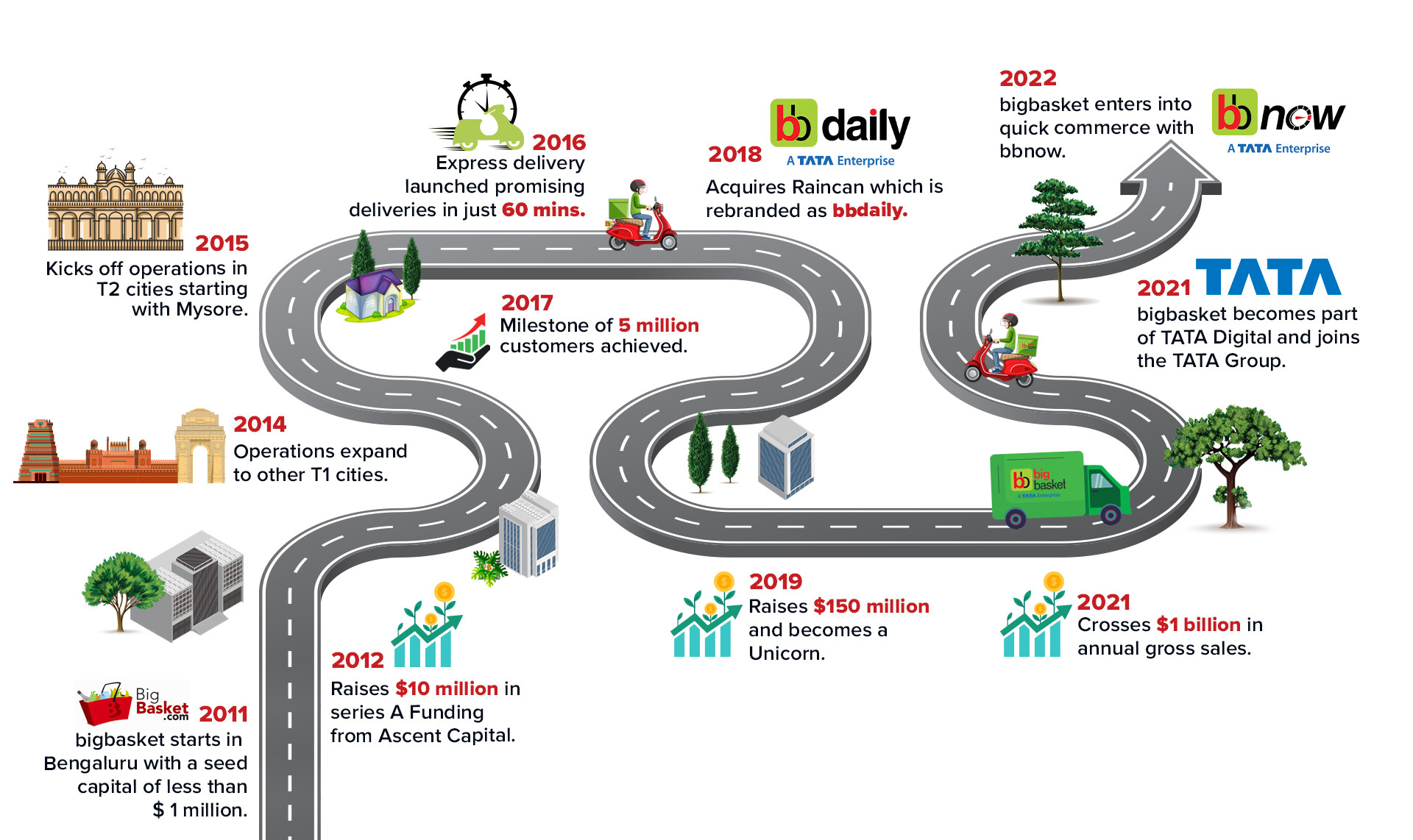

Image 1 / 2
The founders brought an earlier grocery business with them
BigBasket's five founders were V. S. Sudhakar, Hari Menon, V. S. Ramesh, Vipul Parekh, and Abhinay Choudhari. The business launched in Bengaluru in December 2011. BigBasket's careers page identifies the team; contemporary coverage preserved by the company supplies the operating history.[4][5]
Several founders had worked together on Fabmart, an early Indian ecommerce business started in 1999. Its grocery experience led to the physical Fabmall chain, subsequently acquired by Aditya Birla. Menon's later account describes lessons from both formats returning to BigBasket. Choudhari also brought an existing online grocery operation, ShopasULike, into the founding business. This was accumulated retail experience, rather than five newcomers discovering that food required a supply chain.[1][6]
The operating model developed with volume. Menon recalled initially buying from Metro Cash and Carry because the company lacked enough demand for direct supply, then opening its own warehouse. Stock control developed over time: contemporary 2012 coverage describes daily procurement and a planned warehouse. Later inventory ownership should not be projected backward onto every launch operation.[1][6]
Early distribution was local too. A 2012 interview described planned promotion in malls and apartments, alongside radio and local print. The company could connect customer acquisition to the cities it could actually serve. That plan is evidence of the intended channel mix, not measured channel returns.[6]
A missing ingredient could spoil the whole order
Grocery completeness has a different meaning from delivering a collection of unrelated products. In a 2026 interview, Menon explained that three missing items from a 25-item basket could create disproportionate frustration. A household might still need another shopping trip. He identified fill rate, on-time delivery, and in-stock availability as core operating measures.[7]
These measures address different failures. An item can appear available but fail to reach the customer. A complete basket can arrive late. A reliable time slot offers little help when the required ingredient is unavailable. Their connection to repeat ordering is plausible; the interviews do not isolate the retention effect of each measure.
Menon defended inventory control because dependence on neighborhood stores shared margins and weakened control over availability and quality. His earlier interview also described refrigerated delivery equipment and city-specific sourcing. These choices bought control at the cost of running the physical operation.[8]
Fresh produce added another problem: the shopper could not examine each item. Direct farmer relationships, collection centers, sorting, and agronomist support made quality an upstream responsibility. Investor Actis described this system in 2020, including daily collection and advice about crops and inputs. Its account is an investor's description, not an independent experiment proving every claimed farmer benefit.[9]
Repeat purchases needed several delivery formats
BigBasket did not discover rapid fulfillment only after Tata arrived. It acquired Delyver in 2015 to strengthen local delivery, and Menon described dark stores for urgent top-up purchases. The company still controlled the underlying grocery inventory. A shorter delivery window was another use of its network, not necessarily a move to sourcing each order from a nearby independent shop.[10][8]
The 2018 RainCan acquisition supported a different recurring job. Rebranded bbdaily, it offered morning delivery of household staples. Subscriptions could turn a repeated decision into a standing instruction. The current bbdaily FAQ still describes daily, alternate-day, weekly, and other schedules, with pauses and prepaid payment. In June 2026, Menon said the milk-subscription business had been integrated into the main app. A surviving separate FAQ is not proof that every historical app flow remains available everywhere.[11][12][3]
During the 2020 lockdown, demand alone could not guarantee fulfillment. Uber's partnership announcement attributed disruption to shortages of personnel and vehicles. It supplied cars and bikes for BigBasket deliveries in four cities. Extra demand can expose a constrained operating step rather than immediately improve economics.[13] BigBasket also raised a US$60 million bridge round in April 2020.[14]
Tata supplied an ecosystem, not an automatic profit formula
Tata's May 2021 announcement identified the acquisition target as Supermarket Grocery Supplies Private Limited. It emphasized grocery's place in a broader consumer ecosystem and BigBasket's fresh supply chain and private labels. The announcement described more than 12,000 farmers and 50,000 products at that time; those historical figures should not be treated as today's local assortment.[2]
The partnership later reached beyond grocery. Tata documented a September 2024 iPhone launch through bbnow and Croma. That event establishes a working category collaboration. One seven-minute promotional delivery does not measure typical service or establish the profitability of electronics delivery.[15]
By February 2025, Menon said 80% of orders came from quick commerce. He described larger dark stores, shorter picking and packing times, and an expanded assortment. He also said bbnow's contribution margin was negative and forecast a later improvement. Contribution margin, store profit, and whole-company net income answer different questions; his forecast is not a subsequent result.[16]
In June 2026, Menon acknowledged starting late in quick commerce and emphasized profitability, order value, and careful store expansion. The company appointed Amit Nanda CEO, while Menon and Parekh continued as board members and mentors. The change preserved founder involvement while transferring executive responsibility.[3][17]
The accounts show losses without settling every operating question
Tata Sons' FY2025–26 subsidiary table reports these separate legal-entity figures, in Indian rupees. One crore equals ten million rupees.[18]
| Entity | Turnover | Loss after taxation |
|---|---|---|
| Innovative Retail Concepts | ₹8,223.09 crore | ₹3,073.12 crore |
| Supermarket Grocery Supplies | ₹2,298.24 crore | ₹101.69 crore |
These are not Tata Digital's group revenue or a standalone bbnow segment statement. Adding the turnover rows would risk counting transactions within the business twice. The table establishes substantial losses in the consumer-facing entity; it does not attribute them entirely to delivery speed or prove that every mature store has negative contribution.
The 2026 strategy remained contested. Parekh's May interview emphasized fresh produce, private labels, and deeper existing markets. August reporting described a planned reduction in geographic coverage, citing industry executives. That is evidence of a reported retrenchment plan, not a verified current city-by-city closure list. A precise present footprint needs address-level confirmation.[19][20]
The current product competes on an already crowded shelf
Checked on November 5, 2026, BigBasket's official app listing remains available and advertises groceries, broader everyday categories, regional-language search, and SmartBasket access to past purchases. Its national marketing coverage is broader than the listing's qualification that bbnow is available in selected cities. Neither establishes service at a particular address.[21]
Pricing is a basket-and-location question rather than one universal subscription fee. The current BigBasket FAQ says delivery and handling charges vary with location and basket value. Its bbnow policies also distinguish speed from returns: no cash on delivery, no returns at the doorstep, and support-mediated return requests.[22][23]
| Alternative | Current published pricing boundary | Relevant offer |
|---|---|---|
| Blinkit | Delivery charges depend on the store and appear at checkout | Local groceries and everyday products |
| Instamart | Variable delivery fees; published Swiggy One terms waive delivery above ₹199, subject to subscription conditions | Grocery and broader merchant assortment |
| Zepto | Published terms allow order-dependent delivery and other service charges | Fast grocery and everyday shopping |
| bbdaily | Published FAQ lists ₹3 or ₹5 milk-only delivery charges in specified cities, with exceptions | Recurring morning essentials |
These are published terms, not identical live basket quotes. Product prices, promotions, membership eligibility, handling fees, and serviceability need comparison at the same address and time.[24][25][26][12]
The transferable opportunity sits earlier in the chain: helping a produce supplier and buyer agree what an acceptable lot looks like. This is also an existing market. Intello Labs sells grading and sorting systems; Clarifresh offers configurable inspections, offline capture, and quality reporting. A small service could test hands-on grading calibration for one farmer-producer organization and one buyer, rather than build another delivery app. The paid demand remains unproven.[27][28]
Timeline
- 1999–2006: Earlier Fabmart and Fabmall experience precedes BigBasket.[1]
- 2011: BigBasket launches in Bengaluru.[5]
- 2015: Delyver acquisition strengthens local delivery.[10]
- 2018: RainCan becomes part of bbdaily.[11]
- 2020: Uber supports lockdown deliveries; BigBasket raises a bridge round.[13][14]
- 2021: Tata Digital acquires a majority stake.[2]
- 2022: Company roadmap dates bbnow's quick-commerce entry.[4]
- 2026: Nanda becomes CEO; the product continues amid profitability and footprint changes.[17][20]
Sources
- Menon on scaling BigBasket
- Tata's majority acquisition announcement
- Menon's June 2026 transition interview
- BigBasket's founders and company roadmap
- Contemporary 2013 coverage preserved by BigBasket
- Contemporary 2012 founding coverage
- Menon on order completeness and fresh produce
- Menon on inventory and delivery operations
- Actis on BigBasket's farmer supply chain
- Delyver coverage preserved by BigBasket
- RainCan acquisition reporting
- bbdaily's published service and fee FAQ
- Uber's 2020 delivery partnership
- BigBasket's April 2020 bridge funding
- Croma and bbnow iPhone collaboration
- Menon's February 2025 operating interview
- BigBasket's CEO appointment announcement
- Tata Sons FY26 annual report, printed page 141
- Parekh's May 2026 strategy interview
- August 2026 reporting on geographic focus
- BigBasket's current official Android listing
- BigBasket's current customer FAQ
- bbnow policies
- Blinkit delivery FAQ
- Instamart's current published terms
- Zepto's current published terms
- Intello Labs' grading and sorting products
- Clarifresh inspection and pricing FAQ