Overview
Blue Apron made cooking easier by taking responsibility for the work before dinner: choosing recipes, buying ingredients, portioning them, and getting a complete box to the door. That promise joined a consumer brand to a demanding physical operation. When fulfillment became harder, the company paid through higher costs and a weaker experience for customers it had already spent money to acquire.[2][26]
The company survived through changes in ownership and production. FreshRealm bought its fulfillment assets in June 2023; Wonder bought the remaining company that November. The brand still sells meals in 2026, with broader formats and more flexible ordering. Its later move to Misfits Market shows that outsourcing production leaves the customer promise dependent on another operator.[9][11][16]
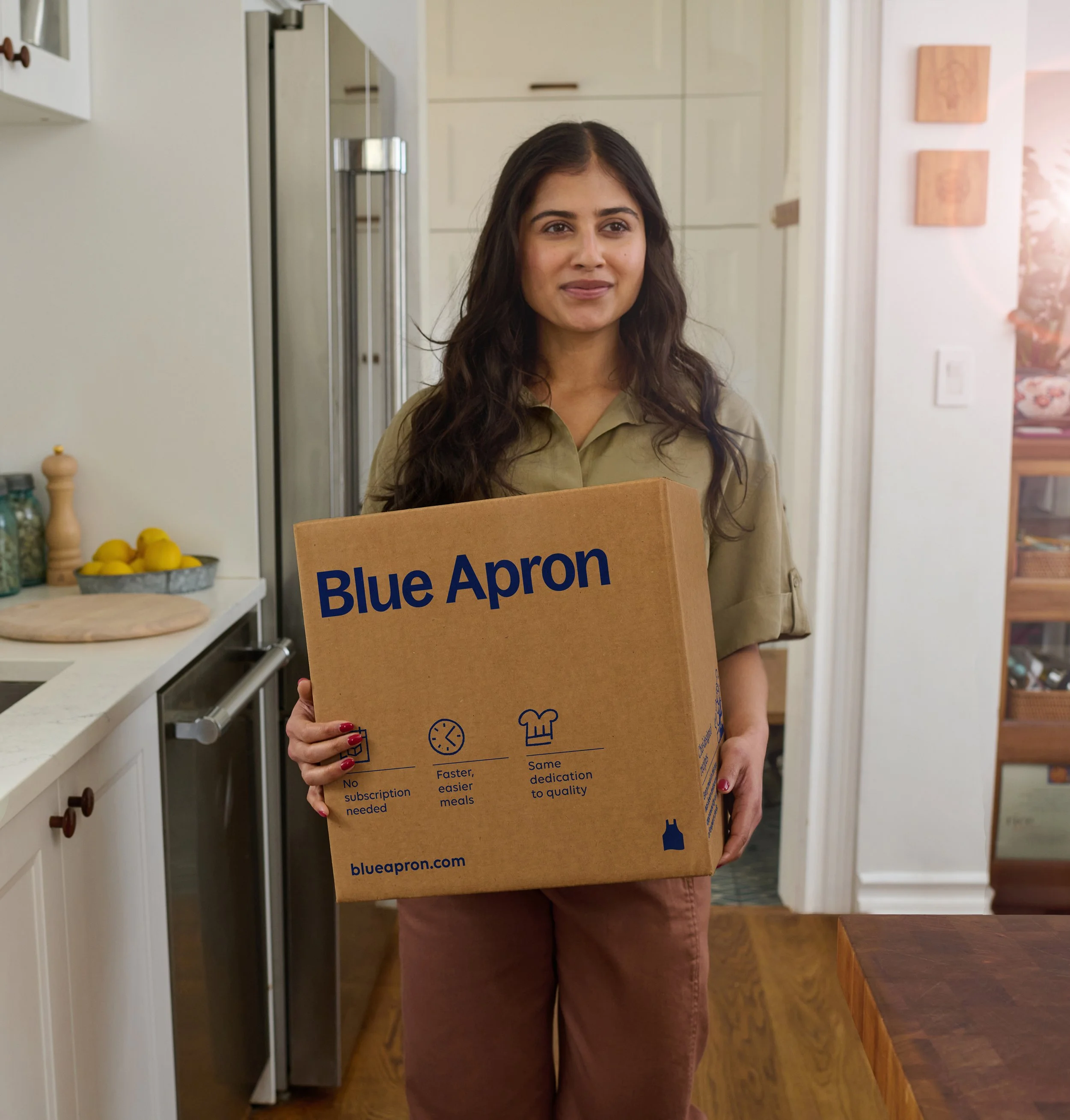
Image 1 / 1
A cooking experience with the preparation removed
Matt Salzberg and Ilia Papas wanted to cook with interesting ingredients without arranging every purchase themselves. They recruited chef Matthew Wadiak and launched in August 2012, initially packing deliveries and asking friends to try them. Salzberg's 2014 interview emphasized cooking and learning, with technology supporting the experience behind the scenes.[1]
The founders brought complementary skills: Salzberg led the business, Papas technology, and Wadiak the culinary operation. The product left the enjoyable part of cooking with the customer while taking over planning and procurement. It still required the household to cook, which limited the convenience it could offer against a prepared meal.[1][27]
That distinction shaped the competitive field. In a 2017 interview, Salzberg identified offline grocery shopping as the main alternative. A household could like the recipes yet choose groceries, takeout, or a faster dinner on a particular week. The service had to earn a recurring place in that routine.[27]
The recipe was connected to the supply chain
Blue Apron's June 2015 funding announcement described $135 million led by Fidelity, intended for sourcing and fulfillment. It reported more than three million meals monthly. Direct farm relationships and advance menu planning helped coordinate what farmers grew with what customers would later cook.[3]
Its 2017 filing described forecasts linked to recipe selection, supplier availability, and fulfillment capacity. Inside refrigerated facilities, software instructed workers how to portion ingredients and pack boxes. Shipping choices and packaging changed with route, weather, and destination. An error at any step could leave a customer unable to cook the planned meal.[2]
The commercial extensions followed the same home-cooking brand: Blue Apron Market sold tools and pantry goods, Blue Apron Wine offered pairings, and the 2017 BN Ranch acquisition moved further into sourcing. Those extensions broadened the business, while the core box still needed reliable execution.[2]
Distribution combined referrals with paid channels such as direct mail, television, podcasts, and digital advertising. The filing reported that 34% of customers active in the first quarter of 2017 had been acquired through the referral program, which offered complimentary deliveries. Referrals also carried food and fulfillment costs.[2]
Contribution narrowed the payback margin
The SEC challenged an early marketing-efficiency comparison between cumulative customer revenue and acquisition spending. Blue Apron's June 2017 response replaced that presentation with a contribution measure that subtracted cost of goods sold, excluding depreciation and amortization. It reported $111 of contribution during the first six months after an initial order against $94 of average Cost per Customer.[4]
That left a much smaller cushion than comparing acquisition cost with revenue. The measure also left corporate expenses outside the calculation. Its use of historical cohorts and average production costs could inform spending, but could not guarantee that the next customer would pay back on the same schedule.
The 2019 investor presentation made the customer mix clearer. For the cohort acquired in the third quarter of 2017, the top 30% by subsequent revenue supplied more than 80% of first-year revenue. That was a retrospective ranking: it showed the value of loyal households without proving the company could identify them cheaply before purchase.[7]
Blue Apron later sought more focused audiences and different purchase occasions. WW x Blue Apron offered recipes aligned with the WW program. Jet.com supplied an on-demand channel, while an earlier Costco test put kits in selected stores. These relationships tested distribution outside the original subscription funnel; the records here do not isolate their contribution to profitable growth.[22][23][24]
The IPO and a difficult fulfillment transition overlapped
Blue Apron's IPO closed on July 5, 2017, issuing thirty million shares and generating $278 million in net proceeds. At the same time, the company was bringing its Linden, New Jersey facility into operation. Its annual report later acknowledged that unexpected complexity and costs hurt revenue expectations, product launches, and acquisition and retention.[5][26]
Third-quarter 2017 cost of goods sold, excluding depreciation and amortization, reached 78.1% of net revenue, versus 70.9% a year earlier. The company attributed much of the increase to its new operating infrastructure. It cut marketing while improving Linden. Customer count fell from 943,000 in the second quarter to 856,000 in the third; that metric counted people with a paid order during the quarter, rather than a fixed subscriber population.[5]
Reducing acquisition spending while repairing fulfillment was understandable. It also exposed the dependence of growth on continuing marketing. For full-year 2017, revenue increased to $881.2 million from $795.4 million in 2016, while net loss widened to $210.1 million from $54.9 million. Annual revenue growth had not produced an annual net profit.[6]
The company did improve parts of the operation. Its first-quarter 2019 presentation showed positive adjusted EBITDA of $8.6 million alongside a net loss of $5.3 million. Adjusted EBITDA excludes several expenses and was a quarterly result. It does not establish annual net profitability.[7]
Competition and household habits remained plausible contributors to the longer decline. The evidence supports a concrete operating setback around Linden, but does not assign every lost order to that facility. By full-year 2022, Blue Apron reported $458.5 million in revenue and a $109.7 million net loss, and continued to seek funding for the business.[8]
Two different transactions changed the business in 2023
On June 9, 2023, Blue Apron transferred fulfillment centers, equipment, know-how, and related staff to FreshRealm. It received approximately $25 million upfront, subject to adjustments, with other value tied to a note, milestones, and volume rebates. The headline of up to $50 million was therefore not all immediate cash. An initial ten-year agreement made FreshRealm its exclusive meal-kit supplier.[9]
Blue Apron retained the customer-facing business. In September, Wonder announced a company acquisition at $13 a share, approximately $103 million in equity value. The tender-offer filing confirms that the deal closed on November 13, with Blue Apron becoming a wholly owned subsidiary. FreshRealm's asset purchase and Wonder's equity purchase had different buyers and different objects.[10][11]
Wonder wanted Blue Apron within a broader offering of meals and dining occasions. In August 2025, Blue Apron announced à la carte ordering, Dish prepared meals, Assemble & Bake dishes, and an expanded menu. Its products also became available through the Wonder app. The change addressed convenience and commitment, two constraints of the original format.[12]
Outsourcing required another handoff in 2026
FreshRealm filed for Chapter 11 in April 2026. Its court papers described Blue Apron's allegations of quality, safety, and operational breaches, and a disputed termination notice. These were contested contractual positions. The settlement and transition documents set out a move of the Blue Apron-related production and fulfillment business to Misfits Market.[14]
A later debtor filing reported court approval on June 2 and closing of the Misfits asset sale on June 4. This was a supplier transition, not another sale of the Blue Apron consumer brand.[15]
Blue Apron's own July blog confirms the Misfits relationship. It told customers that recipe ingredients would be packed in sections rather than separate recipe bags, and introduced ingredient checklists on recipe cards. It also described possible changes in fulfillment location and transit time. Customers would now sort ingredients before cooking, so the operating change also changed their work in the kitchen.[16]
Moving assets off the balance sheet changes who operates the facilities, but customer trust still depends on the resulting box. Contracts, recipe specifications, packing instructions, and actual delivery need to agree through a transition. The sources do not establish that every post-transition order failed, nor do they support treating the brand as shut down.
What a new entrant would face today
As of November 5, 2026, Blue Apron's offer includes traditional kits, ready meals, Assemble & Bake, and Family Style. The April Family Style announcement targeted households of three to six with mix-and-match mains and sides. Its public FAQ lists optional Blue Apron+ at $9.99 monthly and a separate recurring-order discount. That FAQ contains 2025 trial details; current checkout charges were not independently verified.[13][18]
An indexed scheduled menu for November 23 showed examples including a $7.49-per-serving pasta kit and an $8.99 prepared burrito. Those are listed item prices for that menu, before a confirmed delivered basket total. HelloFresh remains an alternative with recurring weekly deliveries and separate premium selections. A general recipe planner or another broad meal-kit brand would face established products and the same physical execution problem.[17][19]
A more focused proposal is Batch Bridge: a service and small tool for a refrigerated meal brand rehearsing a move between fulfillment providers. It would compare reference specifications with trial boxes and record discrepancies before a larger cutover. TraceGains already supports brand and contract-manufacturer specifications; SafetyCulture offers inspections and operational checklists. The proposed distinction is a bounded handoff rehearsal, with physical trial shipments and a named accountable reviewer. Customer payment and an advantage over existing tools remain unproved.[20][21]
Timeline
- 2012: Salzberg, Papas, and Wadiak launch Blue Apron.[1]
- 2015: A $135 million financing supports sourcing and fulfillment expansion.[3]
- 2017: The IPO and Linden transition overlap; annual net loss reaches $210.1 million.[5][6]
- 2018–2019: WW and Jet.com broaden distribution; company reporting emphasizes customer mix and contribution.[22][23][7]
- June 2023: FreshRealm acquires the production and fulfillment assets.[9]
- November 2023: Wonder completes its company acquisition.[11]
- 2025: The brand relaunches with à la carte ordering and more meal formats.[12]
- 2026: Family Style launches; fulfillment moves through the Misfits transition.[13][15][16]
Sources
- Salzberg interview, Observer, April 17, 2014
- Blue Apron S-1, June 1, 2017
- Blue Apron financing announcement, June 9, 2015
- Blue Apron SEC response on marketing efficiency, June 14, 2017
- Blue Apron third-quarter 2017 results
- Blue Apron fourth-quarter and full-year 2017 results
- Blue Apron first-quarter 2019 investor presentation
- Blue Apron 2022 Form 10-K
- Blue Apron closes FreshRealm transaction, June 9, 2023
- Blue Apron Wonder merger announcement, September 29, 2023
- Wonder tender-offer amendment confirming closing, November 13, 2023
- Blue Apron relaunch announcement, August 11, 2025
- Blue Apron Family Style announcement, April 14, 2026
- FreshRealm settlement motion and agreements, docket 21, April 27, 2026
- FreshRealm docket 285, June 30, 2026, reporting the June 4 closing
- Blue Apron announces Misfits partnership and packing changes, July 6, 2026
- Blue Apron scheduled menu for November 23, 2026, observed November 5
- Blue Apron membership and autoship FAQ, observed November 5, 2026
- HelloFresh payment and billing FAQ, observed November 5, 2026
- TraceGains co-man collaboration product, observed November 5, 2026
- SafetyCulture production-management product article, indexed 2026
- WW x Blue Apron announcement, December 20, 2018
- Blue Apron strategic actions and Jet.com distribution, November 13, 2018
- Blue Apron retail Costco FAQ, indexed excerpt
- Blue Apron relaunch blog and delivery-box photograph, August 2025
- Blue Apron 2017 Form 10-K, fulfillment-transition risk disclosure
- Salzberg interview on grocery competition, Axios, June 29, 2017