Overview
Clarative built AI software for reviewing vendors and tracking whether they met their contracts. Its product joined questionnaires, documents, service commitments, and incident data in one workflow. NFX dates the San Francisco startup to 2023. By October 2026, investor K5 Global listed it as acquired by OpenAI, while a public team announcement described a move into OpenAI’s Forward Deployed Engineering group. The purchase structure, price, and exact transaction date remain unverified. [1] [2] [3]
Clarative narrowed broad document and data analysis into a specific job: help risk managers connect a vendor’s evidence with their own assessment rules. The surviving material supports that product story more strongly than a conclusion about financial success or failure.
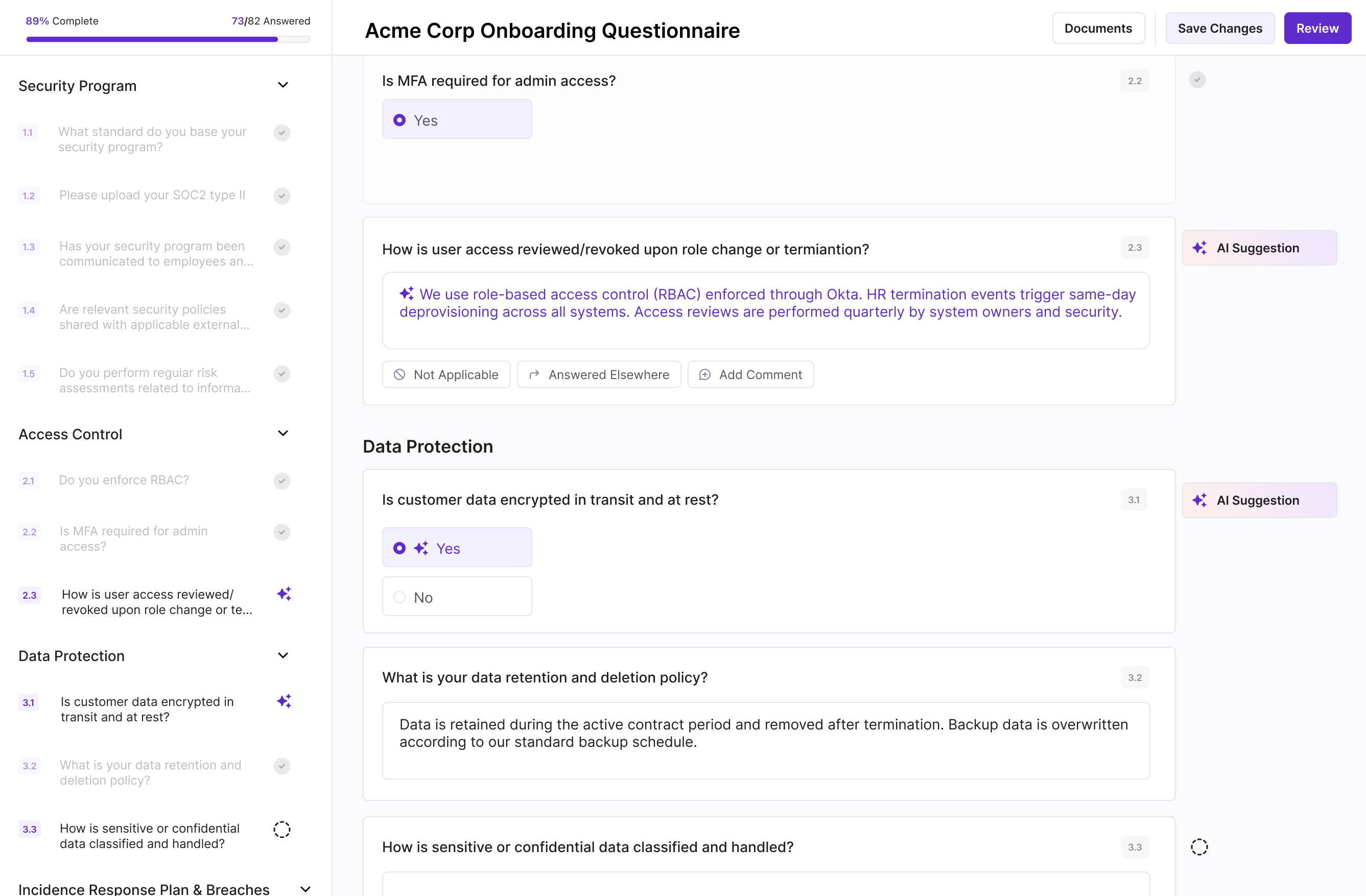
Image 1 / 1
Founding Story
Public material identifies Nick Gavin as co-founder and CEO. A reproduced team announcement names Steven Jiang and Tony DiPadova alongside its author in the original pitch to NFX’s James Currier. The founders’ original introductions and ownership split remain unclear. Two dated founder interviews were unavailable. [3] [4] [12]
An early company hiring brief described custom AI helpers across procurement, supply chain, marketing, and analytics. It emphasized preparing enterprise data for AI, with a team drawn from Palantir and Benchling. Later documentation focused on third-party risk management. That progression shows a narrower customer workflow emerging from a broad enterprise-data premise; its precise pivot date is unknown. [5]
Timeline
- 2023: NFX records Clarative’s founding year. [1]
- September 2024: Plug and Play promoted Clarative in an enterprise AI showcase in Chicago. [6]
- July 2025: A company product update described reports connecting vendor monitoring to contractual service commitments. [7]
- By October 2026: K5 listed an OpenAI acquisition, and the team’s announcement described joining OpenAI’s deployment engineers. No reliable closing date or consideration was established. [2] [3]
What They Built
Clarative’s documented workflow began with a vendor and an assessment playbook. A risk manager could define requirements, collect a questionnaire and supporting documents, then review suggested findings against those requirements. The designer’s case study shows AI suggesting vendor answers and citing evidence during assessment review. Reviewers could check what supported a finding before accepting it. [8] [9]
The product also tracked events after onboarding. Its risk-event documentation describes outages, security breaches, and other vendor issues receiving an AI-assigned risk level. Users could resolve or dismiss an event, request verification from a business owner, and leave an activity trail. This connected periodic assessments to ongoing operations. [10]
Market Position
Target Customers
The documented buyers were third-party risk managers, IT teams, and compliance specialists, particularly in financial institutions and insurance. Clarative addressed repeated evidence review and continued vendor oversight. Its documentation also offered a DORA guide; that positioning does not establish that using the software satisfied a legal obligation. [8]
Market Size
The reviewed evidence does not establish Clarative’s addressable spending, contract values, or customer count. A market-size figure would add false precision.
Competition
At an industry demo day, Clarative appeared alongside Certa, Sayari, Coverbase, Bitsight, ProcessUnity, and other risk tools. The lineup places Clarative among assessment and risk-monitoring tools with overlapping buyers. Clarative’s specific product emphasis was joining assessment evidence with operational monitoring. [11]
Business Model
The hiring brief describes founder-led customer discovery, enterprise sales, pilots, and customer success. That supports a direct enterprise sales model. Public prices, revenue, gross margin, and funding totals were not established. The delivery work required to connect customer data could materially affect economics, but its cost cannot be measured from these sources. [5]
Cymate’s customer testimonial identifies Gavin as Clarative’s co-founder and quotes him: “That's why we chose you - we're not in the set and forget mode. We need a partner”. The testimonial supports a relationship with an outbound-sales agency, but gives no attributable pipeline or revenue result. [12]
Traction
Founding designer Regina Yan reports a 75% reduction in due-diligence assessment time and 100% early-adopter retention. These are the designer’s project results. The page does not provide cohort size, measurement period, or an independent audit. They support evidence of customer use, with limited grounds for extrapolation. [9]
Post-Mortem
Enterprise context connected the product choices
Clarative’s strongest documented mechanism was the link between evidence and customer-specific rules. A model could draft an answer; the product still needed to know which document applied, which control mattered, and who should review the result. The designer’s emphasis on source citations and the product’s verification requests made those dependencies visible. This is an interpretation of the documented workflow, rather than proof that it caused the OpenAI transaction. [9] [10]
The transition reveals less about standalone economics
The team announcement connects Clarative’s experience to OpenAI’s enterprise deployment work. K5’s acquisition label corroborates an exit, but neither source establishes which assets transferred or the return to investors. The record cannot support a failure diagnosis, an acqui-hire-only legal classification, or a claim that customers lost access on a particular date. Current independent product availability also remains unverified. [2] [3]
Key Lessons
- Clarative’s move from broad AI helpers to vendor oversight gave its context tools a concrete customer job. A broad technical capability still needs a defined workflow.
- Clarative’s cited findings and verification requests made review part of the product. Evidence collection and a reviewer’s decision require distinct states.
- Clarative’s reported customer results need their missing cohort and measurement context before they can support claims about repeatable economics.
Sources
- NFX company profile
- K5 Global portfolio
- Team transition announcement reproduced in LinkedIn activity
- Third Party Risk Association panel announcement
- Clarative founding GTM role
- Plug and Play enterprise AI showcase
- Clarative compliance reporting update
- Clarative documentation overview
- Regina Yan’s due-diligence case study
- Clarative risk-event documentation
- Tony DiPadova’s product and industry-event posts
- Cymate customer testimonials