Overview
Context.ai built analytics and evaluation tools for companies making conversational AI products. Founded in London in 2023, it helped product teams understand what users wanted from their conversations and where an AI application disappointed them. Its initial customers included Cognosys, Lenny's Newsletter, and Juicebox. [1]
The useful insight was that a conversation needs a different measurement system from a sequence of clicks. Context.ai expanded into evaluations and private deployments before its team joined OpenAI in April 2025. The founders continued working on evaluations inside the model company. [2]
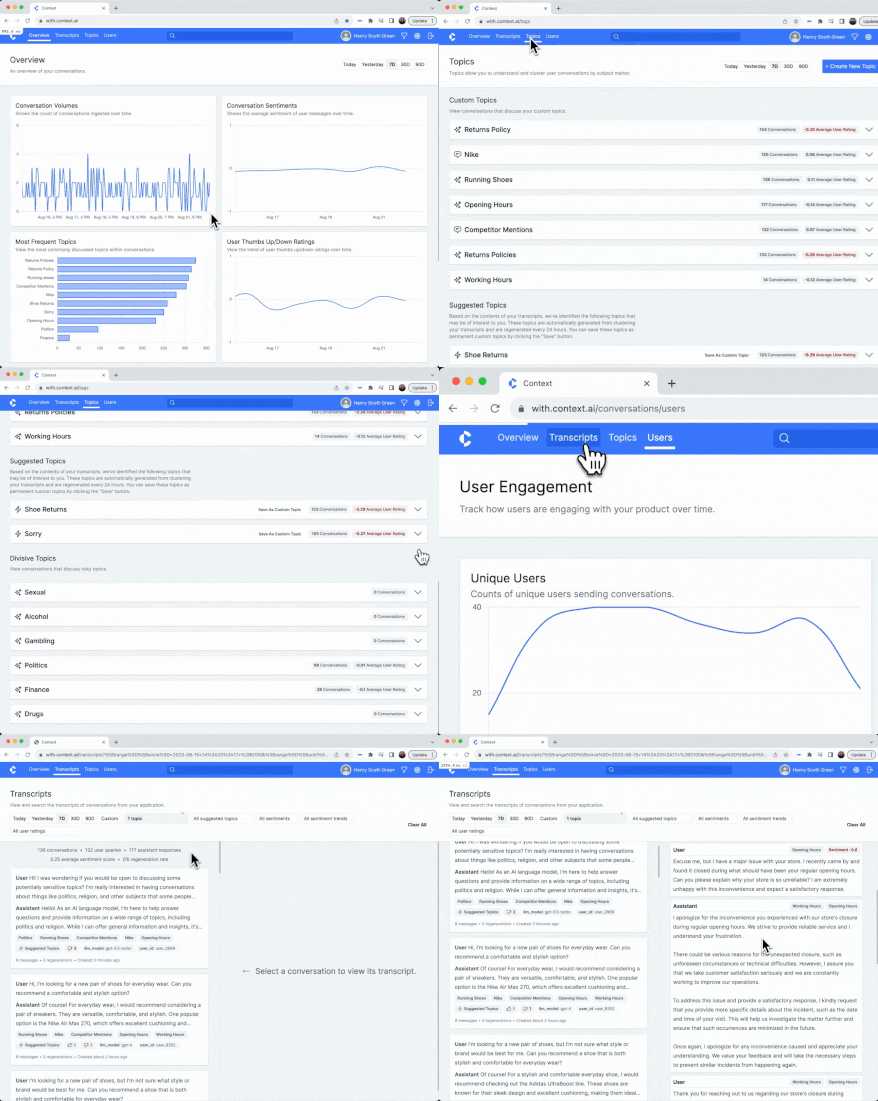
Image 1 / 1
Founding Story
Henry Scott-Green and Alex Gamble studied computer science together at University College London from 2013 to 2016. Their shared projects included an application for cancer patients at Guy's and St Thomas' NHS Foundation Trust. Scott-Green then spent seven years in product management at Google. Gamble completed a machine-learning master's at Cambridge and spent six years at Google as a software engineer. They reunited to explore startup ideas in early 2023. [3]
Their launch announcement connected those backgrounds to a concrete measurement problem. Scott-Green said, "It's hard to build a great product without understanding users and their needs." Gamble explained, "The current ecosystem of analytics products are built to count clicks." These remarks describe the gap they chose: interpreting unstructured conversations rather than tracking another button press. [1]
Investor Tomasz Tunguz described earlier work on YouTube conversations and safety, and Google's APIs. That experience mattered because the proposed buyer was a product team trying to interpret behavior, rather than a research lab comparing benchmark scores. [4]
Timeline
- Early 2023: Scott-Green and Gamble began exploring startup ideas together. [3]
- August 2023: Context.ai launched with $3.5 million in funding co-led by GV and Theory Ventures. [5]
- November 2023: The team added pre-launch evaluations, retention analytics, manual ratings, and embeddable analytics. It also announced CodebaseChat as a side project. [6]
- September 2024: A founder demo showed configurable conversation categories, transcript inspection, feedback signals, and self-hosted analytics. [7]
- January 8, 2025: Scott-Green published an account of the operational difficulties of serving self-hosted enterprise customers. [8]
- April 15, 2025: The team announced it was joining OpenAI. TechCrunch reported that products would wind down; deal terms were undisclosed. [2] [9]
What They Built
Context.ai ingested conversation transcripts and organized them into topics. A product manager could see common requests, compare satisfaction across categories, then inspect the conversations behind a weak result. The original interface displayed conversation volume, sentiment, frequent topics, and user ratings. LangChain integration helped developers send the underlying data. [4]
The later founder demo made the intended workflow explicit. Customers defined a taxonomy, or set of categories. Context.ai also suggested clusters that might reveal unexpected uses. Teams could inspect a transcript, apply a rating, and pass a problem to a colleague. Sentiment, thumbs-up feedback, and conversion events offered different signals about the same interaction. These were examples in a demonstration, not disclosed customer performance results. [7]
Evaluations added a second job: test an application before users encountered it. November's release also brought alerts and retention analytics. This moved Context.ai toward a loop connecting observed problems to changes that could be tested. [6]
Market Position
Target Customers
The initial audience was teams building products around large language models. Named customers supplied evidence of adoption, but public announcements did not disclose contract sizes or distinguish every paying account from a design partnership. Context.ai also reached founders through a GV event in London featuring speakers from Synthesia and Google DeepMind. That establishes an ecosystem relationship, not a commercial partnership with those companies. [5] [10]
Market Size
No credible company-specific market estimate was found. The customer need was observable; its addressable revenue was not. Counting every company using a language model would overstate the number prepared to buy a separate analytics product.
Competition
The important boundary was between independent measurement tools and the platforms running AI applications. By October 2025, OpenAI offered datasets, trace grading, and other evaluation features. Its June 2026 update announced that Agent Builder and Evals would close on November 30, 2026. This sequel shows that platform availability can change again after an acquisition. It does not prove Context.ai created those products. [11]
Independent competition remains substantial. Langfuse currently offers its core self-hosted platform for free, including evaluation and datasets. A new company cannot justify its existence merely by offering private hosting or another evaluation dashboard. [12]
Business Model
Context.ai sold enterprise software and supported private deployments when customers required their conversations to remain within customer-controlled infrastructure. Scott-Green's January essay described that choice as a response to repeated enterprise requests. It also identified version drift, customer-specific infrastructure, slower debugging, and deployment delays as costs. [8]
The disclosed funding round was $3.5 million. Public evidence reviewed here does not establish revenue, gross margin, retention, or acquisition consideration. Funding and named customers therefore support a history of financed product development, not a claim of commercial scale. [5]
Traction
Cognosys, Lenny's Newsletter, Juicebox, and ChartGPT appeared in the founder's funding announcement. Their names show early use across different AI applications. No comparable later customer count or audited usage series was found. [5]
Post-Mortem
A valuable problem can outgrow its first product
When announcing the move to OpenAI, Scott-Green described "a few pivots along the way." The observed progression ran from conversation analytics to evaluations and enterprise deployment requirements. The team transfer preserved its work on measurement while the independent product ended. [2]
The structural tension is an inference: conversation data makes analytics useful, but the same sensitive data can make a shared hosted service difficult to sell. Private deployments answer that objection while adding support work. In January, Scott-Green wrote that Context.ai had implemented self-hosting after repeated requests, then encountered operational headaches. This supports the tension; it does not establish that support costs caused the acquisition. [8]
The strongest alternative explanation is straightforward opportunity. OpenAI wanted evaluation expertise, and the founders chose to work there. Public sources do not disclose their negotiating position, alternatives, runway, or investor returns. A claim that a platform crushed the startup would exceed the evidence.
A later company uses the domain
The historical domain now identifies Explore Interfaces Inc. in its July 2026 terms. The present website describes a different company. This history covers Scott-Green and Gamble's London startup, which operated before the team joined OpenAI. [13]
Key Lessons
- Context.ai identified a real change in product measurement: transcripts carried information that click analytics missed. Its interface connected aggregate topics to inspectable conversations.
- Enterprise privacy requirements affected delivery costs as well as security claims. Context.ai's founder documented the operational burden of supporting software inside customer environments.
- Context.ai's move into evaluations followed work on production analytics. Observing failures and testing proposed fixes were related customer jobs, though public evidence does not reveal their commercial contribution.
- The team acquisition and product wind-down had different outcomes. Without terms or operating figures, the useful lesson is about transferable expertise and customer continuity, not a verdict on financial success.
Sources
- Company launch release, reproduced by Citybiz, August 31, 2023.
- Henry Scott-Green's team announcement, April 2025.
- UCL interview with both founders, undated.
- Tomasz Tunguz's investment announcement, August 30, 2023.
- Founder funding announcement, August 2023.
- Founder November product update, November 2023.
- Founder product demonstration, September 2024.
- Founder essay on self-hosted deployment, January 8, 2025.
- TechCrunch team-transfer report, April 15, 2025.
- GV founder-session announcement, 2023.
- OpenAI AgentKit announcement and retirement update, October 6, 2025; updated June 3, 2026.
- Langfuse self-hosted pricing, checked October 23, 2026.
- Current domain's customer terms, July 6, 2026.