Overview
Coolest Cooler raised $13,285,226 from 62,642 Kickstarter backers in 2014 for a cooler with a blender, speaker and charger. The product reached many customers, but the business closed in December 2019 with thousands of rewards still unfulfilled. Its campaign demonstrated demand at a price that did not cover the eventual cost of delivery. [1], [3].
The case is about an obligation that grew faster than the company’s capacity to finance it. Later retail sales were meant to pay for earlier rewards. That created a conflict between the people whose pledges launched the product and the new customers whose purchases could fund further shipments. The 2017 Oregon settlement formalized that dependence on future net income. [4].


Image 1 / 2
Founding Story
Portland inventor Ryan Grepper created the product. An unsuccessful 2013 campaign preceded the much larger 2014 relaunch; BBB records the operating business’s start in 2014. These dates describe different milestones. The company was Coolest LLC, while Coolest Cooler was its product and public brand. [6], [5].
The proposition was easy to demonstrate: one wheeled object could anchor an outdoor gathering. Grepper told TIME, “I just want to make the coolest cooler out there”. TIME included it in its 2014 inventions list. That attention helped make the product recognizable, but did not validate the production budget. [7].
Grepper’s campaign FAQ attributed the relaunch to summer timing, supporters from the first attempt, design changes and more focused marketing. The same FAQ said only one prototype existed in August 2014. Manufacturing, weight and component choices were still being finalized while people committed money. [2].
Timeline
- 2013: The first crowdfunding attempt did not reach its goal. [6].
- July–August 2014: The relaunch raised $13.285 million against a $50,000 goal. A common reward tier required $185 plus $15 US shipping. [1], [2].
- February 2015: The FAQ’s intended shipping start passed without completing fulfillment. [2].
- 2016: The company sought additional funding while selling through Amazon. Some backers paid another $97 for accelerated delivery. [8], [9].
- June 2017: Coolest and Grepper entered an Oregon Department of Justice settlement governing delivery groups, a backer fund and contingent $20 payments. [4].
- August 2018: Coolest announced the Vibe soft cooler in two sizes. [11].
- December 2019: Grepper announced the closure, attributing the final constraint to higher tariffs after earlier production and financing problems. [3].
What They Built
The cooler combined ordinary cold storage with powered and mechanical accessories. Its lid carried a blender; a removable Bluetooth speaker, USB charging, light, plates, knife and bottle opener extended the outdoor-party idea. This was a shipped physical product, rather than an unbuilt campaign rendering. [12].
A 2016 GeekWire hands-on followed backer Josh Belzman, who paid the additional $97 and received his unit. The blender stopped after use, then worked again after charging. The company sent a replacement battery, speaker and shirt. That episode documents both a functional product and a support response. It cannot establish a fleet-wide failure rate. [9].
Fictiv’s 2018 disassembly makes the manufacturing burden visible. The speaker holder alone involved several molded pieces; the plate and knife door required more housings, fasteners and mechanisms. Its authors identified tooling and assembly complexity as likely cost drivers. They did not publish Coolest’s actual supplier invoices or prove that one component caused the insolvency. [12].
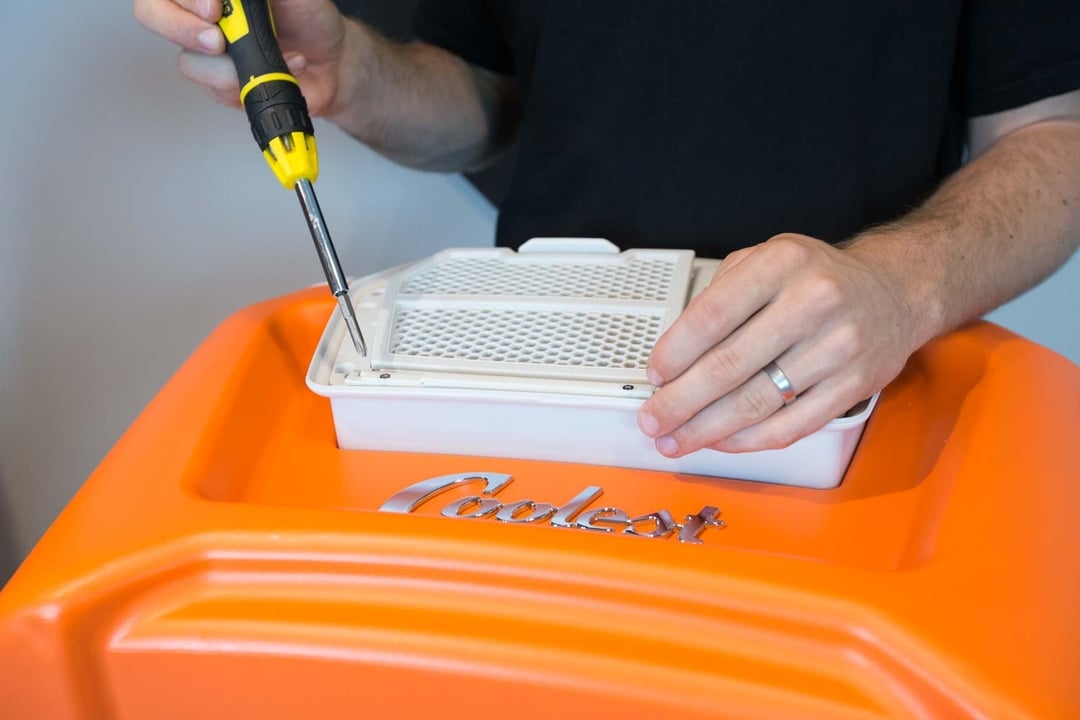
The product later became more modular. A 2019 review described a $249.99 base cooler, a $399.99 blender configuration and a $349.99 solar configuration. The supplied review sample included the blender, while the solar option was described separately. Those are historical prices and configurations. [13].
Market Position
Target Customers
The original customer was an outdoor host who valued carrying several party functions together. Demonstrations could communicate that benefit in seconds. The campaign attracted enthusiasts, but promised a manufactured object with shipping, support and replacement-part obligations.
The 2018 Vibe launch addressed shorter outings when a full-size cooler was excessive. Its magnetic lid, mounting system and included accessories extended the same convenience proposition into a separate soft cooler. [11].
Market Size
The campaign total measures pledges, not equity funding, recurring revenue or the whole premium-cooler market. Nor does 62,642 equal the number owed one cooler: the settlement identified 60,439 confirmed backers and recorded 38,979 fulfilled commitments at signing. Different dates and eligibility rules prevent treating those counts as interchangeable. [1], [4].
Competition
A normal cooler plus separate appliances could perform many of the same jobs, with less integration. The integrated product saved packing decisions but concentrated cost, weight and repair dependence in one purchase. Current RovR accessories demonstrate an alternative approach: its catalog separately lists a $29.99 cup holder and $39.99 prep board. The prep board’s detail page says backordered, so a listing does not prove immediate availability. [14], [15].
Business Model
The initial promise sold future rewards before the full delivered cost was known. By 2017, Grepper reported roughly $235 to make and ship each remaining backer cooler after development and tooling costs. This was his stated fulfillment cost, not a verified complete lifetime cost per unit. He hoped supplier changes would reduce it. [10].
He explained the resulting dependence directly: “we can only ship more Backer rewards with money made by selling more coolers.” The retail channel was intended to generate profit for backer fulfillment. Customers waiting for years could reasonably see new retail shipments as competing with their rewards, even when management described those sales as necessary. [10].
The settlement required at least 10% of net income from cooler sales to enter a fund for one remaining group. It also imposed delivery duties for specified complainants and Oregon residents, and a $20-per-cooler fallback for eligible unfulfilled Group C backers at the three-year mark. It expressly denied an admission of violation. The fallback was not a full campaign refund or proof that every eligible person received payment. [4].
Outcome and evolution
The company closed after attempting retail sales, factory changes, borrowing and new products including the Solar Lid and Vibe. Grepper cited tariffs rising to 25% as the final obstacle. His account also acknowledged that production and shipping cost more than the original pledges and that debt financed continued work. The earlier funding shortage and settlement show that the problem preceded the tariff increase. [3], [8].
The Vibe launch is independently documented by the company’s 2018 release. The Solar Lid appears in contemporary product coverage and the founder’s final letter. No verified successor operating company or current owner-backed support program emerged from this review. A surviving promotional-products listing is insufficient evidence of new manufacture or continuing warranty support. [11], [13], [16].
Key Lessons
- Price the delivered obligation before scaling demand. More pledges increase the amount owed when each promised unit costs too much.
- Treat accessory mechanisms as production work. Small molded parts, fasteners and assembly steps can accumulate behind a simple demonstration.
- Separate a rescue plan from a funded commitment. Future retail profit is uncertain; earlier backers cannot spend a projection.
- Keep the chronology of external shocks. Tariffs may worsen an exposed business without explaining earlier shortages and delays.
Sources
- Original campaign
- Original campaign FAQ
- Shutdown report and complete founder email
- Oregon assurance of voluntary compliance
- BBB company profile
- Campaign launch history
- TIME founder interview and invention feature
- Early cash shortage
- Customer delivery, actual use and support response
- 2017 founder update
- Vibe launch
- Physical teardown
- Modular configurations hands-on
- Current RovR accessory catalog
- Current RovR prep board
- Surviving Coolest promotional-products listing