Overview
Hopin turned conferences into online venues where people could watch a stage, join small groups and meet other attendees. Founded by Johnny Boufarhat in 2019, it reached pandemic demand with a product designed for interaction beyond a video call. Its later decline exposed the risk of building a large, broad software company around an exceptional period of compulsory online attendance. [1] [3]
Two transactions divided the business. RingCentral bought Events and Session assets in July 2023 for $15 million upfront, with up to $35 million in additional performance-based consideration. Bending Spoons acquired the remaining StreamYard group in April 2024. As checked October 27, 2026, RingCentral Events and StreamYard still offered products. The events sale price cannot measure the entire company's investor recovery. [7] [9] [10] [11] [13]

Image 1 / 1
Founding Story
In a November 2021 HBR interview, Boufarhat said: “I spent about two years kind of stuck in the house.” [2]
The early proposition combined access with encounters that ordinary broadcasts missed. Boufarhat told Seedcamp: “Connecting people is at the core of what we do at Hopin.” The investor led a pre-seed investment in summer 2019 and described its own use of the product for summits and workshops. These were early users with both a distribution network and an investment interest. [1]
Dave Schools, Hopin's first hire, later described the team's formation. An introduction through Online Geniuses founder David Markovich connected him with Boufarhat in December 2018. They spoke through 2019, and Schools joined full time that September. His account helps separate the solo product's development from the company's later launch and growth milestones. [16]
Boufarhat was a self-taught programmer whose UPPSTART profile names earlier projects Quiin, Readory, UN1verse and Multiplex. The surviving profile supports those names, but this review does not establish the operating histories of every project. [14]
Timeline
- 2019: Seedcamp backed Boufarhat's early product; Schools joined in September. [1] [16]
- February 2020: Hopin announced a $6.5 million seed round. [1]
- June 2020: A $40 million Series A supported capacity expansion; Hopin reported more than 16,000 organizations using the platform. [3]
- January 2021: Hopin announced its $250 million cash-and-stock acquisition of StreamYard. [4]
- August 2021: A $450 million Series D took reported funding since February 2020 above $1 billion. [5]
- 2022: Hopin reduced staff in February and July as demand and operating expectations changed. [6]
- July 31, 2023: RingCentral completed its Events and Session asset purchase. [7]
- April 2024: The remaining StreamYard business joined Bending Spoons. [9] [10]
What They Built
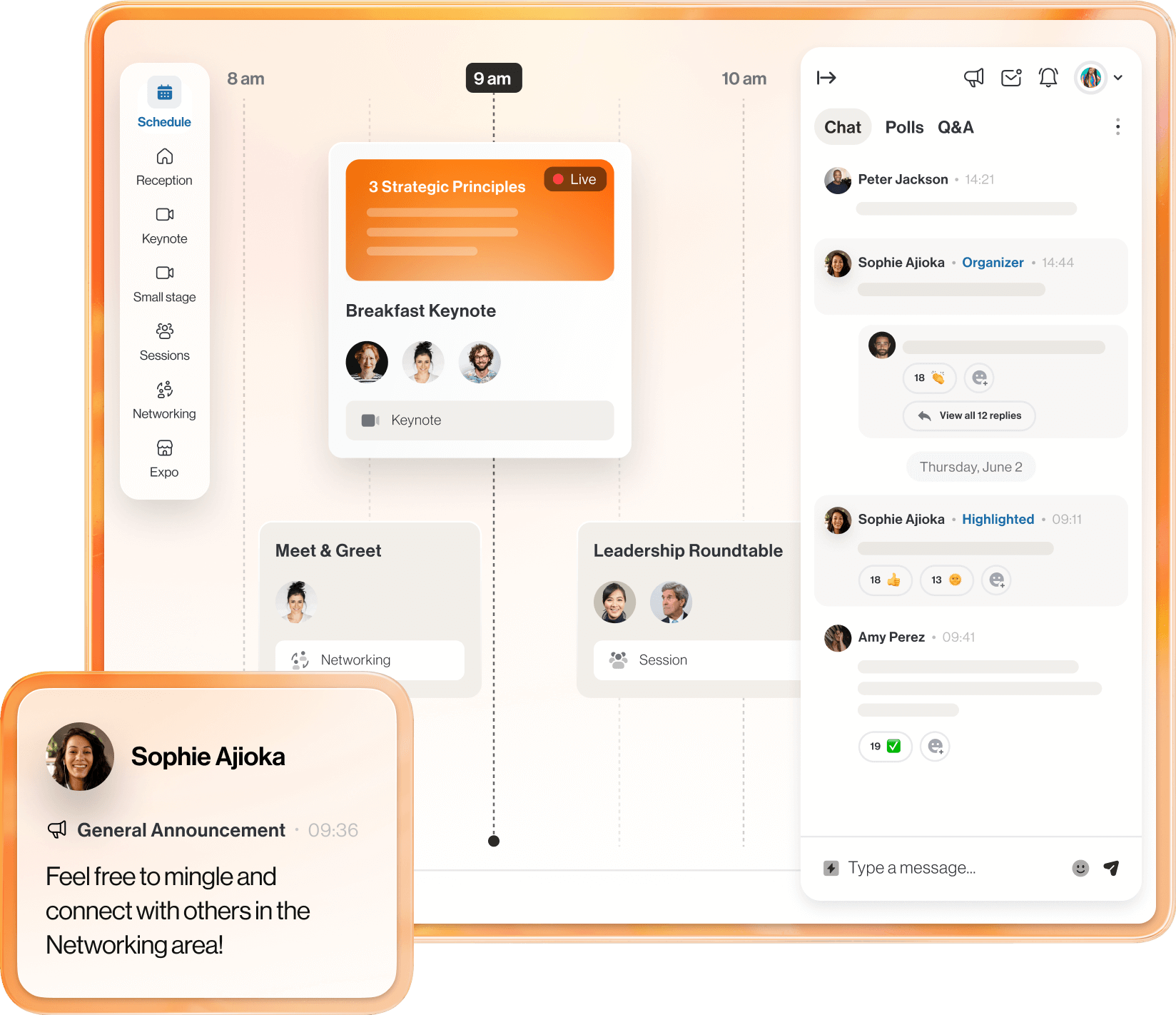
Hopin organized an event into distinct spaces. A main stage carried presentations. Group sessions let attendees speak together. One-to-one networking reproduced introductions, while expo booths gave sponsors a place to meet participants. Organizers could create an event, register an audience and move participants between these spaces. Organizers brought an audience to each event; Hopin supplied the venue. [1] [3]
Hopin then bought complementary capabilities. StreamYard added browser-based production and distribution to social platforms, with branding, guests and audience comments. It also remained a standalone product. The acquisition announcement reported more than $30 million in StreamYard annual recurring revenue by the end of 2020; that was an annualized revenue measure, not audited annual profit. [4]
Other acquisitions widened the scope further. Boomset added onsite tools such as kiosks and badges. Attendify added registration and engagement capabilities; Streamable brought video hosting, and Jamm brought video collaboration. The 2021 funding release describes a multi-product ambition. A larger feature set also meant more products to maintain and more customer jobs to reconcile. That operational consequence is an inference, not a disclosed integration-cost figure. [5]
The current successor still reflects the original venue idea. RingCentral's marketing shows schedules, stages, networking and expo navigation. It now offers integrations, reporting and content reuse alongside event delivery. These continuing capabilities matter when judging whether a new entrant has found an abandoned market. [12]
Market Position
Target Customers
The initial audience included small organizers and communities. Schools describes a rapid move toward business customers and enterprise sales when larger conferences adopted Hopin. That shift brought bigger budgets but also production and support expectations. An event cannot quietly retry tomorrow when speakers and attendees have arrived. [16]
Named users help establish the breadth of demand. Hopin's June 2020 release named the United Nations, Dell and The Wall Street Journal. UN Tourism independently identifies Hopin as the platform for its June 2020 Global Compact Leaders Summit material. UPPSTART's founder page also confirms the conference used Hopin. Customer names establish usage, without proving retention or a profitable contract. [3] [15] [14]
Market Size
The pandemic created a large audience with little choice about meeting online. By August 2021, Hopin reported more than 100,000 organizations and over 800 employees across 47 countries. These measures demonstrate reach and organizational expansion. They do not reveal how many organizations paid, renewed or required the full platform after physical venues reopened. [5]
No comparable paid-customer cohort or events-only revenue series was available in the reviewed sources. Treating the full conference industry's spending as Hopin's addressable software revenue would overstate the opportunity.
Competition
A conference venue competes on interactions, production and organizer workflow. General meeting tools compete on familiarity and existing distribution. Hopin could justify more depth during lockdowns, but organizers later regained physical venues and could choose simpler online formats. The 2022 staff reductions are consistent with that pressure; they do not establish a single cause. [6]
The current baseline includes the successor itself. RingCentral Events is sold standalone, starting at $99 per organizer monthly with the stated billing commitments. It advertises unlimited events and registrations. StreamYard offers a free plan and paid individual tiers, with business pricing handled separately. An affordable standalone event tool is already available; a new company needs a narrower customer problem than access to video or networking features. [11] [13]
Business Model
Hopin sold software to organizers and expanded into a portfolio of event and video products. The StreamYard purchase added an established subscription revenue stream as well as production technology. That distinction matters: portfolio growth could include purchased recurring revenue alongside growth in Hopin's original events business. [4] [5]
Hopin's financing created room for acquisitions and fast hiring. Its August 2021 release reported a $450 million round and more than $1 billion raised since February 2020. Contemporary reporting put that round's valuation at $7.75 billion. Neither funding nor valuation is revenue. [5] [17]
Axios reported that selected later investors could recover roughly half their outlay. Final shareholder recoveries were not verified. [18]
Traction
The growth was tangible. Hopin reported more than 850,000 users and over 16,000 organizations by June 2020. By early 2021, StreamYard's acquisition announcement described over five million Hopin users and 100,000 organizations hosting events. The acquired streaming business separately reported over 100,000 paying customers. These are different products and different measures; adding them together would obscure the business. [3] [4]
Outcome and evolution
The strongest explanation combines a demand shock with scope and cost decisions. Hopin scaled for a period when online events were compulsory, while assembling a broad platform through acquisitions. As that environment changed, it cut staff repeatedly. Skift reported a 12 percent reduction in February 2022 and roughly 29 percent in July. [6]
Continuing demand provides a counterweight to this explanation. Buyers still wanted the technology. RingCentral completed its purchase of specified technology assets and customer relationships, then continued the product. The $15 million upfront payment and up to $35 million contingent payment apply to that asset package, not Hopin's cash or remaining businesses. In the acquisition announcement, Boufarhat said: “We’re excited about RingCentral’s plans to grow and invest in the Events and Session platforms”. Whether all performance-based consideration was earned is unverified here. [7] [8] [11]
The remaining company was in the process of becoming StreamYard Top Corp when Bending Spoons announced its acquisition agreement in April 2024. That announcement names StreamYard, Streamable and Superwave. Bending Spoons' current portfolio confirms StreamYard was acquired in April 2024, providing a later completion check beyond the original agreement. This review does not establish separate current availability for every minor product in that group. [9] [10]
Key Lessons
- Hopin built interaction around a stage when organizers urgently needed it. The useful product insight preceded the pandemic, but compulsory adoption was a weak basis for forecasting normal demand.
- Hopin bought StreamYard as both production infrastructure and a standalone subscription business. Keep acquired revenue separate when judging the original product's traction.
- Hopin expanded into onsite events, hosting and collaboration while hiring quickly. A broad platform raises the cost of changing direction when customer behavior shifts.
- Hopin's two sales transferred different assets to different owners. Compare like-for-like financial measures before turning a valuation and an asset price into an investor return.
Sources
- Seedcamp announces Hopin seed round
- Johnny Boufarhat interview transcript
- Hopin Series A announcement
- Hopin acquires StreamYard
- Hopin Series D company release reproduced by citybiz
- Hopin cuts staff again
- RingCentral 2023 second-quarter Form 10-Q
- RingCentral acquisition announcement
- Bending Spoons StreamYard acquisition announcement
- Bending Spoons current portfolio
- RingCentral Events pricing
- RingCentral Events current product
- StreamYard pricing
- UPPSTART 2020 founder speaker profile
- UN Tourism Global Compact Leaders Summit 2020
- Dave Schools on early Hopin marketing
- Hopin Events and Session sale context
- Axios on investor cash returns