Overview
Luxe let drivers summon someone to park their car and return it later. Founded in San Francisco in 2013, it turned an ordinary parking purchase into a coordinated service. Its consumer operation ended in 2017. Volvo Cars then bought its platform, technology, key staff, and other assets.[1][9][10]
The difficult assumption was that a denser network would make personal valet service affordable. More customers also required paid staff, garage capacity, and responsibility for cars. The software retained value after the original consumer model stopped working.
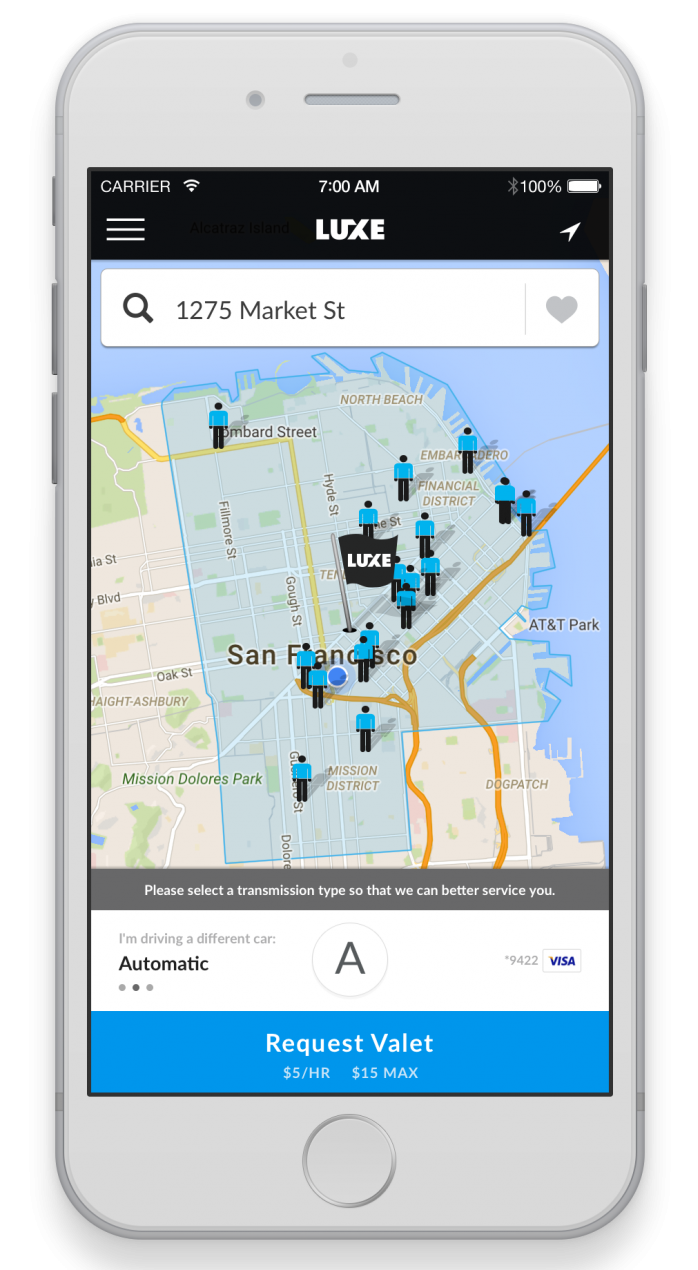
Image 1 / 1
Founding Story
Curtis Lee and Craig Martin started Luxe in 2013. Lee had worked in product roles at Google, Zynga, and Groupon. In his October 23, 2015 Forbes interview, he said: “I previously worked with my cofounder Craig Martin at Zynga.” Martin was the engineer; Lee handled product. A beta began in April 2014, before the public October launch.[1]
Launch coverage also named Greg Zanghi as a co-founder.[2]
Lee's own parking difficulties suggested the service. Early restaurant promotion brought occasional users; commuters offered a repeated habit. In the same interview, Lee said: “The key was commuters”. That distinction shaped distribution, but frequent use alone could not establish profitable delivery.[1]
Timeline
- 2013–October 2014: Founding, a private beta, and public launch.[1]
- March 3, 2015: Luxe announced $20 million in Series A financing led by Venrock, with Redpoint, and an Android release.[3]
- July 2015: Luxe moved its valets from contractor status to employment.[6]
- January 1, 2016: Its Philadelphia closure took effect; Boston also paused.[7]
- April 7, 2016: Hertz announced its lead investment in a concluded Series B and planned collaboration.[4]
- May 2016: Tesla owners in San Francisco and New York received a parking-and-charging offer.[13]
- May 25, 2017: The announced final San Francisco door-to-door service date.[8]
- September 8, 2017: Volvo announced the asset and key-staff purchase.[10]
- March 2020: Volvo linked its new service-delivery product to the acquired Luxe intellectual property.[11]
What They Built
Drivers entered a destination before arriving. A named attendant met them, took the vehicle to a secure facility, and later returned it within the service zone. Philadelphia's launch described a half-hour return notice, app payments, overnight charges, referrals, and defined operating hours. This was a physical service with a mobile interface, not merely a map of available spaces.[5]
At launch, AQ, Stones Throw, and Alta CA helped promote the service. Contemporary reporting describes leased garage spaces and the need to coordinate two moving people, the customer and attendant. A car could be returned somewhere different from its original handoff.[18]
Additional services used the time a car was already in custody. A 2016 Tesla pilot added charging in San Francisco and New York.[20] Electrek later reported an owner email, a $15 charging supplement, and monthly options. It did not establish a completed dashboard integration or nationwide availability.[13]
Market Position
Target Customers
The strongest early use case was a driver making a recurring urban trip. A commuter valued predictable arrival and retrieval; a garage operator supplied space; an attendant supplied time. All three had to fit the same price and schedule. Occasional restaurant visits could introduce the product without producing the same frequency.
Market Size
A city's parking expenditure is broader than demand for paid vehicle collection. Luxe needed customers willing to cover both a space and the added handling. No independently verified serviceable-market estimate or complete revenue series was recovered. Downloads and monthly growth cannot supply those missing measures.
Competition
Drivers could park themselves, buy a monthly garage pass, reserve a space, or use a conventional venue valet. A fixed stand concentrated handoffs; door-to-door service offered more freedom but required attendants to move between addresses. That operational difference mattered more than whether both services had an app.
Today's alternatives demonstrate continuing demand without validating Luxe's cost structure. SpotHero reported its 100 millionth parking transaction in December 2025 and operations in over 400 cities. This is a company-reported cumulative milestone, not annual revenue or Luxe's available market.[14]
Business Model
Luxe charged for parking and optional services, with pay-per-use and subscriptions. In Philadelphia, August 2015 coverage listed $5 per hour and a $20 daily maximum, plus overnight charges. Those local, dated prices should not be combined with a different city's rate or the older screen above.[5]
The March 2015 company announcement reported 90% monthly customer growth and 97% monthly transaction growth. Hertz's April 2016 release described different growth measures and a frequently used service. These promotional figures cover different dates and definitions; they are not a consistent audited cohort series.[3][4]
Reuters later reported approximately $75 million raised and a roughly $160 million valuation. These are attributed financing measures, not cash remaining, sales, or the eventual sale price. No complete audited cost or revenue series establishes Luxe's final operating margin.[9]
Traction
The service extended beyond a demonstration. The Philadelphia launch included a defined service area, a referral offer, and local restaurant enthusiasm. By December 2015, however, a customer notice announced that market's suspension. Geographic expansion and retrenchment appeared within months of each other.[5][7]
Hertz supplied more than a financing headline: its release described a concluded investment, a board seat for CEO John Tague, and plans for joint services. It also called Luxe's use frequent and reported hundreds of thousands of downloads. Those statements establish investor commitment and management's claims. They do not verify profitable transactions or completion of every proposed partnership service.[4]
Post-Mortem
The spring consumer closure preceded the September asset transaction. June reports of possible Uber asset talks were not a completed purchase.[19] Volvo's own September announcement identifies platform technology, data scientists, app developers, and engineers joining its digital organization. It does not describe a purchase of every share or disclose a price.[10]
In March 2020, Volvo explicitly connected Volvo Valet to the 2017 intellectual-property purchase. Retailer employees collected customers' cars for maintenance, supplied loaners where arranged, and documented vehicle condition. This placed the technology inside an existing retailer relationship, with a different service purpose.[11]
As checked October 27, 2026, Volvo still advertises pickup and delivery at participating retailers. Courtesy vehicles depend on retailer policy and availability. That current offer establishes an asset sequel; it does not reopen Luxe's independent consumer valet network or prove availability at every retailer.[12]
Density could increase obligations alongside demand
In October 2015, Lee expected scale to make “economics get better”. Luxe also tried preferred drop-off points to improve efficiency.[1] A commuter can occupy a space for much of a working day. More bookings do not automatically create more turnovers. Staff time, parking cost, and customer price needed to improve together.
Reuters' September 12, 2017 interviews identified expensive parking capacity, labor, and damage costs across the valet category. Its reported $2–$5 job margins were founders' category accounts before damage, not an audited Luxe margin. Lee told Reuters that another funding attempt “wouldn't have turned out well”. Capital became a constraint after the service economics failed to improve as expected.[9]
Better control added a real operating commitment
The 2015 employment change addressed scheduling, training, and customer experience. Time's interview described the difficulty of covering unpopular hours with contractors. Employment gave management more control; it also required funding the staffed service. The evidence does not isolate that decision as the cause of closure.[6]
Useful technology did not settle the investor outcome
The Volvo purchase and later service challenge a simple product-rejection account. Customers had used Luxe, and its technology supported a different operating model. Reuters attributed its account of unrecovered investor capital to an unnamed person close to Luxe. The undisclosed transaction price and incomplete distribution record prevent a precise recovery calculation.[9][10][11]
Key Lessons
- Repeat use needs a full cost test. Luxe found habitual commuters, but a parked car, attendant time, and damage exposure still had to fit the price.
- A partnership has a defined scope. Hertz committed capital and announced plans. Tesla's offer covered specific cities. Neither established national, profitable delivery.
- Operational control needs funding. Luxe's employment change addressed service consistency. Measure that improvement alongside the cost of reliable staffing.
- Assets can work in another business. Volvo used acquired technology within retailer servicing. Preserve the difference between that continuation and the original investors' return.
Sources
- Forbes: Curtis Lee interview, October 23, 2015
- TechCrunch: October 2014 launch
- Luxe: March 3, 2015 financing announcement
- Hertz: April 7, 2016 investment announcement
- The Philadelphia Inquirer: August 2015 launch
- Time: July 2015 employment change
- Philadelphia Magazine: December 2015 closure notice
- TechCrunch: Customer closure notice
- Reuters: September 12, 2017 retrospective
- Volvo Cars: September 8, 2017 asset purchase
- Volvo Cars: March 31, 2020 Volvo Valet launch
- Volvo Cars: Current Volvo Valet service
- Electrek: Tesla owner announcement, May 20, 2016
- SpotHero: December 1, 2025 milestone
- Summon: Current pricing
- Summon: Current operator software
- Flash: Parkonect valet reporting documentation
- TechDrive: October 24, 2014 launch reporting
- Axios: June 8, 2017 asset talks
- TechCrunch: Reproduced Tesla pilot statement