Overview
Mighty Health was a Y Combinator-backed (Summer 2019) digital wellness company building an all-in-one daily health app for adults 50+. Founded in 2018 by repeat entrepreneur James Li, Stanford/Columbia physician Dr. Bernard Chang, and CTO Felipe Lopes, the company combined joint-friendly exercise programs, personalized nutrition plans, and human coaching into a $29/month subscription. It raised roughly $10.6M across three rounds before being listed as inactive by YC; the exact cessation date is not established.
The available record does not establish the company’s financial failure mechanism. A human-coached product and health-plan sales can create operating demands, but coaching costs, enrollment revenue, burn, and investor outcomes remain undisclosed. Oregon PEBB procurement material recommended Mighty Health for 2025, and Providence’s 2025 benefit guide listed it as a member service. These documents establish a plan-distribution offering, not actual enrollment or recognized revenue. [31] [32]
YC lists Mighty Health as inactive, and its website was unavailable during this review. The exact cessation date, final service availability, and any formal shutdown explanation remain unverified. A staff role ending does not establish those details.
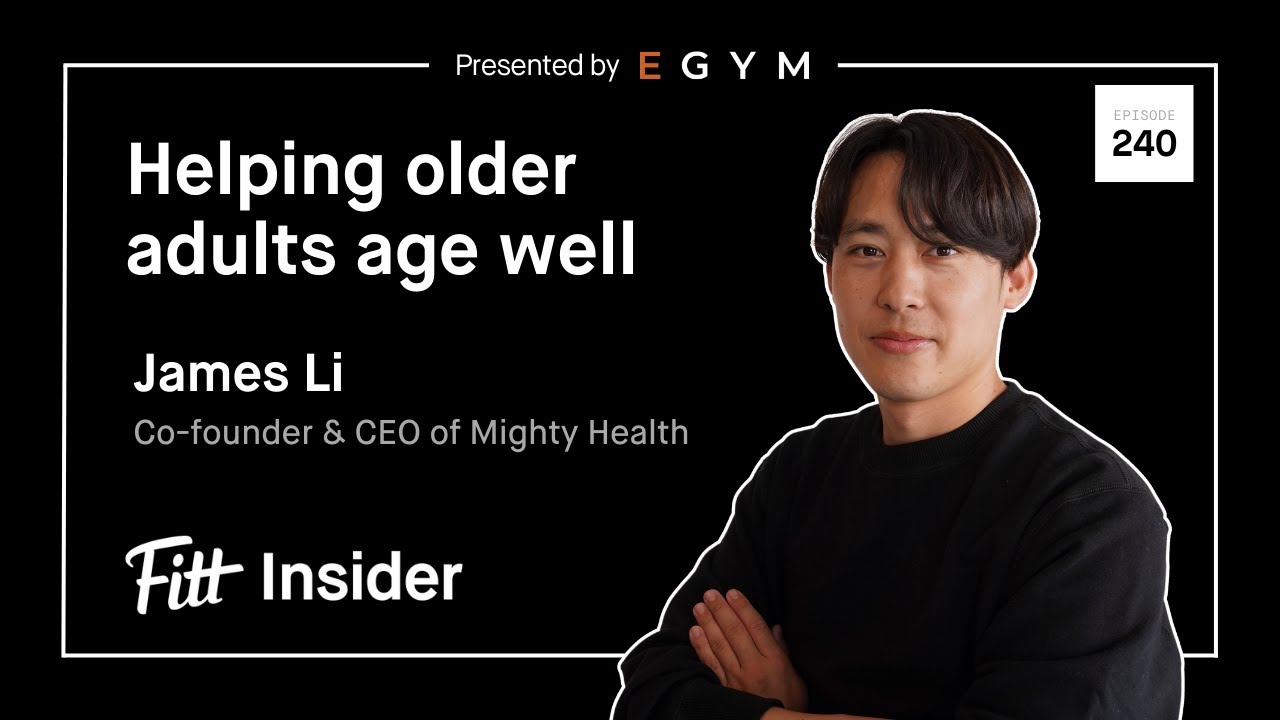

Image 1 / 2
Founding Story
James Li's origin story for Mighty Health begins with a family emergency. His father was rushed to the hospital for emergency open-heart surgery. He survived, but the experience exposed a gap Li hadn't considered: the health and fitness industry had virtually nothing designed for adults over 50 who wanted to stay functional, not just fit. As Li told TechCrunch: "Growing up, we can often think of our parents as invincible — they look after you and take care of you, and you usually don't worry too much about them."[3]
Li was not a typical health-tech founder. He had written speeches for then-Vice President Joe Biden in college and was named Georgetown Entrepreneur of the Year before co-founding EncoreHQ (later Encore Alert), a marketing intelligence platform acquired by Meltwater in 2016.[4] That first exit gave him credibility with investors and a template for what not to do operationally — he later admitted he "put [his] own health on the back burner" during that company, suppressing stress until it "took a huge toll."[23]
The medical credibility came from Dr. Bernard Chang, Vice Chair of Research at Columbia University Medical Center and the youngest-ever emergency department doctor to receive a top-tier NIH grant.[5] Chang holds an MD from Stanford, a PhD in Psychology from Harvard, and later added an Executive MBA from Oxford's Saïd Business School (2023–2025).[29] Felipe Lopes, the third co-founder and CTO, had previously built EncoreHQ alongside Li, giving the founding team a pre-existing working relationship and a prior exit together.[4]
The founding team's composition was unusual: a political speechwriter turned entrepreneur, an academic physician, and a technical co-founder. The research surfaced no information on how the three met or why they chose this specific problem beyond Li's father's surgery. What is clear is that the team brought complementary credibility — Li for fundraising and storytelling, Chang for clinical legitimacy, Lopes for execution.
The initial consumer wellness app later added health-plan distribution. The sources do not establish that older adults could only discover it through insurers.
Timeline
- 2018: Mighty Health founded.[0]
- June 2019: Participated in Y Combinator Summer 2019 batch.[0]
- August 21, 2019: First funding round (per Tracxn).[12]
- June 11, 2020: Legal entity Mighty Technologies Inc incorporated.[30]
- June 19, 2020: Launch HN post on Hacker News, claiming 85% 12-week retention and ~10 lbs average weight loss. Received 134 points and 77 comments.[17]
- July 13, 2020: Announced $2.8M funding from YC, NextView Ventures, RRE Ventures, Liquid2 Ventures, Soma Capital.[9]
- Late 2020: Product launched.[6]
- December 11, 2022: JMIR preprint submitted showing positive health outcomes in 166 users.[33]
- January 26, 2023: Series A of $8M led by Will Ventures and GFT Ventures (per Crunchbase).[13]
- February 6, 2023: Announced $7.6M seed funding (per Fitt Insider) — overlapping with the reported Series A, suggesting possible misreporting.[10]
- January 23, 2024: Founder interview noting partnerships with health plans covering 9M Americans.[14]
- June 4, 2024: Fitt Insider podcast: Li discusses adding a virtual clinic and coach retention.[25]
- 2025: CTO role ends according to the cited profile; this does not establish company cessation.[19]
What They Built
Mighty Health's product was a mobile app designed specifically for adults 50+ who wanted to maintain daily function — the ability to chase grandchildren, climb stairs, carry groceries — rather than achieve athletic performance. The app combined three core components: joint-friendly exercise programs, personalized nutrition plans, and a dedicated human coach.[7]
The user experience began with an onboarding assessment that captured health conditions, mobility limitations, and goals. From there, the app generated a personalized daily plan: short exercise videos designed to be gentle on joints, meal guidance tailored to conditions like diabetes or hypertension, and check-ins from a coach who monitored progress and adjusted the plan. The coaching layer was the differentiator — as Li put it on the Fitt Insider podcast, "our members come for the content but they stay for the coaches."[25]
The product used a freemium model. The free tier offered limited workouts; all-access membership cost $29.00/month or $179.99/year.[8] The app held a 4.7/5 rating on the Apple App Store, with users praising the accessibility of the exercises and the responsiveness of coaches.[16]
The clinical evidence base was a core part of the product story. A Mighty-sponsored JMIR preprint (submitted December 2022) studying 166 active users found that 88.6% felt overall healthier, average weight loss was 11.2 lbs, 77.7% reported improved mobility, and among diabetics, average A1C decreased by 0.7.[33] The study surveyed a convenience sample of active users who had already used the program for at least 90 days and completed at least 5 weekly tasks. Outcomes were self-reported, with no randomized comparison group. The findings show associations in selected users; they do not establish treatment efficacy or benefits for a GLP-1 population.
The product evolved over time. In June 2024, Li announced the company was adding a virtual clinic — a move that would have expanded Mighty Health from a wellness app into a more comprehensive telehealth offering.[25] The observed record does not establish whether the proposed virtual clinic launched or its effect on costs.
What made Mighty Health different from alternatives like SilverSneakers or Omada was the combination of clinical credibility (a Columbia physician as Chief Medical Officer), a consumer-grade mobile experience, and human coaching at a relatively low price point. SilverSneakers offers in-person and digital fitness, with access depending on the member’s plan; Omada was clinically focused on chronic disease prevention but required a longer, more intensive program. Mighty Health positioned itself as the accessible middle ground — a daily habit app with medical legitimacy.
Market Position
Target Customers
Mighty Health targeted adults 50+, a demographic that controls a disproportionate share of U.S. wealth and healthcare spending. The company's positioning was functional rather than aesthetic: as Li described it, "We really believe that function is a foundational level of your hierarchy of needs... for most of our members it's that nagging knee pain that's really bothering you that's stopping you from chasing your grandkids around a cruise ship."[26]
The target customer was not the fitness enthusiast — it was the person who had never used a fitness app, who was intimidated by gyms, and who needed a program that accommodated existing health conditions. This was a large but diffuse market, and reaching it through consumer channels was expensive.
Market Size
The addressable market was enormous and growing. The U.S. population aged 50+ numbered over 100 million, and the Medicare Advantage market alone covered roughly 30 million Americans by 2023. Mighty Health's partnerships with Medicare Advantage and commercial health plans gave it theoretical access to over 9 million Americans.[14] The company was also backed by AARP and participated in the AgeTech Collaborative, signaling credibility in the aging space.[27]
But theoretical access is not the same as adoption. The 9 million figure represented the number of Americans whose health plans had Mighty Health as a covered benefit — not the number who had actually enrolled. Enrollment, conversion, and contract revenue were not disclosed in the observed sources.
Competition
Mighty Health competed on two fronts simultaneously: consumer wellness apps and clinically validated chronic disease programs.
On the consumer side, the competitive set included SilverSneakers (a Tivity Health program), which offered gym access and fitness classes to Medicare Advantage members at no cost to the user. SilverSneakers had a critical distribution advantage: it was embedded in insurance plans, so members didn't have to pay out of pocket or actively seek it out. Mighty Health's $29/month subscription was a harder sell when a free alternative was already covered by the user's insurance.
On the clinical side, Omada Health and Livongo (acquired by Teladoc) had established themselves as the credible digital health platforms for chronic disease prevention and management. These companies had raised hundreds of millions of dollars, had published clinical evidence in peer-reviewed journals, and had dedicated sales teams for health plan contracts. Mighty Health's single JMIR preprint — sponsored by the company itself — was thinner evidence than what these incumbents could offer.
Distribution was an important operating question. The sources do not establish customer acquisition costs, relative contract conversion, or whether incumbents caused Mighty Health’s outcome.
Health-plan benefit choices affect a vendor’s reach, but relative vendor budgets and program adoption are not established by the observed record.
Business Model
Mighty Health's business model had two revenue streams: direct-to-consumer subscriptions and B2B2C contracts with health plans.
The consumer subscription was $29/month or $179.99/year.[8] Coaching cost per member, service intensity, and contract margins were not disclosed. Consumer pricing alone cannot establish whether the service was profitable. Health-plan procurement uses a separate commercial arrangement. Oregon’s April 2024 material recommended staged participant pricing of $40/month for months 1–5, $25/month for months 6–12, and $8/month for monitoring months 12–36. This was proposed procurement pricing, not recognized company revenue. [31]
The company raised approximately $10.6M total across three rounds.[12] The company did not disclose revenue, coaching cost, burn, or runway in the observed record. Missing disclosure cannot establish that contracts failed to produce meaningful revenue. Providence’s 2025 guide confirms a listed offering, while actual member uptake remains unknown.
Traction
Mighty Health's early engagement metrics were strong. In the June 2020 Launch HN post, the founders claimed that on average 85% of users stuck to their plans for at least 12 weeks and lost ~10 pounds.[17] The post received 134 points and 77 comments — a respectable but not exceptional response for a YC launch.
The reported survey describes selected active users’ perceived outcomes. Those findings do not establish causal efficacy, pharmaceutical-equivalent benefits, or outcomes in a new population. [33]
The app maintained a 4.7/5 rating on the Apple App Store,[16] and user reviews were positive. The company also claimed partnerships with Medicare Advantage and commercial health plans covering 9 million Americans.[14]
What's missing is the conversion data: how many of those 9 million covered lives actually enrolled? How many of the app's users were paying subscribers versus free-tier users? What was the churn rate beyond 12 weeks? None of these numbers were ever disclosed. The 12-week retention claim is the only retention metric available, and it says nothing about whether users stayed for 6 or 12 months — which is what matters for subscription economics.
Post-Mortem
The Primary Cause: Not Established
The company’s inactive status and unavailable website are observable. A detailed financial explanation is not. Human coaching, content delivery, and health-plan contracting have operating costs, but their contribution to Mighty Health’s outcome cannot be ranked without revenue, cost, retention, and transaction data.
The Structural Mechanism: Service and Distribution Requirements
Coaches were part of the product’s accountability proposition. Replacing them with a model does not establish equivalent service, retention, or a cost saving. The reported 166-user survey measured associations among selected active users, rather than a controlled intervention or a new GLP-1 program. [33]
The Capital Constraint: An Unmeasured Hypothesis
The reported funding totals do not reveal burn, runway, or why operations ended. Differences between round labels and rounded funding amounts do not prove distress or a restructured round. Comparisons with another company’s financing cannot establish a minimum capital requirement for this business.
The Counter-Narrative: A Documented Health-Plan Offering
Oregon PEBB’s 2024 procurement material recommended Mighty Health for 2025 with staged participant pricing. Providence’s 2025 member guide subsequently listed coaching, daily tasks, nutrition, and lessons. This is stronger evidence of plan distribution than an assertion that partnerships never became a service. Neither document supplies actual enrollment, recognized revenue, or current 2026 service availability. [31] [32]
The Missing Post-Mortem
No formal explanation was observed. Silence does not show that founders considered the model unsolvable. A rebuild should test daily participation, operational workload, and contractual delivery rather than assume an undocumented failure cause.
Key Lessons
- Separate benefit reach from enrollment. A listed offering and a covered population are different from active users or recognized revenue.
- Measure the human work before automating it. Coaching may support participation. A software replacement needs its own evidence of workload, retention, and safe service boundaries.
- Match claims to the study design. Self-reported outcomes in active users do not establish clinical effects, medication-program benefits, or outcomes for a different population.
- Treat capital requirements as an operating model. Funding comparisons cannot replace contract economics, actual sales duration, and cost measurements.