Overview
Myspace made music discovery social by giving bands a place to publish and fans a reason to bring friends. Its early strength combined personal expression with direct access to musicians. Later, advertising commitments and a crowded product made that experience harder to improve as Facebook gained ground. This explanation fits the evidence better than blaming colorful profiles alone.[1][2]
The original mass-market network lost its position, but the company and domain survive. Viant's 2025 annual filing identifies Myspace.com as an owned site. Reports in August 2026 describe another proposed relaunch, without a launch date.[3][4]
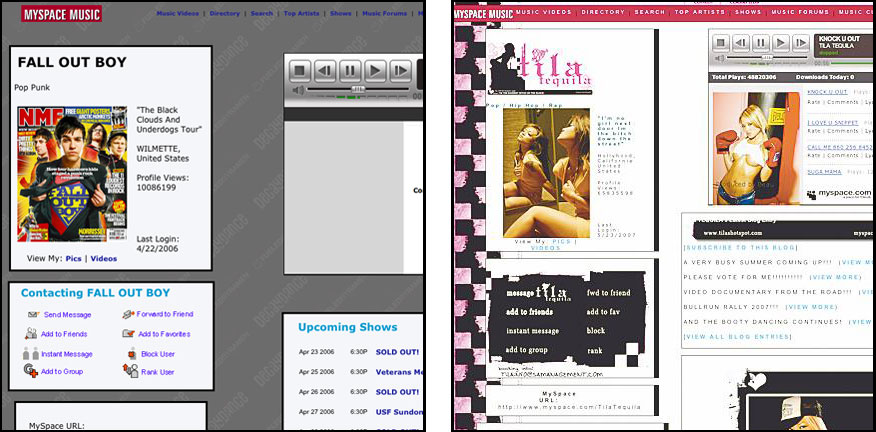
Image 1 / 1
A community with something to share
Chris DeWolfe and Tom Anderson launched Myspace within eUniverse in August 2003. Stereogum's oral history reports that the team used eUniverse's existing mailing list to attract early users. The service therefore began with distribution resources as well as a social-network idea.[5]
Researchers Irina Shklovski and danah boyd describe a more specific opening. Friendster removed profiles representing bands. Anderson welcomed musicians and asked what they needed. Music profiles followed in early 2004, with gig calendars, searchable band listings, and a Flash player. Fans could hear songs on the profile without installing a separate music application.[1]
That structure linked a band's promotional work to the network's growth. A musician brought listeners; listeners displayed music and connected with other fans. A profile could be useful before its owner had assembled a large personal friend list. Customization let people express affiliation, although the same researchers noted the usability problems of automatic playback.[1]
The artist results were tangible, though uneven. In Stereogum's interviews, Colbie Caillat recalls unsigned-artist chart placement leading to label interest. Gareth David describes Los Campesinos! receiving offers after publishing demos. These are participant accounts of discovery, rather than evidence that plays reliably became income. Former marketing chief Josh Brooks also recalls excessive expansion into ancillary products as Facebook offered a cleaner communication experience.[5]
Music became a business with several layers
Myspace pursued more than display advertising. Its separate record-label venture, announced in 2005, used Interscope for manufacturing and Fontana for distribution. This gave the company a route from discovering artists to releasing their work.[6]
In April 2008, Myspace announced a broader music joint venture with Sony BMG, Universal Music Group, and Warner Music Group. The announcement cited nearly 30 million monthly unique visitors to the music channel and more than five million artist profiles. Those were company-reported channel and profile measures, not paying customers.[7]
The September rollout added licensed, advertising-supported streaming, playlists, and MP3 purchases through Amazon. EMI, Sony/ATV, and The Orchard expanded the catalog relationships. McDonald's, Sony Pictures, State Farm, and Toyota sponsored the launch; Toyota Tuesdays offered weekly music downloads. These deals show an attempt to turn existing music behavior into commerce and sponsorship revenue. They do not establish profitable unit economics.[8]
A contract made product change expensive
News Corporation bought Myspace's parent Intermix in 2005 for $580 million. In August 2006, Fox Interactive Media signed Google's search and advertising agreement. The official release promised $900 million in minimum revenue-share payments, conditional on traffic and other commitments. The agreement covered the wider Fox network, including Myspace; it was neither an unconditional payment nor a Myspace valuation.[2][9]
Julia Angwin's account describes Google and News Corp negotiating the agreement while sidelining the founders. Her reporting makes the organizational issue concrete: people responsible for the user experience did not control a major commercial constraint.[10]
Reuters later reported former executives' accounts that traffic commitments discouraged reducing pages and advertising. Its investigation also describes engineering instability and management conflict. Facebook overtook Myspace in U.S. unique visitors in 2009. The supported inference is that commercial pressure reduced Myspace's freedom to repair an increasingly difficult product while a competitor improved.[2]
The evidence does not isolate one cause. Customization helped recruit users before it contributed to clutter. Facebook's growth, technical execution, and leadership changes all mattered. A disliked interface alone cannot explain why a once-useful music community struggled through repeated changes of owner and positioning. Nor does the choice of a particular programming technology establish why the network declined.
Ownership changed; the original habit did not return
Specific Media acquired Myspace in June 2011, with Justin Timberlake taking an ownership stake and a creative role. The reproduced acquisition announcement proposed entertainment programming and socially shared advertising campaigns. News Corp retained a minority stake in Specific Media.[11]
The 2013 relaunch received a reported $20 million campaign across television, radio, and online media. The Orange County Business Journal described a horizontal, tiled interface and a creative-community pitch. It also reported about $15 million in Myspace revenue for calendar 2012 against estimated operating costs of $43 million. Those reported measures indicate a substantial operating gap, though they are not an audited net-loss figure.[12]
Time Inc. acquired a 60% interest in Viant in 2016; Meredith acquired Time in 2018. Viant's founders regained that interest in 2019. The latest annual filing still places Myspace within Viant.[3][13]
Two later events exposed obligations that outlasted growth. In 2012, the FTC alleged Myspace shared identifiers that advertisers could connect to users' names despite its privacy promises. The settlement required a privacy program and independent assessments. Separately, Viant acknowledges that a server migration lost older user media. The Internet Archive preserves a collection of 490,000 MP3 files gathered between 2008 and 2010; this is a partial historical collection, not a restoration of the service.[14][3][15]
What a new entrant must prove
As checked on November 5, 2026, Myspace's accessible privacy page retains music, video, and people navigation. Its policy, revised in June 2024, says it shares information with affiliate Viant. This establishes continuing web presence and stated data practices; it does not verify that every account or music feature works.[16]
Rebuilding customizable profiles already has competition. SpaceHey offers HTML/CSS profiles, chronological feeds, and community features; it reports over two million members and is invite-only. Bandcamp handles direct music sales. Bandzoogle sells musician websites with music players, calendars, commerce, and fan tools.[17][18][19]
A narrower experiment would connect a local gig lineup to artist pages and explicit fan subscriptions, with portable contact lists. Its proposed customer is the independent promoter who already brings bands and audiences together. This preserves the useful distribution loop without requiring a new global network. The unresolved question is whether promoters will pay for that shared workflow when websites, sales platforms, and group chats already cover much of it.
Timeline
- 2003–2004: Myspace launches; dedicated music profiles follow.[1][5]
- 2005–2006: News Corp buys Intermix; Fox signs Google's conditional advertising agreement.[2][9]
- 2008–2009: The licensed music joint venture launches; Facebook passes Myspace in U.S. visitors.[8][2]
- 2011–2013: Specific Media acquires Myspace; another relaunch follows.[11][12]
- 2016–2019: Ownership passes through Time and Meredith before Viant's founders regain control.[3][13]
- 2026: Owners discuss a further relaunch; no launch date is established in the reporting reviewed here.[4]
Sources
- Shklovski and boyd, Music as Cultural Glue
- Reuters investigation, April 2011
- Viant 2025 annual report
- NBC Boston, proposed relaunch, August 2026
- Stereogum, oral history, March 2020
- LAist, Myspace Records announcement
- Sony Music, April 2008 joint venture announcement
- Sony Music, September 2008 product rollout
- Fox/Google agreement announcement filed with SEC
- Julia Angwin, MySpace's tangled web
- Specific Media announcement reproduced by Anadolu
- Orange County Business Journal, relaunch campaign
- Viant, founders acquire Meredith stake
- FTC, privacy settlement announcement
- Internet Archive, Myspace Dragon Hoard
- Myspace privacy policy
- SpaceHey features and funding
- Bandcamp fees, June 2026
- Bandzoogle pricing