Overview
Neptune.ai turned the record of a machine-learning experiment into a product. Researchers could keep parameters, metrics, code references, and artifacts together, then compare runs without rebuilding their history from spreadsheets. Its origins lay inside deepsense.ai; contemporary reporting dates the separate Warsaw startup to 2017.[1][2]
A customer relationship became its exit. OpenAI announced an acquisition agreement on December 3, 2025, after working with Neptune on tools for large training runs. Neptune’s external service subsequently closed. Its history shows how a focused supplier’s work can continue inside a customer’s research organization while outside customers lose the product.[3][4]
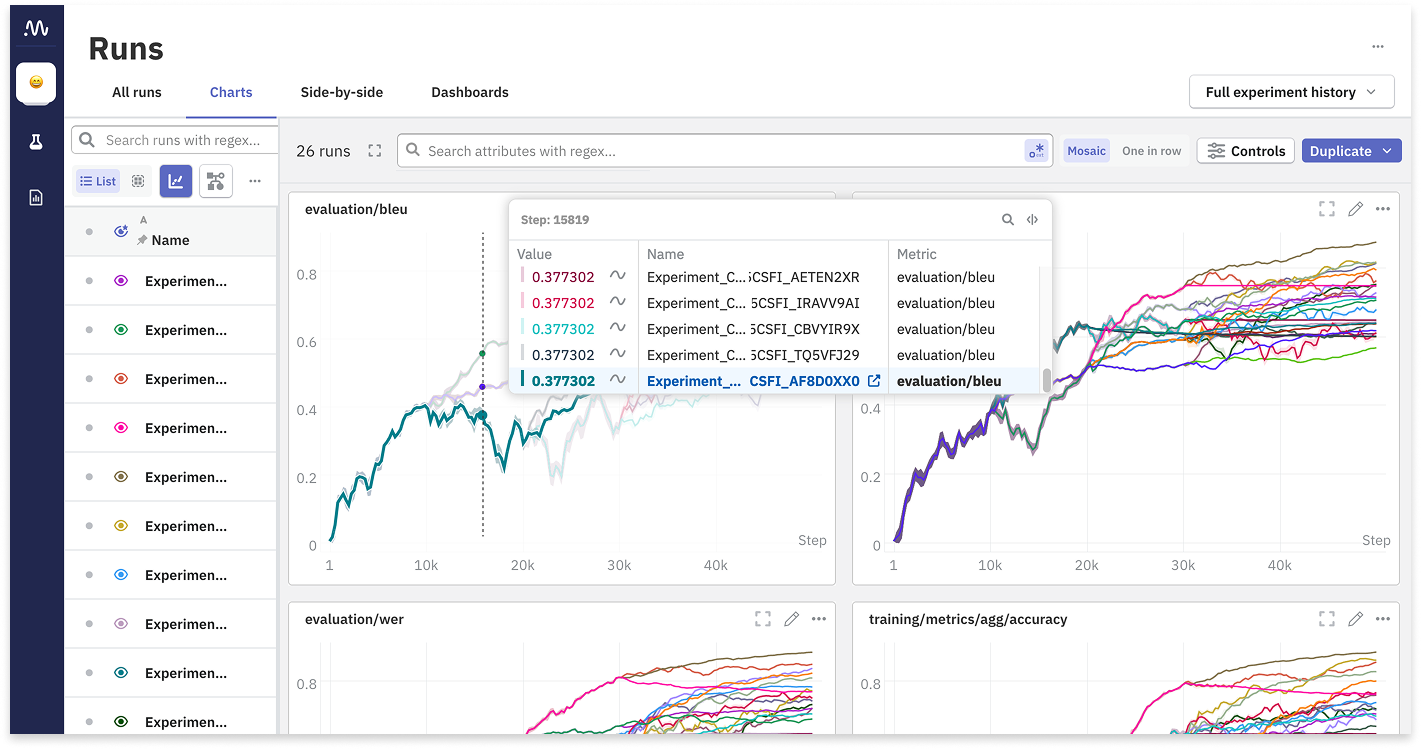
Image 1 / 1
Founding Story
The original problem appeared after a research success. Deepsense.ai won Kaggle’s Right Whale Recognition competition in January 2016. Producing the winning model was easier than reconstructing its exact development path: the team spent about three weeks recreating its steps. Its September 2016 account describes roughly 1,000 experiments behind the result.[1]
Neptune grew from that work into a separate business. A 2022 founder interview identifies Piotr Niedźwiedź, Jakub Czakon, Paulina Prachnio, and Piotr Łusakowski as founders who met at deepsense. Niedźwiedź had also founded CodiLime and deepsense.ai. The product addressed a practical mismatch: software teams had established ways to manage code, but model builders struggled to preserve the surrounding experiment.[2]
Niedźwiedź described software development as having “almost no end-to-end platforms.” Czakon said the company wanted to “focus on the developer’s experience.” Those short remarks explain the choice to build a component that fitted existing workflows rather than own every stage of model development.[2]
Timeline
- 2016: Deepsense.ai described the competition experience and introduced Neptune’s experiment-management platform.[1]
- 2017: The founding year reported in the later founder interview.[2]
- November 2019: B2venture says it began backing the Warsaw team.[5]
- April 2022: An $8 million Series A led by Almaz Capital brought reported funding close to $13 million.[2]
- December 3, 2025: OpenAI announced a definitive acquisition agreement.[3]
- March 2026: Neptune ended its hosted service. Its support notice records March 6 at 12:00 UTC; the transition documentation had scheduled March 5.[6][7]
What They Built
Neptune made an experiment inspectable after it finished. A researcher logged a run’s settings and measurements. A colleague could find that run, compare its charts, and inspect the associated material. The early platform also kept source snapshots and helped teams queue work on remote machines.[1]
The later product concentrated on foundation-model training. Its product material describes layer-level losses, gradients, and activations: measurements that help researchers see problems hidden by a single overall score. It also describes branches and restarts, with inherited history displayed together. These were vendor claims about the product, rather than independent performance benchmarks.[8]
OpenAI supplied stronger evidence of the use case than a generic customer logo. Its acquisition announcement says the companies had worked together on comparing thousands of runs and examining metrics across model layers. The planned integration would put that work inside OpenAI’s training stack.[3]
Market Position
Target Customers
The audience moved from general machine-learning teams toward laboratories running large models. Neptune offered hosted and self-hosted deployment. Its later positioning emphasized keeping expensive training runs observable as their internal measurements multiplied.[8]
Market Size
No reliable market-size estimate specific to Neptune’s eventual segment appears in the sources reviewed. Counting all spending on AI infrastructure would overstate the market for experiment tracking. The relevant question is how much teams will pay to detect training problems and retain usable research records.
Competition
Neptune named Weights & Biases and MLflow as alternatives, then provided migration guides for both during its closure. By October 2026, MLflow documents a self-hosted tracking server and customer-controlled artifact stores. Weights & Biases lists a free cloud tier and paid team plans. These alternatives make a generic replacement difficult to defend.[7][9][10][11]
Business Model
Neptune sold a hosted product alongside self-hosted deployment. The reviewed sources establish paying customers and institutional funding, but do not establish revenue, gross margin, profitability, or acquisition consideration. They also do not show whether a small number of frontier laboratories dominated revenue. The customer-concentration explanation therefore remains a hypothesis, not a financial finding.[2][8]
Traction
In April 2022, TFN reported more than 100 paying companies, including New Yorker, InstaDeep, and Roche. Czakon described roughly 20,000–25,000 users and fast growth. Those figures describe that period; they cannot establish the customer base at acquisition.[2]
Distribution included technical education. Investor b2venture singled out Neptune’s developer marketing and linked Czakon’s writing about it. That is evidence of an intentional channel, although its search-ranking praise is an investor’s assessment, not an audited acquisition-cost calculation.[12]
Post-Mortem
A focused component became internal infrastructure
The strongest interpretation is that Neptune’s specialization improved its strategic value. The original job was preserving an experiment’s history. The later job involved understanding model internals at frontier-training scale. OpenAI’s account connects that capability to its own research work and planned integration. Chief scientist Jakub Pachocki said Neptune helped researchers “analyze complex training workflows.”[3]
That does not prove the independent business had exhausted its options. Public sources do not disclose its finances, negotiations, or alternatives. The evidence supports a narrower mechanism: deep work with a demanding customer produced tooling that the customer chose to own. A supplier can win technically while its product’s broad availability ends.
The customer’s record depended on the service’s survival
Neptune offered an export process and destination-specific guides during the transition. Its documentation says customer content and personal data would not transfer to OpenAI. It also warned that remaining hosted data would be deleted. The later support notice says deletion was permanent and recovery was unavailable.[7][6]
This exposed a tension in the product’s purpose. Researchers used Neptune to retain the path behind a result, yet retaining that path after closure required action outside Neptune. Exportability therefore belongs in the product’s everyday workflow. Treating it as a migration task leaves the research record dependent on a vendor’s timetable.
Key Lessons
- Specialization can earn a strategic buyer. Neptune’s narrow experiment-tracking role led to work inside OpenAI’s training workflow. A useful component can gain depth without becoming an entire platform.
- Customer success and product continuity can diverge. The acquisition preserved the team’s work inside OpenAI while ending external service. Infrastructure buyers must assess both technical quality and their ability to leave.
- Research records need independent copies. Neptune’s deletion notice makes the consequence concrete. Teams should test whether an exported record remains understandable before they need it.
Sources
- Deepsense.ai, Neptune – Machine Learning Platform, September 26, 2016.
- TFN, Github for machine learning, Neptune.ai raises $8M Series A funding, April 12, 2022.
- OpenAI to acquire Neptune, December 3, 2025.
- Neptune documentation home and product screenshot.
- B2venture’s acquisition announcement.
- Neptune support, Service shutdown overview, indexed first-party excerpt.
- Neptune acquisition and shutdown transition hub.
- Neptune product page, indexed first-party excerpt.
- MLflow tracking server.
- MLflow artifact stores.
- Weights & Biases pricing, checked October 23, 2026.
- B2venture developer-marketing resources.