Overview
Promptfoo turned a developer's need to compare AI answers into a business testing how AI applications break. Ian Webster and Michael D'Angelo founded the company in 2024, after its open-source project began in 2023. Its trajectory shows how a useful testing tool can become part of the infrastructure required to sell enterprise AI.[1][6]
OpenAI announced an agreement to acquire Promptfoo on March 9, 2026. The planned destination was Frontier, its enterprise agent platform. Promptfoo's current website identifies the company as part of OpenAI, although the reviewed sources do not establish an exact closing date. The software remains available.[2][3]


Image 1 / 2
Founding Story
Webster had led Discord's Platform Ecosystem organization before managing products built with language models. He encountered a practical problem: a working demonstration did not show whether a product would behave safely across real inputs. In his July 23, 2024 seed announcement, he described building for “people like me — application developers.” D'Angelo, a longtime friend, joined him after working on machine learning at Smile Identity.[4]
The project initially helped developers compare prompts and model outputs. In a June 10, 2025 company account, D'Angelo wrote that “happy path testing wasn't enough.” Testing an application with cooperative questions missed the inputs that exposed unwanted behavior. That observation pushed the product toward automated adversarial testing, often called red teaming.[1]
The distinction mattered commercially. A developer could use a comparison tool to choose a prompt. A security team needed evidence about an application's behavior before permitting deployment. Promptfoo pursued both users, with a free tool for experimentation and a commercial platform for organizations.[8]
Timeline
- 2023: The first open-source release appeared, according to the company's retrospective.[1]
- July 23, 2024: Promptfoo announced a $5 million seed round led by Andreessen Horowitz.[4]
- September 6, 2024: Semgrep published an engineering account explaining its use of Promptfoo.[5]
- July 29, 2025: Insight Partners led an $18.4 million Series A, with Andreessen Horowitz participating.[6]
- March 9, 2026: Both companies announced the OpenAI acquisition agreement, subject to closing conditions.[7]
- October 23, 2026 review: Promptfoo's About page describes it as part of OpenAI; pricing and product documentation remain available.[3][8]
What They Built
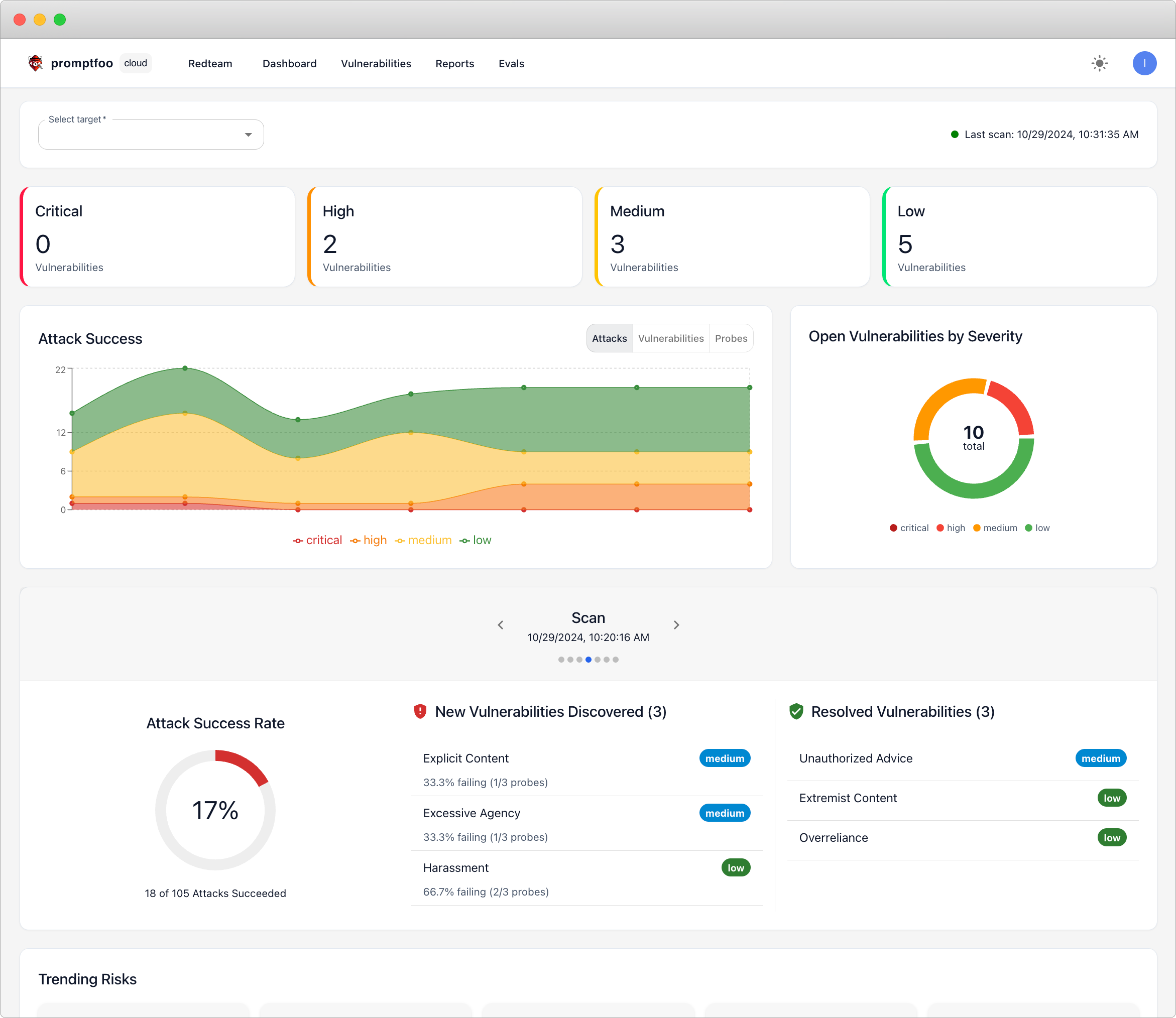
Promptfoo gives developers a repeatable way to ask an AI system many questions and compare its answers. A user defines inputs, selects models or application endpoints, and supplies rules for judging responses. The tool runs the cases and presents results in a comparison view. It can also run inside a team's automated build process.[9]
Its security work asks a different question: can a deliberately hostile input make the application disclose information or take an unwanted action? The target includes the surrounding application, its retrieved information, and its tools. A model that refuses a dangerous request in isolation does not establish that the full application enforces the same boundary. Promptfoo's seed announcement described application-specific failures such as information disclosure and tool misuse.[4]
Semgrep provides a useful customer account. Its engineers wanted to reproduce production prompts, compare outputs, and avoid writing a new interface or model-provider integration for every experiment. Their published workflow used Promptfoo alongside their own preparation code. That is a concrete reason to adopt the tool: it removed testing work unrelated to Semgrep's own product.[5]
Market Position
Target Customers
The initial audience consisted of developers building AI features. The paid product addressed security and engineering teams that needed shared results, permission controls, deployment options, and ongoing monitoring. An individual could start locally; an enterprise could buy controls around the same testing activity.[8]
Developer education gave the project another distribution channel. Anthropic's public prompt-evaluation course includes lessons introducing Promptfoo, writing classification evaluations, and building custom graders. This verifies its presence in another model provider's developer education. It does not establish a commercial partnership or customer contract.[10]
Market Size
The reviewed sources do not establish a reliable standalone market size for AI application testing. Developer adoption and large-company usage indicate demand, but neither measures spending. A company using the free tool may never become a paying account.
Competition
LangSmith offers offline and production evaluations, comparison views, and human review. Giskard combines an open-source library with a commercial platform for agent testing and red teaming. Both compete with parts of Promptfoo’s product.[11][12]
The structural competition is between a testing product that works across providers and testing embedded in the platform where customers already deploy agents. The former offers portability. The latter can reduce setup and connect findings to deployment controls. OpenAI's acquisition rationale explicitly favored integration within Frontier.[2]
Business Model
Promptfoo uses a free community edition alongside custom-priced enterprise and on-premise plans. At review time, the community plan includes core evaluations and a monthly red-team probe allowance. Paid plans add organizational controls, monitoring, support, and deployment choices. The public pricing page does not disclose contract values.[8]
The seed and Series A announcements disclose financing, not revenue. The reviewed material does not establish recurring revenue, gross margin, retention, or acquisition returns. It therefore cannot show whether open-source adoption converted efficiently into a durable standalone business.
Traction
The founders' acquisition announcement reported more than 350,000 developers had used Promptfoo, with 130,000 active monthly. It also said teams at more than a quarter of Fortune 500 companies relied on the product. These are company-reported adoption figures. They are not counts of paying customers.[7]
The July 2025 Series A material contains inconsistent large-company counts: one paragraph says more than 30 Fortune 500 companies, while another says more than 40. The independent Semgrep account provides firmer evidence of a specific working deployment than treating those totals as audited customer data.[13][5]
Post-Mortem
The surrounding application became the important boundary
The strongest explanation for Promptfoo's strategic value is its move from comparing answers to testing business behavior. The company's founders had direct experience shipping AI applications. Their product addressed failures that appear when a model interacts with instructions, private information, and external tools.
In OpenAI's March 9 announcement, Webster said: “We started Promptfoo because developers needed a practical way to secure AI systems.” The stated integration target connected that testing work to an enterprise agent platform.[2] My interpretation is that the application layer gave Promptfoo both its original opening and its attraction to a platform buyer. Enterprises needed help evaluating the system they would actually use.
An alternative explanation is that OpenAI primarily wanted an experienced team. The public evidence cannot assign a value to each asset. But both announcements discuss continuing the software and integrating technology, which supports a broader product-and-team interpretation rather than a pure personnel transfer.[7]
Integration creates a new test of trust
In an August 2024 interview with Andreessen Horowitz, Webster argued that application developers outside large AI labs needed access to practical security tools. His proposed answer was open-source tooling available across companies.[14]
Ownership by a model provider creates a tension with that original position. Customers need confidence that testing remains useful across providers. The founders directly addressed continuity: they committed to maintaining the open-source suite and supporting multiple models. Current documentation still lists OpenAI, Anthropic, Google, and other providers.[7][9]
That commitment is evidence of product direction, not proof of future neutrality. The question for customers is observable: can they continue to reproduce tests against their own complete applications, inspect the evidence, and use the findings outside the acquirer's platform?
Key Lessons
- An internal pain can reveal a wider buyer. Promptfoo began with developers comparing outputs. Adversarial testing connected the same work to enterprise deployment decisions.
- Adoption needs a denominator. Monthly users, organizations using a tool, and paying contracts measure different things. Promptfoo's public traction supports reach, not a revenue estimate.
- Distribution can cross competitive boundaries. Anthropic's evaluation course used Promptfoo before OpenAI ownership. Useful developer infrastructure can spread through ecosystems whose owners compete.
- Portability must survive the sale. The open-source product continues. Its ability to support complete applications across providers is the practical test of the founders' continuity promise.
Sources
- Celebrating 100,000 Users — Promptfoo
- OpenAI to acquire Promptfoo — OpenAI
- About Promptfoo
- Promptfoo Raises $5M — Promptfoo
- Does your LLM thing work? — Semgrep
- Promptfoo Raises $18.4 Million Series A — Insight Partners
- Promptfoo is joining OpenAI — Promptfoo
- Pricing — Promptfoo
- Intro — Promptfoo documentation
- Prompt evaluations — Anthropic
- LangSmith Evaluations — LangChain
- Giskard documentation
- Promptfoo Series A announcement
- Democratizing Generative AI Red Teams — Andreessen Horowitz