Overview
SolarCity made rooftop solar easier to buy by combining financing with installation and long-term service. Its lease reduced the homeowner’s initial payment while leaving SolarCity and its financiers to fund equipment upfront. That helped create a large installed base, but expansion needed cash before many customer payments arrived. Tesla completed its acquisition in November 2016. A simpler purchase created a more demanding capital and service business. [3][9]

Image 1 / 1
The founders solved purchase friction
Lyndon and Peter Rive founded SolarCity in 2006. Lyndon became CEO; Peter led technology and initially operations. Their cousin Elon Musk chaired the board from July 2006. In a later interview, Lyndon credited Musk with suggesting solar during a 2004 trip to Burning Man. The brothers’ operating roles and Musk’s idea, financing and board roles should remain distinct. [1][2]
SolarLease launched in 2008. The lease charged a monthly amount; a power purchase agreement charged for electricity produced. SolarCity owned and operated the equipment under those arrangements, with typical contracts lasting 20 years by 2015. A homeowner could adopt solar with little or no initial payment. This changed who funded the asset, rather than making the equipment free. [4]
Google’s June 2011 announcement illustrated the financing channel. It committed $280 million to a fund for SolarCity installations and offered employees a SolarCity discount. This was project financing capacity, rather than $280 million of ordinary startup equity or product revenue. SolarCity later became a Nasdaq-listed company. [3][25]
The model joined different decisions. A household considered its roof, bills and long contract. A project investor considered future payments and tax-related benefits. SolarCity had to acquire a customer, install a working system and keep it serviceable. Contract growth could therefore increase both future receipts and immediate financing needs.
Integration improved control and widened responsibility
In the 2016 acquisition call, Lyndon said SolarCity initially outsourced installation, then brought installation and financing in-house to control the customer experience. That was management’s explanation for its operating model. Installation gave the team control over how the customer’s contract became a working system. [7]
Distribution also required physical selling. The acquisition presentation described more than 800 retail locations through partnerships, including Home Depot. Sales channels could reach households unfamiliar with solar, but each signed contract still needed a site assessment, permits, equipment and a crew. [6]
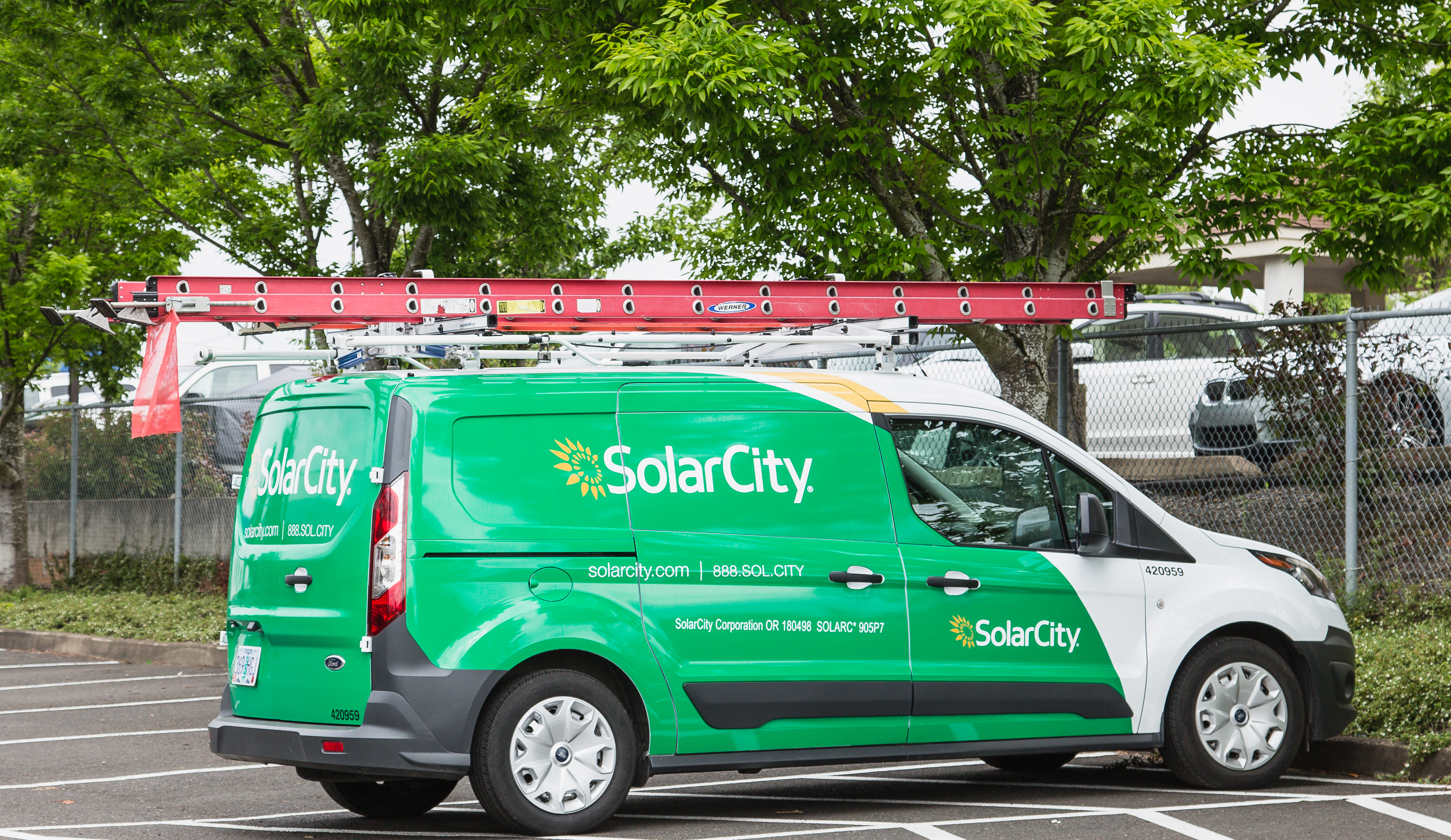
Operational progress was real. SolarCity reported installing 870 megawatts of capacity in 2015, up from 503 in 2014. Megawatts measure generating capacity, not electricity actually produced. Management also acknowledged missed installation guidance and terrain problems on large ground-mounted projects. Improving average costs did not eliminate site-specific delays. [5]
Management’s Q4 2015 figures put blended cost at $2.71 per watt, including $1.90 of installation cost. Estimated pre-tax value before project debt was $3.64 per watt at a 6% discount rate. That value combined upfront financing proceeds with forecast project cash flows, including renewals. Subtracting cost from it did not produce immediate cash profit. [5]
Manufacturing added another commitment. SolarCity completed the Silevo acquisition in September 2014 and entered the Buffalo Riverbend factory arrangement. SUNY’s Research Foundation would own the plant and equipment; SolarCity accepted production, employment and spending obligations. Public support reduced some upfront facility costs while leaving execution duties. This extended the company beyond selling and installing other manufacturers’ panels. [8]
Long-lived assets did not remove short-term cash needs
In 2015, SolarCity recorded $399.6 million of revenue and a consolidated net loss of $768.8 million. The loss attributable to stockholders was $58.3 million after losses allocated to noncontrolling interests. Operating cash outflow was $789.9 million; payments for leased and future leased solar systems were another $1.666 billion in investing activities. These measures describe different parts of the consolidated financing structure. They cannot be substituted for one another. [4]
A lease business recognizes customer revenue across time while developing new assets and supporting an expanding organization. An annual accounting loss alone does not prove that every installation destroyed value. Cash still had to be available when equipment and employees needed payment. Estimates of future renewals, financing access and installation speed therefore mattered alongside customer demand.
Management’s early 2016 letter made positive cash generation the primary goal and growth secondary. It also reported closing Nevada operations after an unfavorable tariff decision. The company could reduce unit costs yet face policy changes that altered a local offer. Historical tariffs and tax arrangements do not establish what a household qualifies for today. [5]
The acquisition had both an operating case and conflicts
Tesla proposed a combined sales, installation and service experience for solar and batteries. The August 2016 presentation forecast $150 million of direct cost savings in the first full year after closing. It was a management target, not proof of savings achieved. The overlap could reduce duplicated selling and overhead, but a common app could not remove roof work or financing risk. [7][6]
Tesla completed the transaction on November 21, 2016, exchanging 0.110 Tesla shares for each SolarCity share. Its annual report recorded approximately $2.1 billion as acquisition-date consideration. The widely reported $2.6 billion announced stock value is a different dated measure; neither is an all-in debt-inclusive cost. [9][10]
Shareholders alleged that Musk used his influence to make Tesla overpay for a financially distressed company in which he had an interest. The 2022 Delaware trial court found the acquisition entirely fair under its assumed strict review standard and ruled for Musk, while recognizing process flaws. Delaware’s Supreme Court affirmed in June 2023. The litigation’s outcome should accompany its allegations. A finding of fair price also does not prove that every promised operating benefit occurred. [10][11]
After acquisition, Tesla reduced solar facilities and ended the Home Depot channel in 2018. [12]
The current offer has changed again
On November 5, 2026, Tesla’s support pages offered conventional solar panels with purchase or lease paths, plus Powerwall storage. Ordering starts with an address and electricity bill; availability and final pricing depend on the design and territory. Main electrical-panel upgrades, if needed, are excluded from the stated final solar price. A national installed-system price cannot be inferred from these pages. [13]
The current solar lease table lists a 25-year term, a 3% annual payment escalator and $600 upfront, comprising a deposit and progress payment. Powerwall-only leasing lists 12 years and a $100 deposit. These are financing terms, not total installed prices or proof of savings. Although introductory copy calls payments fixed, the table and FAQ explicitly describe annual increases. [14]
Powerwall’s current page describes storing solar or grid energy for later use and backup. Its integrated solar inverter connects the generation and storage offer. Actual backup capacity and bill effects require a household-specific design; no current rebate or tax saving is assumed here. [15]
Solar Roof is a separate product outcome. Its product address now redirects to Solar Panels. Electrek reported in August 2026, citing two sources close to the program, that Tesla had stopped supplying Solar Roof tiles. The redirect corroborates a changed sales route; the discontinuation claim remains attributed reporting. Older support documents do not establish current tile availability. [16][17]
Sunrun currently offers solar and battery subscriptions and purchase options. For existing systems, Tesla offers removal and reinstallation, while Sunrun partners with Remi for roof work and panel handling. A new service would face operating providers, not an empty market. [20][19][21]
A narrower proposal is a licensed local solar contractor serving independent roofers on homeowner-owned legacy arrays. It would inspect before removal, coordinate roof readiness and restore the array with documented checks. The opportunity would depend on local crew reliability and referrals. Existing services already cover the broad job; a website alone offers little protection from competition.
Timeline
- 2006: The Rive brothers founded SolarCity, with Musk as chairman. [1]
- 2008: SolarLease broadened access through monthly payments. [4]
- 2011: Google announced its $280 million installation fund. [3]
- 2014: SolarCity completed Silevo’s acquisition and committed to the Buffalo factory arrangement. [8]
- 2015: Annual installed capacity reached 870 MW. [5]
- November 21, 2016: Tesla completed the acquisition. [9]
- 2022–2023: Delaware courts ruled for Musk and affirmed the acquisition’s fairness. [10][11]
- 2026: Panels and Powerwall remain offered; Solar Roof’s product route redirects and discontinuation is reported. [13][16][17]
Sources
- SolarCity 2016 proxy statement
- Lyndon Rive interviewed by DFJ
- Helping homeowners harness the sun
- SolarCity 2015 annual report
- Fourth quarter 2015 shareholder letter
- Tesla and SolarCity acquisition presentation
- Tesla and SolarCity combination call
- Silevo acquisition and Riverbend agreement
- Tesla 2016 annual report: acquisition note
- Delaware Chancery opinion
- Delaware Supreme Court opinion, reproduced by Justia
- Tesla closes solar facilities and ends Home Depot channel
- How to order Tesla solar panels
- How leasing solar with Tesla works
- Powerwall home battery storage
- Tesla Solar Roof product route
- Tesla discontinues Solar Roof tiles
- How much does Tesla solar cost
- Solar panel removal and reinstallation
- Sunrun solar and battery FAQ
- Sunrun roofing with Remi
- California Solar Smart contractor guidance
- SolarCity installation van in Portland
- SolarCity crew rooftop photograph
- SolarCity 2012 annual results
Photo credits: Tony Webster’s original and license · CC BY 2.0 · Ja.hess10’s original and license · CC BY-SA 4.0. Images unchanged.