Overview
Statsig turned the internal tools of a large technology company into a service for other product teams. Founded in February 2021, it combined controlled feature releases, experiments, and product measurement. Its strongest evidence of value came from OpenAI: a customer that agreed to acquire the company in September 2025 and appointed founder Vijaye Raji to lead application engineering.[1][2]
The outcome later split. Statsig says its original team remained at OpenAI while Amplitude took over the product, brand, and customers on May 5, 2026. The platform continues. The useful lesson is how an outside supplier became important to a customer's operating methods, then retained a separate commercial future under another operator.[1][3]
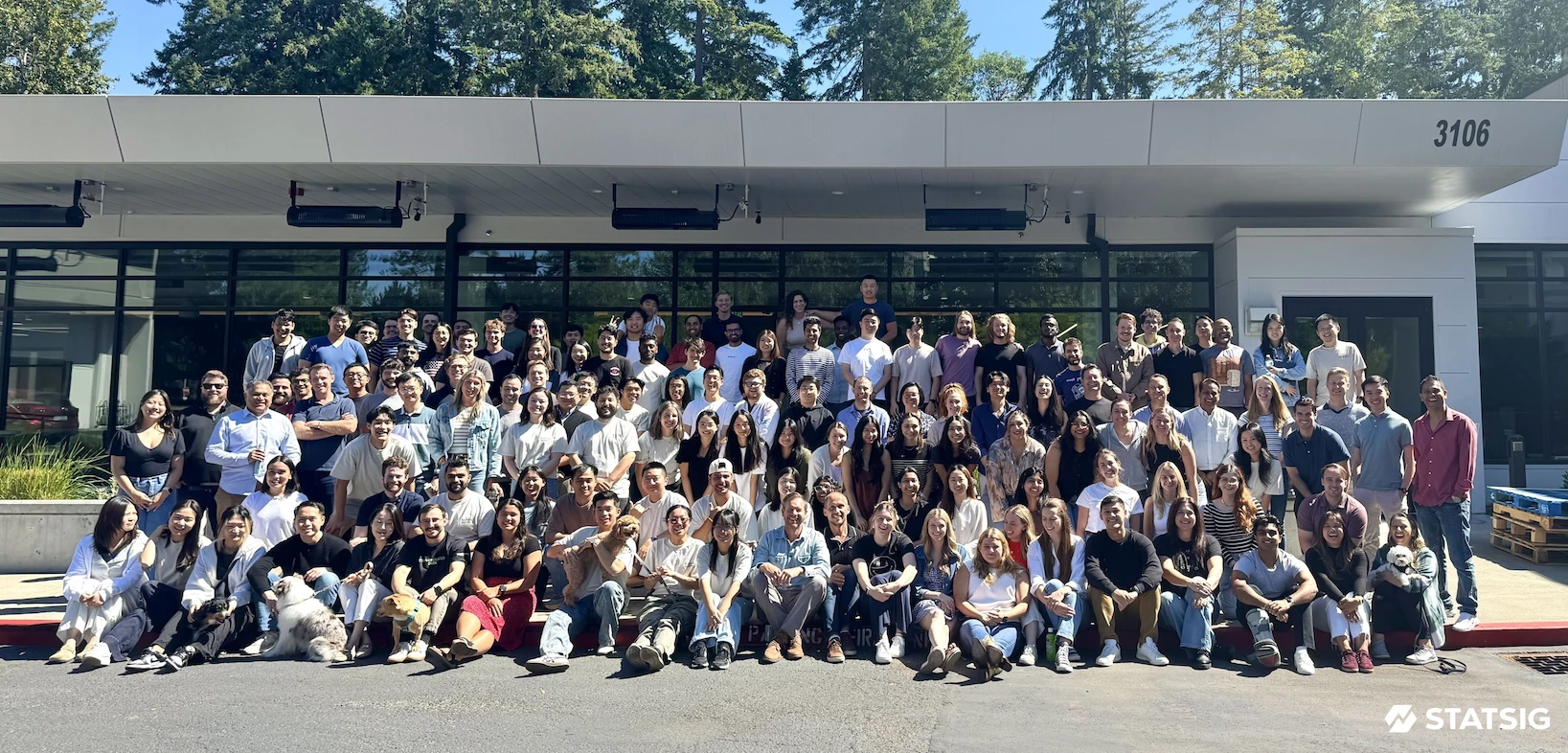
Image 1 / 1
Founding Story
Raji had built both developer tools and consumer products. Madrona's S. Somasegar knew him from Microsoft, where Raji developed the beginner programming language Small Basic. Raji later joined Facebook, built consumer products, and led its Seattle office. Sequoia partner Lauren Reeder traces the investor relationship to Raji's work with Mike Vernal at Facebook. These connections gave the new company access to both engineering talent and investors who had observed its founder at work.[4][5]
The starting insight concerned decision-making. In his March 17, 2021 founding essay, Raji wrote that Facebook's infrastructure helped engineers test ideas in production rather than settle every question in meetings. He described tools for targeting releases, comparing variants, and measuring effects across company metrics. His ambition was explicit: “Big companies shouldn’t be the only ones with such sophisticated tools”. He ended: “This is my inspiration for Statsig”. Those tools required a supporting system, beyond a dashboard that described past activity.[6]
The public material identifies Raji as founder and describes the initial team through its former Facebook experience. It does not establish a complete legal co-founder roster. That distinction matters when describing a company formed by several early employees around one publicly identified founder.
Timeline
- February 2021: Statsig began; Sequoia says it led the Series A that month.[1][5]
- 2022: Sequoia followed with the Series B.[5]
- May 6, 2025: Statsig announced a $100 million Series C at a $1.1 billion valuation, led by ICONIQ Growth, with Sequoia and Madrona participating.[7]
- September 2, 2025: OpenAI and Statsig announced a definitive acquisition agreement, subject to closing conditions. The exact closing date was not established here.[2]
- May 5, 2026: Amplitude announced responsibility for the Statsig brand, customers, and continued platform development.[3]
- October 7, 2026: Statsig released a new agent interface with more granular permissions, showing continued development under Amplitude.[8]
What They Built
A feature flag controls which users receive a change. An experiment assigns users to different versions and compares outcomes. Statsig links those actions to shared product metrics, so teams can release gradually, measure results, and withdraw changes that hurt customers. The same platform includes product analytics and session recordings.[9]
A typical team installs a software library, records relevant events, and defines a metric. It then assigns eligible users to a control or treatment. The important design choice is the connection between release decisions and observed behavior. A flag without measurement controls exposure; an experiment can help establish what that exposure changed.
Statsig also supports two operating models. Its hosted service manages event processing. Its warehouse version runs analysis against data a customer already holds, with either Statsig or another system supplying assignment information. This lets an established data team reuse its existing metric definitions instead of moving every workflow into a separate event store.[9]
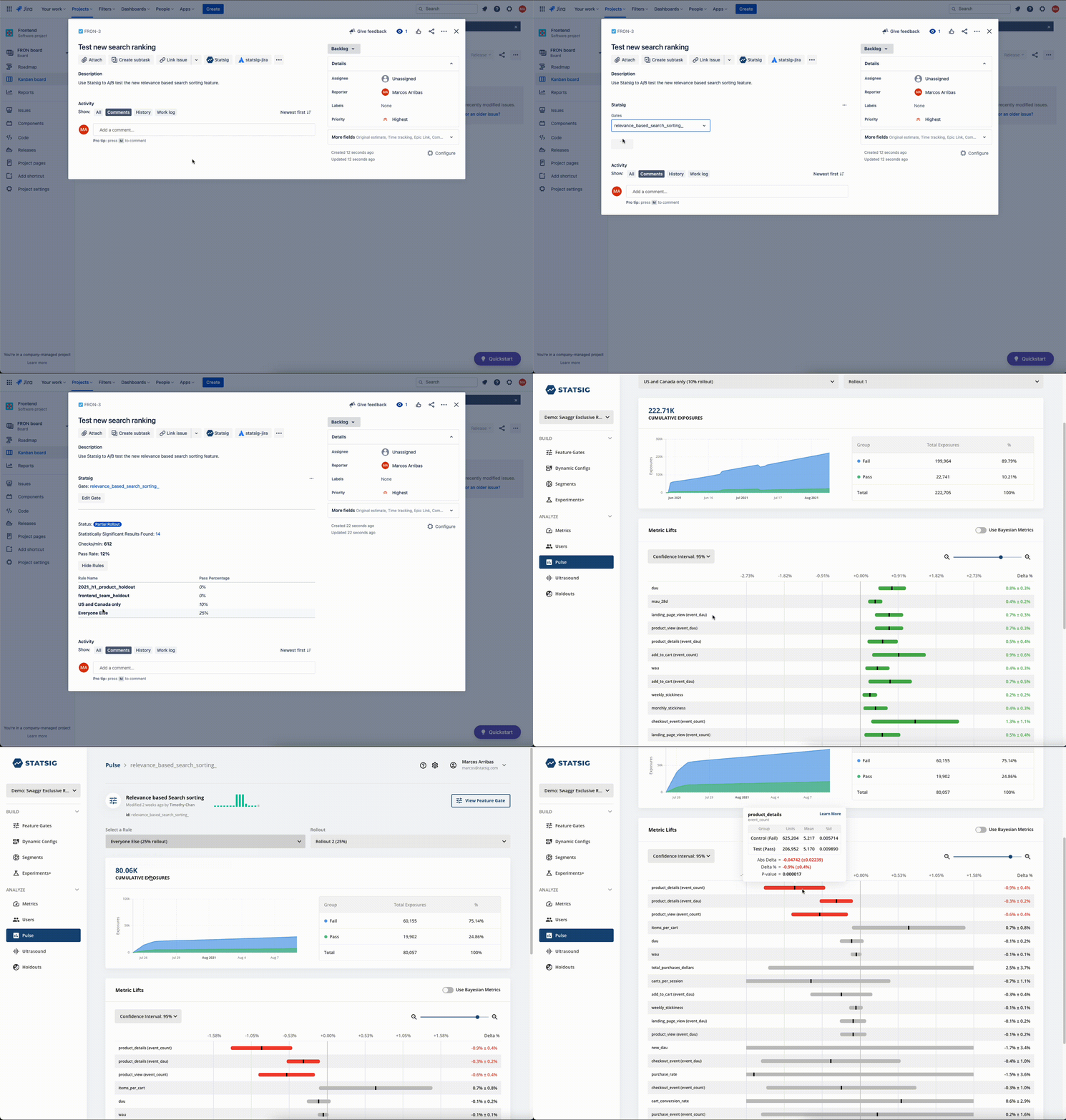
The Jira integration put Statsig inside existing engineering work. Engineers can associate a ticket with a Statsig flag and see rollout or testing information without treating measurement as a separate project.[10]
Statsig also provides experiment-summary PDFs and detailed result exports. Any competing handoff service must improve work that these existing reports leave unfinished.[18]
Market Position
Target Customers
The initial audience included former large-company product and engineering leaders who wanted comparable tools at their new employers. Statsig's 2025 retrospective identifies early customers including Notion, Figma, Whatnot, Brex, and OpenAI. This created an audience that already understood experimentation and needed infrastructure to practice it.[11]
Market Size
The sources reviewed do not establish a reliable market-size estimate. Usage and customer examples show demand, but do not measure the addressable market. A company that runs experiments is also not necessarily a paying Statsig customer.
Competition
The relevant choices include building internal tools, buying a suite, or using a warehouse-centered platform. GrowthBook currently offers free experiments and feature flags, with warehouse and self-hosted options. PostHog combines experiments with analytics and recordings. Both make a generic replacement difficult to justify.[12][13]
Statsig also extended into deployment platforms. Its December 2022 Vercel integration copied configurations into Edge Config, letting applications read flag and experiment settings without a separate request to Statsig.[17]
Statsig competed through a connected workflow and support for demanding data teams. Its eventual combination with Amplitude strengthens the suite alternative. An acquisition therefore creates no obvious vacancy for another broad experimentation product.
Distribution extended beyond developer adoption. In October 2025, Statsig's brand team documented an Austin airport campaign around Formula 1 and the EXL experimentation event. The two audiences received different creative treatments. This is evidence of investment in category awareness, although the post supplies no acquisition-cost or conversion result.[14]

Business Model
Statsig sells software through free, usage-based, and negotiated enterprise plans. At the October 2026 check, its free tier includes two million monthly events and unlimited flag checks. Pro starts at $150 monthly, with five million included events. Enterprise adds options such as warehouse deployment and access controls. These are current terms, not a reconstruction of every historical price.[15]
The pricing connects charges to measurement and data processing while making basic release controls easy to adopt. That can lower an engineer's entry barrier and leave room for expansion as measurement becomes important. The sources do not disclose audited revenue, gross margin, retention, or customer acquisition costs. Funding valuation cannot substitute for those measures.
Traction
Statsig reported 20,000 weekly active users and 170 full-time employees in its December 2025 retrospective. These are company-reported figures; they describe platform use and organization size rather than recurring revenue. The same retrospective attributes adoption to both new customers and greater experimentation within existing teams.[11]
The strongest acquisition-specific customer evidence comes from OpenAI itself. Its announcement says Statsig already played a central role in how OpenAI shipped products and learned from releases. That supports a concrete strategic rationale without requiring speculation about distressed finances.[2]
Post-Mortem
Operating knowledge became part of the asset
Statsig commercialized a way of working learned inside Facebook. Customers received tools that connected engineering autonomy to measurable outcomes. OpenAI then acquired both that infrastructure and people who knew how to operate it. On September 2, 2025, OpenAI described Raji's remit as product engineering for ChatGPT and Codex. Raji called it an opportunity to bring his experience “scaling consumer and enterprise products”.[2]
My interpretation is that repeated use helped OpenAI assess the team. OpenAI could evaluate the work through actual use, rather than a demonstration. The leadership appointment also suggests that OpenAI valued organizational experience beyond the standalone product. This explains why the transaction belongs in a company history even though the customer business later moved elsewhere.
A product can survive a team transfer
The initial agreement promised independent operation and customer continuity. The next operator's account shows the work that continuity required. In June 2026, Amplitude product leader Chris Yu described a team of about 50 people maintaining the service and learning its codebase, operations, and roadmap from the original team. The transfer needed explicit operational teaching.[16]
The outcome challenges a simple talent-only interpretation. The original engineers stayed at OpenAI, yet Amplitude saw a customer business worth maintaining. It also challenges the idea that acquisition alone ensures continuity: a replacement operating team had to learn the system and keep serving customers.
A narrower explanation is that OpenAI mainly wanted Raji and his team. The later separation is consistent with that possibility. Public statements do not explain how OpenAI valued the assets or whether the later arrangement was planned at the original purchase. The history establishes who operates the platform today; deal motives and investor returns remain undisclosed.
Key Lessons
- Existing customers can evaluate a team deeply. OpenAI used Statsig before buying it. The relationship exposed product quality and operating behavior over time.
- Integrated tools can carry an operating method. Statsig linked releases with measurement, helping customers practice experimentation rather than collect another dashboard.
- Continuity requires named operators. Amplitude's account describes people learning the platform and supporting customers. A promise to preserve a service needs staff and a transfer process.
- Track the product after the headline. Statsig's team and customer platform followed different paths. That distinction changes both the history and any proposed competing business.
Sources
- Statsig is joining OpenAI
- OpenAI acquisition and Raji appointment
- Amplitude and Statsig partnership
- Madrona's original Statsig investment
- Sequoia's acquisition account
- Why we started Statsig
- Statsig Series C announcement
- Statsig MCP v3
- Statsig platform overview
- Statsig Jira integration
- Statsig's 2025 retrospective
- GrowthBook pricing and features
- PostHog experiments
- Statsig's Austin airport campaign
- Statsig pricing
- Statsig and Amplitude transition account
- Statsig and Vercel Edge Config
- Statsig result export options