Overview
Tomoro built custom AI systems for large companies. It launched in the United Kingdom in 2023 and worked with customers including Virgin Atlantic, Tesco and Supercell. Its engineers helped connect AI models to the data and business processes needed for daily use. On May 11, 2026, OpenAI announced an agreement to acquire Tomoro for its new OpenAI Deployment Company. By July 8, DeployCo described the purchase as completed.[1][2]
Tomoro sold the work required to make AI useful inside a business. Its model partner bought that delivery capability as it expanded into enterprise services.
Founding Story
The UK entity, Tomoro AI Ltd, incorporated on October 13, 2023. Its public launch followed in November. Ed Broussard had previously co-founded Mudano, the data consultancy acquired by Accenture. That background gave Tomoro experience in enterprise delivery.[3][4]
The wider founding team included Ash Garner, Albert Phelps, Chloe Kelleher, Chris Spencer, Rishabh Sagar, Sam Netherwood and Sandi Chanda. Launch posts, an employee's acquisition announcement and the company officer record corroborate these names. The sources do not establish how every founder first met.[5][6][7]
Spencer's launch post described a future with “humans who provide oversight and direction.” At the acquisition announcement, Netherwood described the work as “designing and deploying AI products in really challenging, complex environments.” The founders focused on applying AI inside organisations.[5][8]
Timeline
- October–November 2023: Tomoro AI Ltd incorporated, then publicly launched in alliance with OpenAI.[3][5]
- May 2025: Tomoro opened its Asia-Pacific headquarters in Singapore, led by co-founder Albert Phelps.[9]
- December 2025: Its Edinburgh office expansion included a £10 million workforce investment pledge over three years.[10]
- May 11, 2026: OpenAI announced the acquisition agreement alongside DeployCo's launch.[1]
- July 8, 2026: DeployCo referred to Tomoro as a recent acquisition.[2]
What They Built
Tomoro's output was customer-specific software. Its Singapore launch release described work across investment research, logistics, customer support, basketball commentary and drug discovery. Those examples establish breadth; they do not establish equal commercial success in every category.[9]
Virgin Atlantic provides a concrete example. The airline's Concierge, built with Tomoro and powered by OpenAI, lets travellers use text or voice to explore flights and holidays. The airline said it also handles Flying Club questions and general assistance. Tomoro contributed the customer experience and implementation, while OpenAI supplied the model technology.[11]
Tomoro also built Become Eternian with Mattel and Amazon MGM Studios. The campaign asked visitors to take a selfie and quiz, then generated a personalised Masters of the Universe character. Tomoro's announcement described OpenAI models behind the experience. This extended its work from service tasks into branded consumer experiences.[14]
Each engagement had to connect the customer's information, controls and operating process to software that employees or customers can use. OpenAI's DeployCo announcement describes that same pattern: select important workflows, embed engineers and build production systems.[1]
Market Position
Target Customers
Tomoro pursued large enterprises with complex operations. Named relationships with Virgin Atlantic, Tesco, Supercell and Fidelity International gave it reference customers across several industries.[1][9]
Market Size
The evidence does not establish a reliable addressable-market figure for Tomoro's specific services. Its hiring and regional expansion show demand for its work, but they cannot determine the size of the whole market.
Competition
The boundary between supplier, partner and competitor became less stable. OpenAI bought Tomoro to expand deployment capacity. Anthropic's parallel services venture, Ode, used its acquisition of Fractional AI as an operating foundation. By July 2026, both ecosystems were adding implementation teams around their models.[1][12]
Business Model
Tomoro provided consulting and engineering engagements. Its filed accounting policy recognises service revenue by stage of contract completion. Public sources do not disclose its contract prices or a complete income statement.[13]
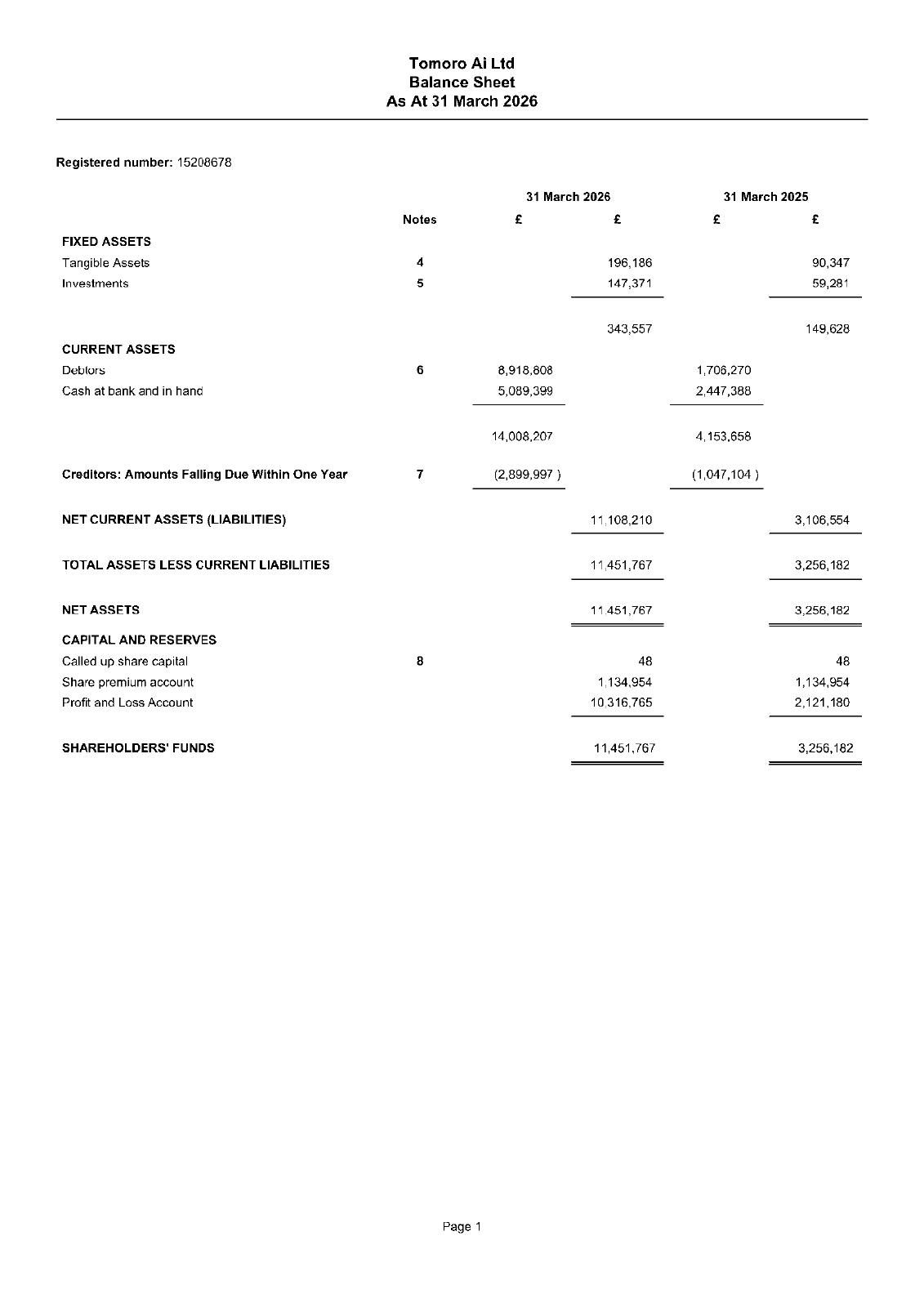
The unaudited UK accounts show £5,089,399 in cash and £11,451,767 in net assets at March 31, 2026. The cumulative profit-and-loss reserve was £10,316,765, compared with £2,121,180 a year earlier. These are balance-sheet measures. They do not disclose annual revenue, an operating margin or the acquisition price.[13]
Traction
The same filing records an average of 89 employees, including directors, during the year ended March 31, 2026, compared with 30 in the preceding year. This is an annual average for the UK entity. OpenAI's acquisition announcement separately described approximately 150 engineers and deployment specialists expected to join DeployCo.[13][1]
Post-Mortem
Delivery became part of the platform
The acquisition brought Tomoro's engineering organisation into the model supplier's enterprise expansion. My interpretation is that close customer work made the firm useful beyond the revenue from individual projects. Its teams could also help OpenAI turn model access into systems customers continued using. The public announcements support that strategic fit; they do not reveal the buyer's internal valuation model.[1]
In his November 2023 launch post, Spencer wrote: “The benefits and risks of aligning to one vendor need balancing and regular review.”[5] A consultancy can gain credibility and technical access through a platform relationship. The platform can then expand into the same delivery layer. Tomoro's acquisition resolved that relationship through ownership. The record does not show that customers abandoned the firm or that it needed a financial rescue.
Growth figures need their original labels
The December 2025 £10 million announcement was a workforce investment pledge. DeployCo's launch financing belonged to the new venture. Neither figure is Tomoro's purchase price. The accounts also omit the income statement, which limits conclusions about project margins and recurring revenue. A defensible account of this outcome keeps those measures separate.[10][13]
Key Lessons
- Tomoro built credibility through named production work. Virgin Atlantic's customer-facing Concierge makes the delivery contribution more concrete than a generic AI partnership claim.
- Its OpenAI alliance became an acquisition route. Founders building on a dominant supplier should examine how that supplier could enter their layer of the business.
- Staff growth and balance-sheet reserves support a substantial operating story. They leave contract economics, revenue concentration and the purchase price unresolved.
Sources
- OpenAI: Launch of the OpenAI Deployment Company
- DeployCo: Agreement to acquire Northslope, July 8, 2026
- Companies House: Tomoro AI Ltd, company 15208678
- The Business Magazine: Tomoro's November 2023 launch
- Chris Spencer: Tomoro launch post
- Akram Dweikat: Tomoro founder and acquisition account
- Companies House: Tomoro AI Ltd officers
- Sam Netherwood: Company-building and acquisition account
- Singapore EDB: Tomoro's Asia-Pacific headquarters launch
- DIGIT: Edinburgh workforce investment pledge
- Virgin Atlantic: Concierge launch
- Ode: Launch and Fractional AI acquisition background
- Companies House: Tomoro AI Ltd accounts, year ended March 31, 2026
- Tomoro: Become Eternian campaign with Mattel and Amazon MGM Studios