Overview
Vercept built Vy, a Mac assistant that understood screens and carried out tasks across applications. Its researchers built models that connected visual understanding with actions across apps. Anthropic announced its acquisition on February 25, 2026, to advance Claude's computer-use capabilities.[1]
The useful tension in its story is between a research team's value and a customer's need for a lasting product. Vercept's expertise continued inside Anthropic. Vy users received a shutdown schedule for March 25. That split explains why an acquisition could advance the founders' technical mission while requiring customers to replace a tool and disappointing an early backer.[2][15]

Image 1 / 1
Founding Story
Vercept formed in late 2024 around researchers with overlapping Allen Institute for AI backgrounds. CEO Kiana Ehsani had led robotics and embodied-AI work: training agents to perceive and act in their surroundings. Luca Weihs had led the AI2-THOR research team. Ross Girshick brought computer-vision research from Microsoft, Meta and Ai2, including object-detection work that predated Vercept.[3][4][5]
The original roster also included Matt Deitke and former Ai2 CEO Oren Etzioni. Deitke's personal site dates his co-founding announcement to November 2024; he later moved to Meta. Anthropic's announcement names Ehsani, Weihs and Girshick among the joining team. Reading that announcement alone would erase two original founders.[3][6]
Weihs wrote in November 2024: “I’ve resigned from Ai2 to start something new.” Ehsani later described the aim as: “Build something that acts for users instead of telling them how to do it.” Her starting observation was personal: advanced coding assistants existed, yet helping her mother with ordinary computer problems still required a call and step-by-step instructions.[4][7]
Timeline
- November 2024: Deitke publicly dates Vercept's founding to this month.[6]
- January 2025: Vercept raised a $16 million seed round led by Fifty Years, with Point Nine and AI2 Incubator participating, according to contemporaneous reporting.[8]
- Spring 2025: Vercept introduced downloadable Vy and the VyUI visual-interaction model.[9]
- February 25, 2026: Anthropic announced the acquisition. Ehsani said the startup had raised more than $50 million.[1][7]
- March 25, 2026: Vercept's published deadline for Vy to stop running. Its notice cancelled paid renewals and offered remaining access without charge until shutdown.[2]
What They Built
Vy let people describe work that crossed application boundaries. In the launch demonstration, Ehsani asked it to clean recorded audio using Adobe tools, combine the result with video using ffmpeg, and upload the video to YouTube. She interrupted the upload workflow to change the title and description. The demonstration mattered because the job required more than answering a question: it required interacting with software and checking intermediate results.[9]
Vercept trained VyUI to connect language with visible screen elements. Its inference partner Together AI described custom model-serving work, short deployment cycles and long sequences of screen interactions. This was a deployed model-and-application effort, rather than a conventional script recorder alone.[10]
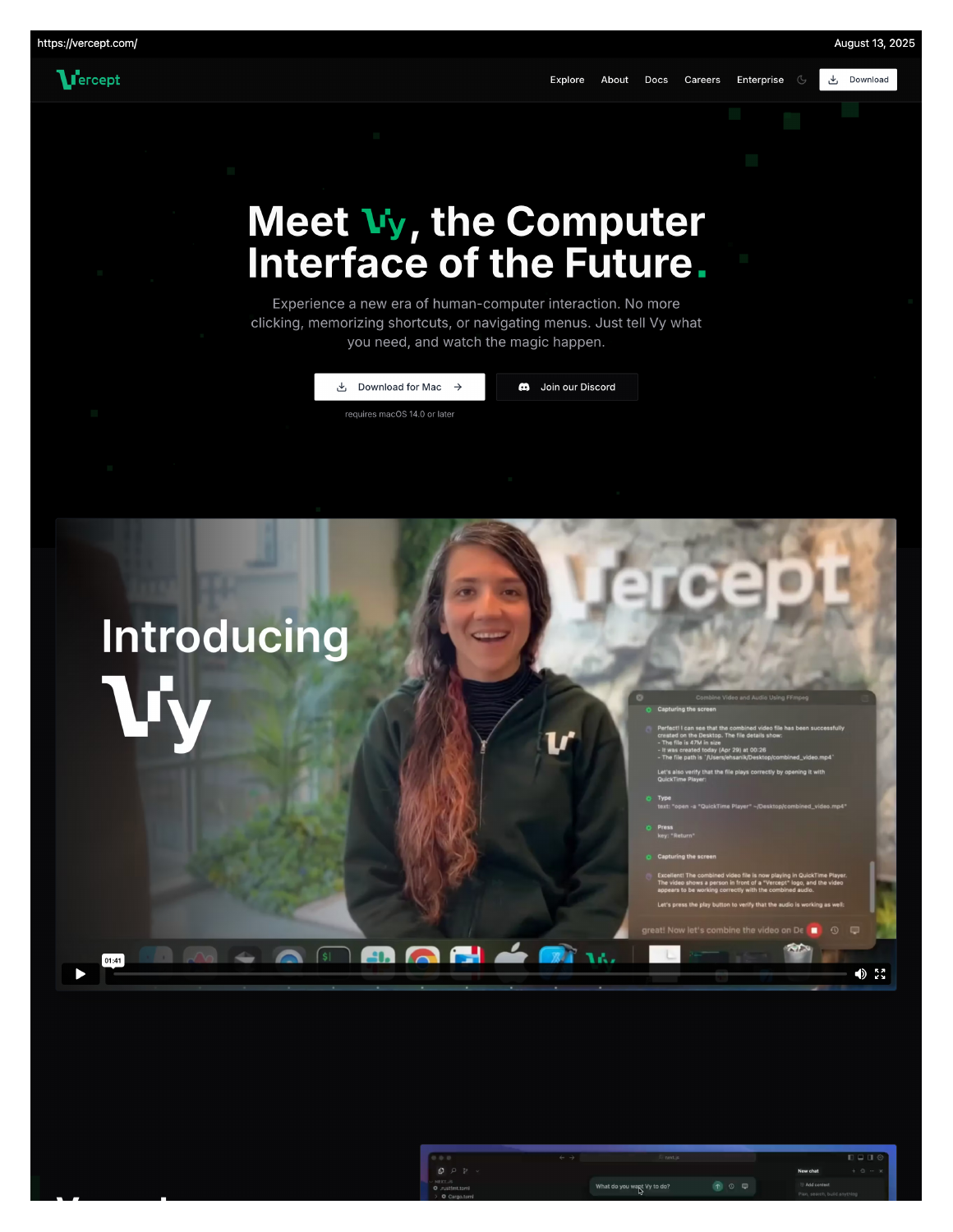
The launch called Vy a native app with access to already signed-in applications. Native installation did not establish that all computation stayed on the device: Together's case study documents hosted inference. That distinction matters when evaluating access to screens, accounts and sensitive information.[9][10]
Market Position
Target Customers
The product addressed people who needed software to perform unfamiliar or repetitive work. Vercept distributed a Mac download and invited users into Discord. Together's customer study describes use in software, finance and content creation, plus accessibility use through speech-to-text. It names no paying customer organizations, so those examples establish use cases rather than verified enterprise contracts.[11][10]
Market Size
No defensible company-specific market-size estimate appears in the examined sources. A broad count of knowledge workers would not establish who trusted Vy with accounts, used it repeatedly or paid for it.
Competition
The competitive boundary moved through the product itself. Anthropic wanted the same perception-and-action expertise for Claude, while Vercept sought an independent interface to existing apps. By March 2026, Anthropic offered desktop computer use through Cowork and Claude Code. UiPath also announced autonomous test execution for October 2026. A new entrant must compete with both general assistants and established automation vendors.[12][13]
Business Model
Vercept sold paid subscriptions, as its cancellation notice confirms. The examined primary sources do not establish price history, recurring revenue, retention, gross margin or customer acquisition cost. Ehsani's more-than-$50-million funding disclosure measures capital raised, not revenue or exit proceeds. The acquisition's financial terms were not disclosed.[2][7][14]
Traction
Together reported a sudden tripling of users without providing the starting count. Its study also reported 92% on ScreenSpot v1, which tests identification of interface elements. Neither figure establishes paid retention or reliable completion of whole workflows. A model can identify a button correctly while the overall task still fails.[10]
Post-Mortem
The research continued while the product ended
The acquisition joined a specialist research team to a lab already pursuing computer use. That fit is explicit in Anthropic's announcement. The inference is that the team's perception and interaction expertise had value beyond the independent Vy subscription business. The public record does not establish whether selling maximized financial returns or whether independence would have produced a stronger business.[1]
The strongest counterargument comes from Ehsani herself: she described ample runway and a successful product, then framed joining Anthropic as a way to pursue a shared mission at greater scale. That account contradicts a cash-exhaustion explanation. It also remains a founder's assessment, unsupported by published revenue or retention figures.[7]
Technical progress did not guarantee service continuity
Etzioni objected to the customer outcome, writing that Vercept was “giving their customers 30 days to get off the platform.” The disagreement shows two different measures of success. Researchers could continue their work inside Anthropic; users still had to replace a tool they had adopted.[15]
The structural risk is specific to broadly capable automation. The same reusable skills that help an independent product operate many apps also make its researchers valuable to a general-purpose model lab. Customer-specific deployment knowledge can strengthen an independent business, but this record does not show whether Vercept had accumulated enough of it to outweigh the acquisition opportunity.
A subsequent Claude release is evidence of Anthropic's continuing product direction. It does not prove which capabilities came from Vercept or measure the acquired team's contribution. That attribution remains unavailable.
Key Lessons
- Measure finished work. VyUI's screen-element benchmark addressed a real technical problem. Buyers still needed evidence that complete jobs succeeded under their own conditions.
- Track the service separately from the team. Vercept's expertise continued after acquisition, while Vy's subscription service received a shutdown deadline. Those outcomes matter differently to founders and customers.
- Make continuity part of the product. A customer adopting cross-app automation should test replacement and recovery paths before depending on it. Vercept's short migration window shows why.
Sources
- Anthropic acquisition announcement
- Vercept acquisition notice and shutdown FAQ
- GeekWire: founding team
- Luca Weihs: biography and November 2024 news
- Ross Girshick: biography
- Matt Deitke: biography and founding announcement
- Kiana Ehsani: why Vercept joined Anthropic
- GeekWire: seed funding and Vy
- Vercept: Vy launch and demonstration
- Together AI: Vercept customer study
- USPTO: Vercept website trademark specimen
- Anthropic: desktop computer use
- UiPath: autonomous testing announcement
- GeekWire: acquisition and founder disagreement
- Oren Etzioni: customer shutdown response