Appjet (S07) at a glance
- The showcase became the product. Real-time collaboration turned hard synchronization technology into an obvious user benefit.
- Acquisition did not erase user obligations. The first closure plan triggered opposition because hosted data and continuity still mattered.
- Open source changed the ending. Community pressure produced an Apache release that outlived both the hosted service and the acquirer's collaboration product.
- A repository is not a handoff. Exports, deployment guidance, governance, maintainers, dependencies, security ownership, and support determine continuity.
Overview
AppJet was a developer-platform and collaboration startup founded by David Greenspan, Aaron Iba, and J.D. Zamfirescu in 2007 and accepted into Y Combinator's Summer 2007 batch. It began as browser-based hosting for server-side JavaScript, tried a PHP pivot, then turned internal real-time synchronization technology into EtherPad.[1][2]
Google acquired AppJet on December 4, 2009 and moved the team into Google Wave. The price was not disclosed. Contemporary estimates placed it in the low eight figures, but those reports are not confirmed terms.
The hosted EtherPad service eventually closed, but user backlash changed the transition. AppJet restored pad creation, released EtherPad and its framework under Apache 2.0, and enabled community successors. The current Etherpad project preserves the real-time editing model and remains actively self-hosted.

Founding Story
AppJet's archived company page names Greenspan, Iba, and Zamfirescu as a three-person executive team. All were MIT alumni; Iba and Zamfirescu had worked at Google. Greenspan specialized in virtual machines and JavaScript, Iba led front-end work and business, and Zamfirescu wrote the web server and persistent-storage system.
The founders wanted beginners and experienced developers to build simple web applications without configuring several languages and infrastructure layers. Iba described the frustration directly: “We were sick of all the hassle of setting up servers, configuring apache, installing MySQL and php and mod_whatever.”[3]
The public beta launched in December 2007. Developers wrote JavaScript in a browser editor, saved it, and published immediately to a hosted URL. AppJet supplied database and Facebook libraries, free hosting, and 10 MB of storage.[4] Source code was inspectable by other users, combining deployment with a learning environment.
The first platform tried to build both a web framework and a hosting service. YC later described this as attempting Rails and Heroku simultaneously, too much infrastructure and product for the startup's financing.[5] A second incarnation moved toward PHP, but YC said the founders disliked the work and abandoned it.
The third incarnation returned to JavaScript and exposed the team's difficult real-time synchronization libraries. EtherPad began as an internal tool and technology showcase. It became the company because users wanted collaborative editing more than a general development platform.
The packet contains only one direct founder quote. No second founder quotation about the pivot or acquisition surfaced, so one should not be reconstructed from secondary paraphrase.
Timeline
- Summer 2007: AppJet entered Y Combinator.
- December 12, 2007: The browser IDE and hosted server-side JavaScript platform launched publicly.
- November 19, 2008: EtherPad launched as a real-time collaborative editor.[6]
- July 1, 2009: Free AppJet application hosting ended so the team could focus on EtherPad.
- September 3, 2009: EtherPad added its document-history time slider.[7]
- December 4, 2009: Google acquired AppJet and moved the team into Google Wave.[8]
- December 4-5, 2009: User opposition prompted a revised closure plan and an open-source commitment.
- December 17, 2009: AppJet released EtherPad and its framework under Apache 2.0.[9]
- April 14, 2010: The original hosted service stopped accepting new pads.
- May 14, 2010: etherpad.com closed; independent services continued from the open source.[10]

What They Built
The original AppJet product was a browser-based editor, runtime, and hosting platform where JavaScript ran on both client and server. Its stack used the Java virtual machine, Mozilla's Rhino engine, and Scala libraries. Developers received an online editor, custom domains, tutorials, examples, storage, hosting, and a support forum.
Running arbitrary user code required isolation and scheduling. AppJet dynamically allocated processor time and stopped abusive programs after a bounded amount of compiled code ran. That addressed multi-tenant resource allocation, infinite loops, and malicious code. The bespoke runtime also made departure difficult: hosted applications could require substantial work or a dedicated server to run elsewhere.
EtherPad narrowed the value proposition. A user created a pad, shared its URL, and collaborated without installing software. Character-by-character changes appeared in real time. Each author received a distinct color; the interface included sidebar chat, saved versions, line numbers, and optional JavaScript syntax highlighting.
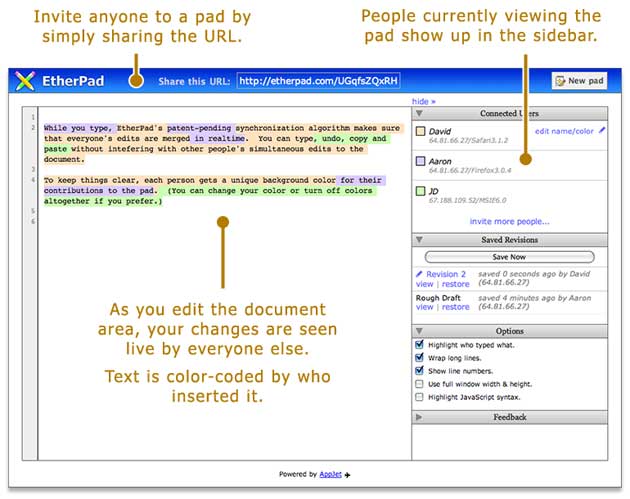
At launch, TechCrunch contrasted that immediacy with Google Docs updates reported around fifteen seconds apart. No independent latency benchmark survives, but the user experience difference was clear. EtherPad later added rich-text formatting, Word, PDF, text, and HTML import or export, plus a time slider that replayed the complete evolution of a document.
The synchronization model, later documented as EasySync, represents edits as changesets and composes concurrent changes through a central server.[11] The maintained codebase identifies parts of its changeset library as copied from the old EtherPad, preserving technical lineage.[12]
The planned business model included access controls, private URLs, professional accounts, and an on-premises Private Network Edition. The free hosted edition supported up to eight concurrent editors. A small number of customers reportedly paid $8 per user monthly, but no revenue or customer count was disclosed.[13]
Market Position
AppJet's platform competed for developers who wanted less infrastructure setup. Its appeal anticipated later platform-as-a-service products, but its scope was unusually broad: language runtime, framework, browser IDE, database layer, hosting, security isolation, tutorials, and community. That made it useful but capital-intensive to maintain.
EtherPad competed more directly with Google Docs, wikis, and installed collaborative editors such as SubEthaEdit. Its advantage was focus. Sharing a URL produced a collaborative space immediately, and every keystroke was visible in real time. TidBITS later characterized it as easier to explain than Google Wave.[14]
The pivot also improved strategic clarity. The general platform had no disclosed user or revenue scale. EtherPad generated hundreds of requests for professional versions, according to the company, and aligned a hard technical capability with a growing collaboration market.
At acquisition, contemporary coverage described a five-person team that included three former Google employees.[15] Google's public rationale emphasized real-time web-collaboration expertise and a shared vision, not AppJet revenue. Public evidence does not establish that EtherPad code became Google Docs, nor identify which components entered Wave.
The hosted shutdown created a second market question: could the product survive the company? The answer was yes because open source changed the custody model. The current Etherpad project remains Apache-licensed and self-hostable, centered on real-time editing, author attribution, revision history, and a time slider.[16]
That survival is stronger than brand continuity. It preserves code and user experience through community maintenance, even though the original hosted service and Google Wave ended. Current project usage claims include Wikimedia, governments, universities, public institutions, newsrooms, and self-hosters, but no audited deployment census exists.
Business Model
The AppJet beta offered free hosting and 10 MB of storage. Paid compute and storage were possibilities, not demonstrated revenue. No platform user count, application count, compute volume, or financing total was found.
EtherPad planned premium access controls, private URLs, and on-premises deployment. A small customer group reportedly paid $8 per user per month for Professional. Private Network Edition customers had licensed installations and support contracts, but no installation, contract, or revenue totals were disclosed.
Google's acquisition terms were not disclosed. TechCrunch reported a low-eight-figure price, while other coverage placed it near $10 million or below $20 million.[17] These are unconfirmed estimates, not deal terms. No audited revenue, expenses, capital raised, ownership, consideration mix, retention package, or proceeds were found.
Traction
EtherPad produced hundreds of professional-version requests according to AppJet, a clearer signal than the platform had shown. The acquisition discussion reached 258 Hacker News points and 98 comments, while the source-release discussion reached 275 points and 73 comments.
The open-source release generated immediate self-hosting discussion and later successor services. Current Etherpad survival is meaningful, but the original pad count, daily users, editor concurrency, growth rate, exports, and deleted hosted data remain unknown.
Post-Mortem
The acquisition succeeded, but the first closure plan failed users
Google acquired AppJet on December 4, 2009. The team joined Google Wave, and professional users stopped being charged. Private Network Edition installations could continue and support contracts would be honored.
The initial plan stopped new free pads and accounts, kept the hosted service available through March 2010, and promised export paths. That paired a successful team acquisition with termination of a collaboration service on which users relied.
The backlash mattered. Within a day, AppJet and Google restored public pad creation, kept the service available during transition, and promised to open both EtherPad and the underlying framework. Existing users could download pads, paid users could export accounts, and self-hosted customers kept installations.
Open source converted shutdown into continuity
The Apache 2.0 release followed on December 17. It was not the original plan; community pressure directly contributed to it. The change did not preserve the hosted service forever, but it preserved the software and made independent operation possible.
The original etherpad.com stopped accepting new pads in April and closed in May 2010. Public evidence does not show that every user completed an export. Yet successors such as TitanPad and the maintained Etherpad project demonstrate that the handoff supported product survival beyond Google Wave.
The first platform exposed transition risk earlier
AppJet had already closed free application hosting in July 2009. Because applications depended on a bespoke runtime, migration could require major work. That earlier transition previewed the same custody problem: hosting convenience creates responsibility for data export, deployment documentation, source availability, licenses, dependencies, and support windows.
The durable asset was a focused capability
YC described AppJet as completing three startups in two years: the server-side JavaScript platform, the PHP attempt, and the real-time JavaScript collaboration product. EtherPad won because it turned synchronization technology into a clear user action. The broad platform tried to solve too much infrastructure; the narrow collaboration product made its differentiation immediately legible.
The rebuild opportunity is therefore not another hosted editor or code forge. It is a metadata-only registry that proves a hosted-service closure and open-source handoff covered dates, notices, exports, repository state, license, deployment documentation, trademarks, governance, maintainers, security ownership, support, exceptions, and corrective actions.
Key Lessons
- A technology showcase can be the product. EtherPad exposed real-time synchronization through a simple shared URL, while the broader platform buried it under infrastructure scope.
- Acquisition does not erase user obligations. The first shutdown plan triggered immediate opposition because exports and service continuity mattered independently of the team outcome.
- Open source changed the closure result. Apache licensing enabled self-hosting, successor services, and a maintained project after etherpad.com and Google Wave ended.
- A release is not a complete handoff. Repositories need deployment guidance, maintainers, security ownership, support endpoints, and customer export evidence.
Sources
- Archived AppJet company page.
- Y Combinator, AppJet profile.
- SitePoint, AppJet platform discontinuation.
- TechCrunch, 2007 AppJet launch.
- Y Combinator, AppJet acquisition retrospective.
- TechCrunch, 2008 EtherPad launch.
- TechCrunch, EtherPad time slider.
- InformationWeek, Google acquisition report.
- LWN, Apache source release.
- Linux Community, hosted closure and TitanPad.
- Etherpad EasySync manual.
- Current Etherpad repository.
- VentureBeat, acquisition and Professional pricing.
- TidBITS, revised transition plan.
- Phys.org, acquisition team report.
- Current Etherpad project profile.
- TechCrunch, acquisition terms report.
- Hacker News, acquisition discussion.
- Hacker News, open-source release discussion.