Overview
Deliveroo made restaurants without their own couriers available for home delivery. The app mattered because it coordinated a physical service: food preparation, rider arrival, and a short journey. Its economics depended on enough demand in each neighborhood to keep that service useful and affordable.
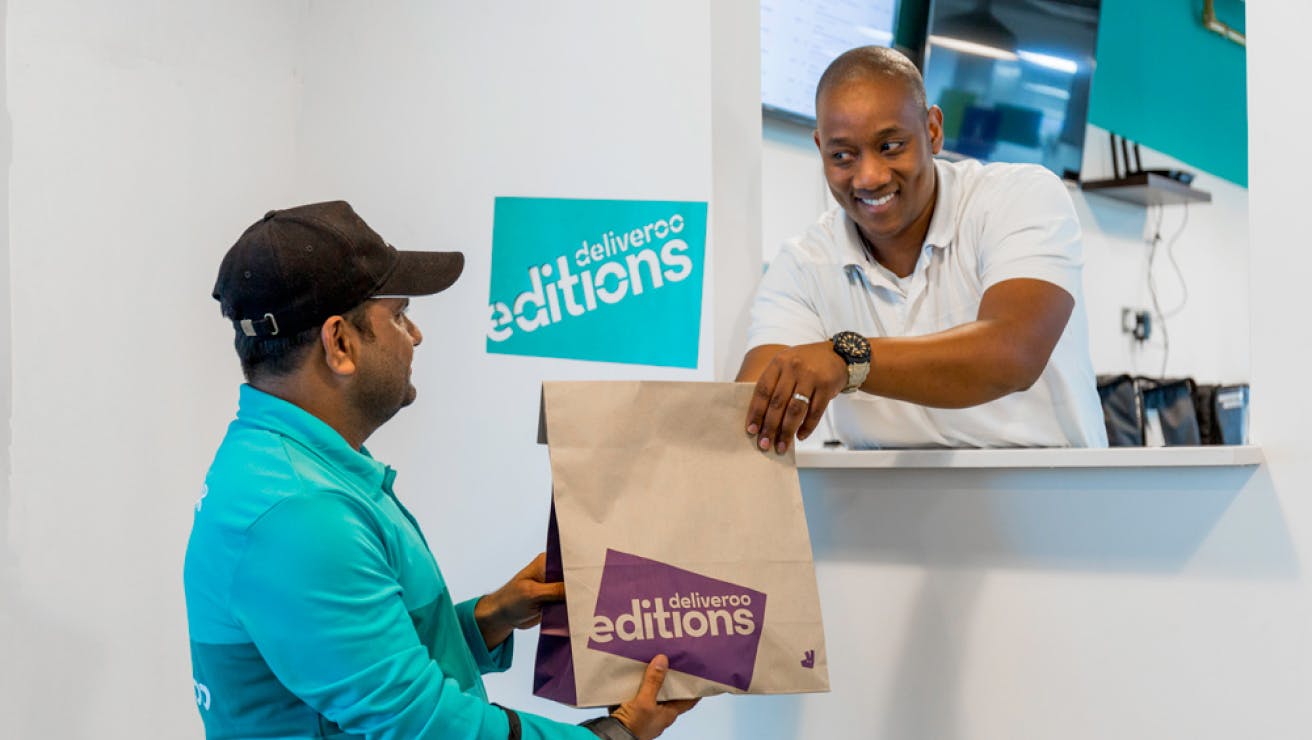
Image 1 / 1
Will Shu and Greg Orlowski launched the business in 2013. DoorDash completed its acquisition on October 2, 2025. Deliveroo continues as a consumer and merchant service, although its new owner has withdrawn it from some countries.[1][11][12]
The useful invention was delivery supply
In a 2016 interview, Shu described finding few appealing London restaurants that delivered. Affordable tablets and smartphones let his team connect restaurants, customers, and couriers without requiring a restaurant to operate its own fleet. Shu spent the early months making deliveries himself. That gave the founder direct exposure to the service his software had to coordinate.[1]
The restaurant supplied food and preparation capacity. Deliveroo supplied ordering, customer acquisition, payment collection, and delivery. A customer could discover a restaurant that previously could not serve their home. Each additional merchant improved selection, but only within a useful journey of the customer. National restaurant counts could not compensate for a weak local offering.
The 2024 annual report explicitly linked profit potential to local share, population density, affluence, and merchant supply. That is management’s strategic account. The practical inference is that orders near one another can support shorter rider journeys and more productive delivery capacity. Expansion into another country starts new local markets; it does not inherit the same economics automatically.[2]
Merchant growth also changed the operating burden
Deliveroo Editions, launched in 2017, put restaurant brands into kitchens built for delivery. Contemporary reporting described brands staffing their kitchens while Deliveroo supplied infrastructure in exchange for a larger commission, or a smaller fee when brands funded construction. This moved the company beyond matching existing restaurants with riders into influencing where food was produced.[5]
The offer reduced the need for a restaurant to open a full dining room in a new catchment. It also introduced physical capacity and site operations. That tradeoff matters: a kitchen still needs enough orders to justify the people and space. Editions remains a current merchant offering; the present page promotes expansion into delivery-only locations.[6]
The 2019 acquisition of Edinburgh software studio Cultivate addressed another layer of the marketplace. Cultivate had already worked on Deliveroo’s payments for three years. The transaction adviser’s account linked the acquisition to payment improvements and more information for restaurants and riders. Reliable settlement was part of keeping both sides participating, even when customers mostly saw an ordering screen.[7]
Funding and regulation affected the model
Amazon’s minority investment required a prolonged competition review. The CMA cleared a 16% stake in August 2020. Its reasoning changed during the pandemic: early financial evidence suggested an urgent cash crisis, but improving conditions led it to conclude Deliveroo was no longer likely to exit. The final clearance rested on competition analysis. Treating the initial emergency forecast as the final outcome would reverse the regulator’s conclusion.[3][4]
Courier classification was a separate constraint. In November 2023, the UK Supreme Court dismissed the IWGB’s collective-bargaining appeal. The judgment concerned a specific statutory and human-rights question; riders’ ability to substitute another person was material. It did not settle every employment question in every country.[8]
In Italy, Eurofound’s repository records judicial administration in February 2026 following allegations about rider pay and exploitation. That is a secondary account of the court measure, rather than a reading of the original order. Separately, the Italian Competition Authority opened an investigation in May into potentially misleading claims about ethical and social commitments to riders. An investigation establishes scrutiny, not a final finding of liability.[10][9]
These issues affect operating design as well as legal expense. A marketplace promising quick delivery must attract enough couriers under the rules of each jurisdiction. A favorable ruling in one country cannot establish the cost of operating elsewhere.
Volume finally produced a small annual profit
The reproduced 2024 annual report records 296.0 million orders, £7,433.5 million gross transaction value, and £2,071.9 million revenue. These are different measures: order count, transaction value, and company income. Adjusted EBITDA was £129.6 million, or 1.7% of GTV. Profit for the year, including continuing and discontinued operations, was £2.9 million. The larger adjusted measure excludes costs that remain relevant to shareholders.[2]
The same report attributes improvements partly to stacked deliveries and shorter rider waits. It says Plus subscribers generated 44% of fourth-quarter orders. These observations connect service coordination and repeat use to the financial story, but do not isolate how much either caused the profit improvement. A profitable year also does not establish that every country or restaurant benefited equally.[2]
Merchant economics remain distinct from platform economics. Deliveroo’s UK terms charge a percentage service fee plus VAT, with settlement adjustments for relevant refunds. Commercial terms vary. A merchant still pays for ingredients, packaging, kitchen labor, and premises from what remains. Applying one assumed commission rate to every restaurant would misstate that calculation.[17]
DoorDash bought a continuing service
The October 2025 closing announcement confirms a completed court-sanctioned acquisition. In February 2026, DoorDash announced exits across Deliveroo and Wolt in Qatar, Singapore, Japan, and Uzbekistan. It cited country conditions and the path to sustainable scale. Singapore’s Deliveroo site now states that service has ended. These country exits are narrower than closure of the whole company.[11][12][13]
Prices checked on November 5, 2026 show continuing local offers. The UK Plus page advertises Gold at £4.99 monthly, with free delivery above £10 at restaurants and £15 at shops. Its FAQ also lists other customer-specific Gold prices and contains inconsistent annual figures, so a universal annual rate is not established here. Service and small-order fees can remain. Silver comes through partnerships, including Amazon Prime, while Diamond is invitation-only.[14][15]
France advertises Plus Or at €3.99 monthly with a €12 qualifying minimum and up to 50% service-fee savings at nearby partners. Country terms differ. UK Uber One currently advertises £4.99 monthly or £49.99 annually, with eligible-order conditions. Subscription price alone therefore does not compare the total cost of the same basket.[16][24]
Current merchant tools also constrain a new entrant. Deliveroo policies tell restaurants to prepare by collection time, package accurately, and use Busy Mode when needed. DoorDash has a Menu Assistant with recommendations and automated edits. Wolt’s portal provides performance-based growth suggestions. Deliverect sells order integration and menu management on custom quotes.[18][19][20][21]
Test the meal after the journey
A narrow opportunity worth testing is Triptest: a guided comparison of packaging and presentation for independent restaurants launching delivery dishes. A cook would test the same dish after a measured journey and keep photos, packaging cost, and sensory observations together.
This practice already exists. A DoorDash-sponsored 2024 study reports that some operators taste-test delivery food, with positive self-reported results. Its US surveys establish interest in food quality, not causal gains or UK demand for another paid tool. DoorDash also publishes free packaging guidance. Triptest would have to improve the consistency of a restaurant’s own tests enough to beat a phone camera and spreadsheet.[22][23]
Timeline
- 2013: Shu and Orlowski launch Deliveroo in London.
- 2017: Editions introduces delivery-only kitchen expansion.
- 2019: Deliveroo acquires its payments collaborator Cultivate.
- 2020: The CMA clears Amazon’s 16% minority investment.
- 2021: Deliveroo becomes publicly listed.
- 2023: The UK Supreme Court dismisses the IWGB appeal.
- 2024: The group reports a £2.9 million annual profit, including discontinued operations.
- October 2025: DoorDash completes the acquisition.
- 2026: Country withdrawals and Italian regulatory scrutiny accompany continuing UK and French products.
Sources
- Will Shu founder interview
- Deliveroo 2024 annual report, ESEF reproduction
- CMA final decision on Amazon minority stake
- CMA final report summary
- Deliveroo Editions launch
- Current Editions offer
- Cultivate transaction adviser account
- Supreme Court press summary UKSC43
- AGCM opens investigation
- Eurofound Italian judicial administration record
- DoorDash acquisition completion
- DoorDash country wind-down
- Singapore closure notice
- UK Plus price
- UK FAQ
- France Plus price
- Merchant service terms
- Merchant policies
- Native DoorDash Menu Assistant
- Wolt merchant portal
- Deliverect pricing
- DoorDash Technomic menu study
- DoorDash packaging guide
- UK Uber One price