Overview
Postmates made local stores available through a courier network before those stores had their own delivery systems. Its consumer app sold convenience; its delivery interface let other businesses use the same network. The company gained a valuable position in Los Angeles and the southwest, and Uber completed its acquisition in December 2020. The Postmates brand continues. The central lesson is that broad selection and frequent ordering can create strategic value while the independent business still loses money. [13]
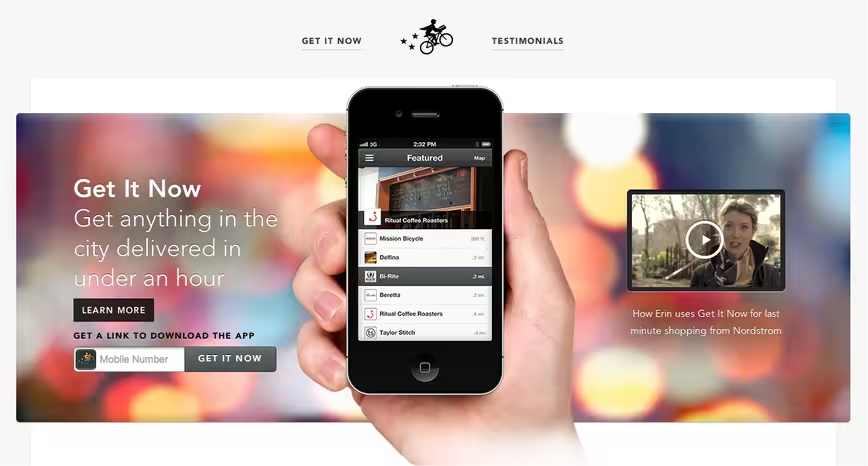
Image 1 / 1
A consumer order could start without a merchant integration
Bastian Lehmann, Sean Plaice and Sam Street founded Postmates in 2011. The initial merchant-oriented idea expanded into a consumer application, where food became a frequent use. [1]
Early deliveries included personal belongings. The consumer proposition then extended to buying goods from local stores. This reduced the need to convince every merchant to install software before a customer could order. A courier could collect the goods, and the customer could follow the delivery. That breadth was useful, but it also left product availability and preparation outside Postmates’ direct control. [2]
The software connected a customer, a merchant and an independent courier. Nearby demand mattered because physical travel and waiting remained part of each order. A restaurant listing could increase selection without improving courier availability at the place and time a customer needed it. That is an operating constraint, not a conclusion that every city or order lost money.
In December 2014, Postmates opened an application programming interface, or API, for other companies to request deliveries. The launch included six partners, among them Threadflip, Curbside and Betabrand. Consumers could receive tracking without leaving the partner’s app. This created distribution through existing storefronts as well as the Postmates app. [3]
Partnerships made the promise more specific
Chipotle named Postmates an official delivery partner in 2015. Its executives said earlier unauthorized services raised concerns about quality and following restaurant rules. A signed partnership therefore added operational agreement, beyond putting another name in a directory. [5]
Starbucks’ December 2015 Seattle pilot went further. Customers ordered inside Starbucks’ iOS app, kept customization and loyalty benefits, and received delivery through Postmates. The companies coordinated sending an order to a barista near pickup time. This connected software distribution to preparation, which mattered for a product whose quality changes during a trip. The pilot covered selected neighborhoods; it was not a national launch. [4]
Postmates also cultivated a consumer identity. Its January 2019 celebrity series, The Receipt, described Kylie Jenner’s purchasing habits. This was promotional evidence of how the company marketed convenience, not proof of typical customer frequency or cheap acquisition. [8]
The distinction between available merchants and merchant partners remained important. Uber’s July 2020 presentation reported 115,000 partnered merchants as of March 31. Its December closing announcement described over 600,000 restaurants and retailers available for delivery and pickup. These measures described different relationships and dates. [12][13]
Lower customer fees still needed someone to pay
Postmates used merchant-supported delivery discounts and introduced Unlimited. In 2016, Unlimited cost $9.99 monthly and waived eligible delivery fees above a $30 order threshold. The offer encouraged repeat use while merchants helped fund a cheaper customer experience. [1]
In March 2019, Party offered free delivery when customers joined nearby orders within a five-minute window. It encouraged customers to choose places already attracting demand, rather than spreading requests evenly across every listed store. This is a plausible way to reduce travel per order; the announcement did not establish realized savings. August’s Group Orders added shared links and spending limits for friends or colleagues. [6][7]
Uber’s acquisition presentation said Unlimited supplied more than 30% of Postmates orders. That showed a meaningful subscription channel, without establishing the profit on those orders. [12]
Postmates’ audited accounts show the gap. Revenue rose from $159.9 million in 2018 to $320.8 million in 2019, while net loss widened from $129.3 million to $420.3 million. In 2019, sales and marketing expense alone reached $335.2 million against $189.5 million of gross profit. Revenue was recognized after settling merchant purchase value and courier fees; gross profit was therefore not the total customer bill minus only a few software costs. These are annual company figures, not per-order contribution margins. [9]
The accounts support a spending and funding problem. They do not isolate whether promotions, particular cities, operating choices or competitive pressure contributed most. Dense markets and batching could improve fulfillment without paying for the entire company.
An IPO route became a network combination
In January 2019, Postmates raised $100 million at a reported $1.85 billion valuation. [11]
It confidentially submitted an initial public offering registration on January 22, 2019, and continued amendments through May 2020. The merger filing says 2019 talks with Uber failed partly because Uber considered its improving unit economics still challenged. This was Uber’s assessment in negotiations, not an independent verdict on every market. [10]
The July 2020 deal valued Postmates at approximately $2.65 billion in stock, subject to adjustments. Uber identified strong southwestern cities, local restaurant brands and complementary delivery technology. Its target of over $200 million in annualized savings a year after closing was a forecast. Shared couriers and merchants could reduce duplicated investment and improve matching; the target itself proves no realized saving. [12]
Uber completed the acquisition on December 1. Its 2020 accounts recorded $3.902 billion as the acquisition-date fair value of consideration, including shares, a note and assumed awards. That accounting measure differs from the announced transaction value, partly because shares were valued at closing. [13][14]
Robotics followed another path. In March 2021, the former Postmates robotics division announced its separation as Serve Robotics, with backing from Neo and Uber. That continuing company is distinct from the retained consumer brand. Its existence does not establish that robots solved Postmates’ historical delivery costs. [16]
What remains available today
On November 5, 2026, Apple listed the Postmates iPhone app under Uber Technologies. It advertised restaurant and retail delivery, advance ordering, tracking and pickup. Uber’s merchant page promoted access to the combined network. Its migration documentation describes moving Postmates delivery-service merchants onto Uber Direct, including compatibility for existing API calls and new dashboard credentials. [17][18][15]

The US Postmates membership page offered Uber One at $9.99 monthly or $96 annually. Eligible orders receive a zero delivery fee, with minimums and other fees still applying. Postmates help separately describes delivery, service and small-order fees. An app download or membership cannot establish the final price of a particular order. [19][20]
Merchant economics also remain explicit. Uber’s standard US changes effective March 11, 2026 list delivery marketplace fees of 20% for Lite, 25% for Plus and 30% for Premium. Plus reaches 30% on Uber One orders. Pickup is 7% with validated in-store pricing, otherwise 10%; local and custom terms vary. These are current Uber merchant packages, not historical Postmates commissions. [21]
Owning the ordering interface is already an available option. Uber Direct publicly starts at $7.99 per delivery, and DoorDash Drive advertises $6.99–$10.99. They fulfill orders from a merchant’s own channels. A new general delivery API would compete with the surviving form of Postmates’ original infrastructure idea. [22][26]
A smaller hypothesis is helping commerce agencies complete store launch rehearsals across checkout, courier collection and staff exception handling. Uber already provides simulated courier tests and requires store pilots, so the opportunity would be paid execution and reusable acceptance records. It needs customer evidence before becoming a standalone software business. [24][23]
Timeline
- 2011: Lehmann, Plaice and Street founded Postmates. [1]
- December 2014: The delivery API opened another distribution channel. [3]
- 2015: Chipotle partnered; Starbucks began its selected-neighborhood Seattle pilot. [5][4]
- 2019: Party and Group Orders broadened shared ordering; IPO preparation continued. [6][7][10]
- December 1, 2020: Uber completed the acquisition. [13]
- March 2021: Serve announced its independent robotics company. [16]
- November 2026: The Postmates app and membership remain offered under Uber. [17][19]
Sources
- How Postmates survived and thrived despite the naysayers
- Food delivery apps have taken over San Francisco
- Postmates launches its own API
- Starbucks delivery by Postmates launches
- Chipotle begins offering delivery via Postmates
- Postmates launches Postmates Party
- Introducing group orders
- The Receipt: Kylie Jenner
- Uber Form S-4 with Postmates audited statements
- Uber amended Form S-4: transaction background
- Postmates raises $100 million
- Postmates acquisition presentation
- Uber completes acquisition of Postmates
- Uber 2020 annual report: Postmates acquisition
- Uber Direct FAQs for Postmates merchants
- Serve Robotics spins out of Postmates
- Postmates iPhone app listing
- Partner with Postmates
- Uber One on Postmates
- What fees might my order include?
- Uber Eats marketplace fee changes
- Uber merchant pricing
- Uber Direct integration overview
- Automated delivery testing
- Uber Direct getting started
- DoorDash Drive On-Demand
- Uber for repair shops