
Product Hunt
Summer 2014AcquiredThe best new products in tech
Pressure-test this opportunity
Explore the risks and possibilities with a prompt for ChatGPT, Claude, or your agent.
The best new products in tech
Explore the risks and possibilities with a prompt for ChatGPT, Claude, or your agent.
Product Hunt turned a daily product list into a recurring meeting place for makers and early adopters. Its history includes acquisition, a spinout and leadership changes, while the service continues to operate. The useful question is how a community preserves its participation and discovery value through those changes. [1] [2]
As checked in October 2026, Product Hunt still offers launches, product categories, reviews, forums, newsletters and advertising. It also publishes launch eligibility and promotion rules. This is an operating platform with documented product changes; the public record does not support treating it as a closed startup or an empty market to rebuild. [3] [4]

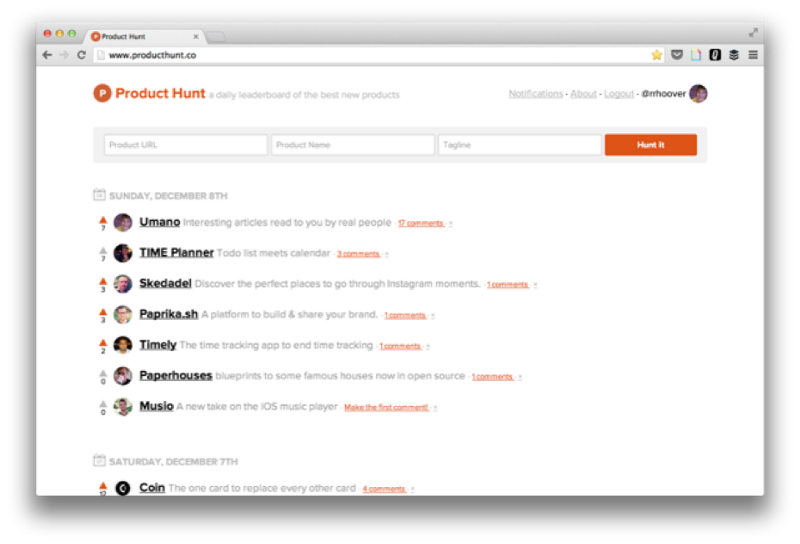
Image 1 / 2
Ryan Hoover started Product Hunt in November 2013 using Linkydink, a collaborative link-sharing tool from Makeshift. He invited startup friends, wrote a blog post and shared the experiment on Quibb and Twitter. His retrospective says the setup took twenty minutes and attracted over 170 subscribers and thirty selected contributors within two weeks. [5]
“Within 20 minutes, I had an MVP,” Hoover wrote. The speed came from using an existing tool and an existing network. He explicitly credited years of blogging and relationships. The result tested whether people wanted recurring product discoveries before he invested in a dedicated application. [5]
Email limited the conversation. Hoover considered Sacha Greif's Telescope before Nathan Bashaw helped build the Rails site over Thanksgiving. Hoover's later account says a functional version took five days. His short explanation of the next need was direct: “I wanted to build a site where I could chat about products with fellow enthusiasts.” [6]
The launch still required manual work. Hoover's January 2014 account describes selected beta invitations, personal welcomes, feedback and tailored outreach. He reported 2,000 users twenty days after public launch. These were founder-reported counts; their significance is the sequence of cultivation before broad distribution. [7]
The original product combined a daily feed, votes, comments, maker participation and email recurrence. Readers could discover a release, ask its maker a question and visit the product. The early interface made this simple enough to become a daily habit. The current launch guide still describes community participation and a homepage leaderboard, while distinguishing submission from editorial featuring. [14]
Community members also built around the platform. Hoover documented Yvo Schaap's leaderboard, Andreas Klinger's Chrome extension and Huntalytics, followed by an official API. Klinger later joined the team. These examples show the community supplying both integrations and potential teammates. They do not establish that every historical extension or API still operates. [6]
Ayyangar's 2023 introduction described his own launches, including Tandem, and identified a limitation: discovery after launch did not sufficiently help users find the best product for a particular need. He discussed Pro Tips as community-maintained product knowledge and further moderation tooling. Those were stated product directions, not proof of every subsequent feature's adoption. [11]

Product Hunt sits among other routes to technology attention: Hacker News, Reddit, app stores, review sites, newsletters and makers' own audiences. Its distinctive asset is the recurring launch community. Copying a vote button would not recreate the participants or their expectation of finding something new each day.
The contemporary product explains important boundaries. Its launch guide says featuring depends on factors beyond votes, and it withholds exact algorithm details to reduce gaming. Its promotion guidance prohibits asking specifically for upvotes, rewarding votes or spamming. Makers are encouraged to request feedback and respond to comments. These rules make organic community participation different from purchased visibility. [4] [15]
The October 2025 points explanation says ranking incorporates genuine engagement, including comments, and that votes can carry different weights. It describes the metric's purpose; it does not independently prove ranking fairness or reveal the algorithm. A displayed number therefore needs its documented meaning and period, especially when comparing historical launches. [13]
TechCrunch estimated the acquisition near $20 million; the price was undisclosed. [9] In 2020, Hoover described the business as profitable and Buckley's investment as significant, without publishing an amount or audited financial statements. Current revenue, margins, ownership percentages and profitability remain unavailable. [10]
Product Hunt currently sells display advertising, newsletter sponsorships and managed campaigns. Its advertising page also offers promoted discussions, AMAs and event partnerships. These are concrete revenue products. The published customer testimonials are marketing evidence rather than independently verified attribution of sales or profitability. [16]
In October 2020, Hoover reported more than 200,000 products launched, 350 million product discoveries and 750 meetups. Those cumulative company counts describe reach across years. They are not current active-user counts or measured customer retention for the products discovered. [10]
The advertising page publishes different newsletter audience figures in different sections, without an accompanying reconciliation. They cannot supply a single verified current subscriber count. The record gives stronger evidence of a durable discovery channel than of the economics of an average launch. [16]
Product Hunt's acquisition announcement promised an independent platform alongside AngelList. The 2021 spinout announcement said independent operation would support a more focused leadership structure and larger projects. It called AngelList a continuing major investor and key partner. The exact closing date and subsequent control rights were not disclosed in those announcements. [1] [2]
Hoover also described burnout when explaining the 2020 CEO transition. This was his own account of stepping back while remaining involved. Leadership succession can preserve a platform even when its founder can no longer sustain the original operating role. [10]
A launch community can bring attention without solving every later choice or retention problem. Ayyangar's maker account is useful here: early launches supplied feedback and confidence, while his companies still changed direction. His proposed improvements addressed discovery beyond the initial event. Launch ranking, product usefulness and sustained business performance must be evaluated separately. [11]
The current points documentation, launch rules and sponsorship offerings already provide public explanations. They weaken the claim that Product Hunt has no governance record. An adjacent tool would need to help staff connect a specific ownership or placement change to responsible teams, effective policies and the notice that applies to that revision. Whether teams need and will pay for a separate handoff packet remains unproved.
The platform's continued operation supports a survival account. Its public financial record cannot establish present profitability, and the observed rules cannot prove that every launch is treated fairly. Those limits call for specific measurement rather than a failure story inferred from acquisition or layoffs.