
Trieve
Winter 2024AcquiredAll-in-one API for search, RAG, & recommendations
Pressure-test this opportunity
Explore the risks and possibilities with a prompt for ChatGPT, Claude, or your agent.
All-in-one API for search, RAG, & recommendations
Explore the risks and possibilities with a prompt for ChatGPT, Claude, or your agent.
Trieve was a Rust-based search, retrieval, recommendation, and RAG platform founded in 2023 by Nick Khami and Denzell Ford. The company raised $3.5 million and sold to Mintlify in a completed transaction announced July 24, 2025.[1][2]
This was an acquisition success, not a failure story. Mintlify adopted Trieve before the founders entered YC, relied on it for documentation search, and later bought the team and retrieval technology as search became central to its product. Survival split after the deal: Trieve's code moved from the Business Source License to MIT and remains public, while Trieve Cloud shut down on November 1, 2025. Repository availability is proven; continuing feature investment is not.
Nick Khami and Denzell Ford met as freshman research partners at the University of Texas at Austin while building a machine-learning model to predict oil locations.[3] They later built semantic retrieval for a knowledge-management product meant to help business teams make stronger arguments. At acquisition, Khami described the first application more narrowly as relevancy-optimized retrieval for litigation attorneys.[4] The descriptions are compatible, but the public record does not establish the earlier product's name, customers, or full feature set.
The pivot came from buyer pull. Prospects did not primarily want the argument application; they wanted the semantic-search infrastructure underneath it.[1] Trieve became a general retrieval platform spanning search, recommendations, and RAG. The founders' aspiration was concise: “Power every retrieval experience on the internet.”[1]

Trieve joined the FUTO Fellows Program in 2023 before YC's Winter 2024 batch.[5] Mintlify found the company before YC after an early retrieval demonstration showed strong quality and performance, according to the buyer.[2]
The canonical format asks for two exact founder quotes. The corpus preserves the ambition line above, but not a second verified verbatim passage suitable for reproduction. No speech is reconstructed.
Trieve wrapped a vector database in the application machinery required for production retrieval. Its backend was primarily Rust and used Qdrant for indexing and vector search. Around that core, Trieve built ingestion, multitenancy, chunk grouping, filtering, relevance weights, recency biasing, recommendations, and RAG endpoints.[6]
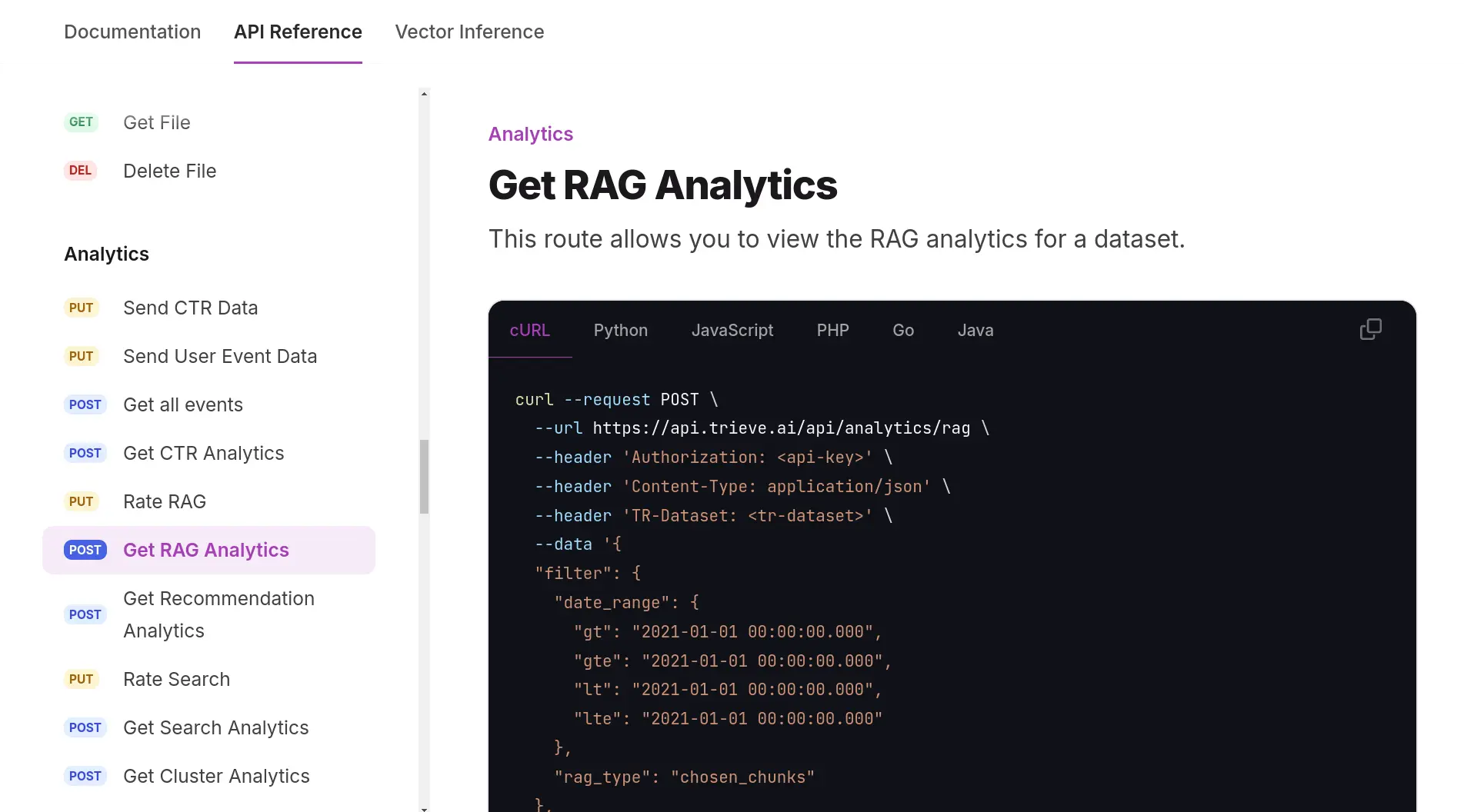
The retrieval path combined dense embeddings, SPLADE sparse vectors, and cross-encoder reranking. Users could replace Trieve's embedding, SPLADE, reranking, or language models with their own.[10] This made relevance tunable rather than fixed to one provider. The product also supported typo-tolerant search, sub-sentence highlighting, grouping, filters, managed-context and user-selected-context RAG, and recommendations.
Trieve could run as a managed cloud or under a paid self-host license through Docker Compose, Kubernetes, AWS, or GCP. TypeScript and Python clients wrapped its REST interface. Access-controlled client keys could restrict routes, organizations, datasets, expiration, and default filters, letting browser clients call search without an extra proxy.[11]
The company also operated dedicated embedding and reranking infrastructure to avoid general-provider latency and rate limits.[12] Its public Hacker News discovery engine demonstrated the product on roughly 40 million vectors. That is a useful scale demonstration, not an independently audited relevance benchmark.
By June 2025, Trieve had expanded from infrastructure APIs into a terminal agent that searched PDF collections. The project showed breadth but attracted less visible interest than the large-corpus demo.
Trieve targeted teams embedding search, recommendations, or RAG into products. Named users included Mintlify, BillTrack50, and AmLaw 100 firms. The company said more than 16,000 search bars ran on its infrastructure.[5] These claims do not establish paid scope, contract size, deployment duration, or customer retention.
No verified revenue, ARR, margins, paid-customer count, cloud usage revenue, self-host license revenue, or professional-services revenue was found. Immediately before acquisition, the founders reported more than 150 million searches, 2.6 million AI conversations, and 5,400 active users.[4] These are company-reported usage metrics, not audited revenue indicators.
Trieve competed directly with Algolia as application search, differentiating through self-hosting, hybrid neural retrieval, RAG, recommendations, and tunable relevance.[6] Qdrant and pgvector could replace pieces of the lower stack, but Trieve argued that its value lay in ingestion, ranking, interfaces, multitenancy, RAG, and operations around vector storage.
The platform's early Business Source License complicated its open-source positioning. Hacker News discussion challenged the label. Relicensing to MIT at acquisition removed commercial-use restrictions but coincided with the end of the managed business.
Trieve sold a managed cloud and paid self-host licenses. An AWS Marketplace engagement also combined search, discovery, and RAG with direct support, showing an enterprise-services channel.[13] Public evidence does not provide numeric pricing or enough storage, RAM, and query data to reconstruct unit economics.
The company raised a verified $3.5 million round and planned to spend it on sales and customer success across commerce, ERP, social media, and adjacent markets.[5] YC lists a seven-person team.[1] Exact headcount at close, burn, runway, ownership, dilution, and investor returns remain unknown.
Neither announcement disclosed price, valuation, consideration mix, earn-out, retention, founder proceeds, escrow, or closing mechanics. July 24 is the completed-deal announcement date; no public legal record establishes the exact closing date.[2]
Trieve's strongest evidence combines developer adoption, named deployments, and buyer use. The 40-million-vector demonstration drew substantial community attention. The financing announcement named customers and 16,000 deployed search bars. Mintlify had already adopted Trieve before YC and used it as the backbone of documentation search.[2]
After acquisition, the founders and team joined Mintlify to lead search infrastructure, though exact employee retention is undisclosed. Code survival is narrower: the MIT repository remains public and unarchived with 2,695 stars and 249 forks, but its last push was January 2026 and its latest release predates acquisition.[10][14]
Trieve's outcome was an acquisition by a preexisting customer, followed by cloud shutdown and code relicensing.
Prospects pulled the founders away from litigation and argument tooling toward retrieval infrastructure. The pivot exposed a broader market and produced a product that a documentation company could adopt early. This was customer discovery with an architectural consequence: Mintlify eventually bought a dependency that had become central to its own user experience.
Mintlify discovered Trieve before YC, tested its retrieval quality, and used it in documentation search. By acquisition, Mintlify said it answered more than 23 million documentation queries each month and wanted Trieve's team to lead search and broader infrastructure.[2] Preexisting production use gave the buyer information that external diligence alone could not.
The founders promised data export, migration support, and continuing self-hosted code. Trieve Cloud then shut down on November 1. The repository became MIT licensed and remained available, but limited post-deal activity cannot support a claim of sustained feature investment. This is the non-obvious mechanism: acquisition improved software freedom while ending the managed product that funded ongoing service.
The counterargument is that cloud shutdown signals product weakness. The record does not show distress, insolvency, or a failed business model. A better reading is buyer focus: Mintlify retained the team and technology for its own retrieval stack while declining to operate a separate general-purpose cloud.