Overview
Boston Dynamics spent decades learning to make machines move through the physical world. Its commercial progress came when that ability served a specific job: inspection with Spot and trailer unloading with Stretch. A remarkable motion demonstration can attract attention. A customer also needs a useful task, dependable operation and affordable support.
Founded in 1992 as an MIT spinout, the company remains active under Hyundai control. Its ownership passed through Google and SoftBank. The ownership changes preserved an operating company with a long research program.[1][2][3]
As of November 5, 2026, the portfolio includes commercial Spot and Stretch robots, Orbit software, and an electric Atlas humanoid in early production. Atlas training and large deployment plans deserve different treatment from demonstrated warehouse operations.[4][5][6]

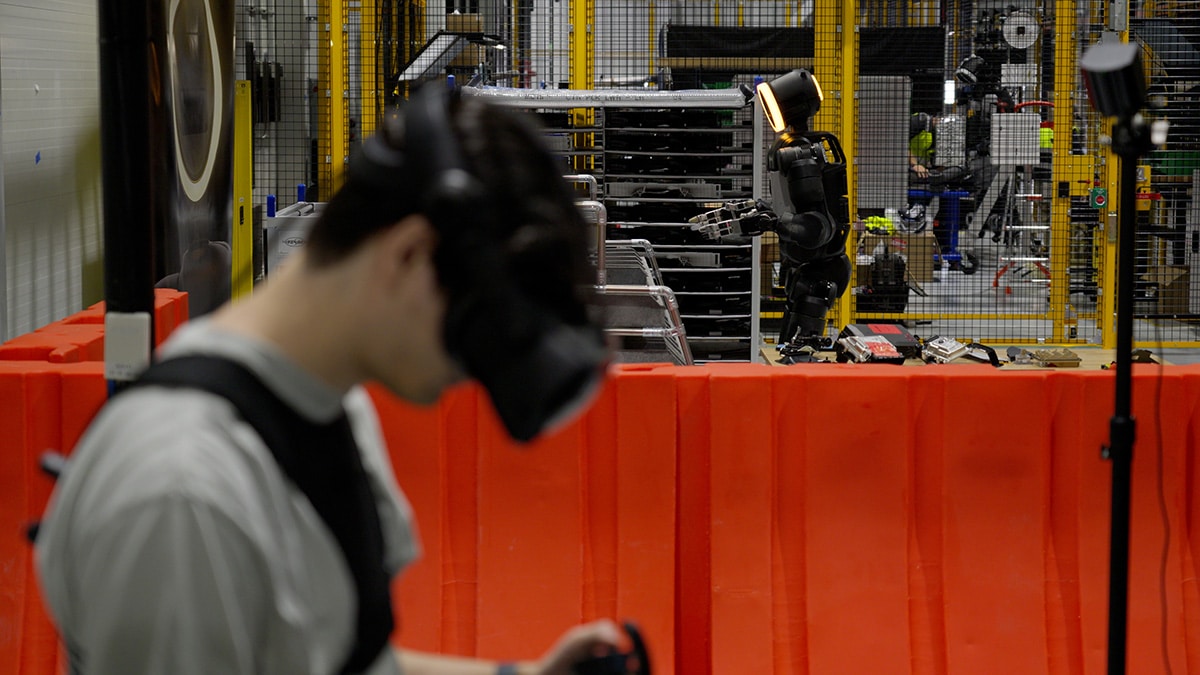
Image 1 / 2
The first commercial lesson came before the famous robots
Marc Raibert founded Boston Dynamics after research on dynamic legged movement at MIT. The early company also built human-simulation software. In a later interview, Raibert described a surgical simulator whose force feedback and graphics attracted enthusiastic surgeons at a trade show. The assumed customer relationship was wrong: surgeons expected payment for their expertise rather than paying for training. Selling to hospitals required resources the small company lacked, so it abandoned the product.[1][7]
Raibert also credited work with Sony on Aibo-related robotics with bringing the team back toward physical machines. He described the company as bootstrapped before Google's purchase. This is a founder's retrospective account, rather than a complete financing record.[7]
The simulator episode makes the later history easier to understand. People can admire a machine without having a budget, a procurement process or a repeatable use for it. That distinction applies to a trade-show queue as much as a viral video.
Research contracts bought hard engineering experience
BigDog took legged robots outside the lab. Its successors required more than balance: the machine had to carry its own power and computing, perceive obstacles and survive difficult terrain. Boston Dynamics' history distinguishes BigDog, LS3, the electric Spot Classic, hydraulic Atlas and the wheeled Handle research project. Handle later contributed to Stretch.[7][8]
Government research supplied both funding and demanding work. A February 2010 DARPA release announced US$32 million for a 30-month LS3 phase covering studies, design and prototypes. That was a development contract, not revenue from a fleet of deployed commercial robots. The program joined DARPA and the Marine Corps Warfighting Lab, with partners including Carnegie Mellon and JPL.[9]
Carnegie Mellon's account assigns Boston Dynamics the mobile platform and describes its own perception work under Boston Dynamics as prime contractor. This division of labor matters. A compelling demonstration can combine the robot maker's hardware with navigation or task software from partners.[10]
DARPA's original Atlas debuted in July 2013 with external power and operator commands. Later changes for the Robotics Challenge improved power efficiency, onboard power and durability. The present electric Atlas is therefore part of a long development lineage, rather than evidence that the original disaster-response prototype became an immediate factory product.[11]
Owners changed before broad product sales arrived
Google acquired Boston Dynamics in 2013. SoftBank announced its agreement to acquire the company from Alphabet in June 2017; it did not disclose transaction terms. Hyundai completed its controlling-interest acquisition in June 2021. That deal valued Boston Dynamics at US$1.1 billion and left Hyundai's group with 80% and SoftBank with 20%. The valuation is not a disclosed cash purchase price for the whole company.[2][3][12]
Hyundai's factories provide places to train and test industrial robots. This can shorten access to real tasks, operators and production systems. It also creates a limit: adoption within a controlling shareholder's facilities does not yet prove broad independent demand.
In July 2026, Hyundai said shareholders were pursuing SoftBank's remaining stake after SoftBank exercised a contractual sale right. Its statement described internal approvals and a contemplated transaction. Some reporting calls the company wholly owned; this analysis confirms Hyundai control but leaves completion of that final purchase unresolved.[13]
Spot converted mobility into a platform
Boston Dynamics opened commercial Spot sales in June 2020, following an early-adopter leasing program. Its announcement reported more than 150 robots used by businesses and researchers. Customers attached sensors and software for construction documentation, remote inspection and hazardous environments. Mounting rails, payload ports and a developer kit let outside teams adapt the robot.[14]
The initial US$74,500 base-kit price belongs to 2020. It should not be presented as a current installed-system quote.[15] Current Spot material reports more than 1,500 robots in customer hands. This is vendor-reported installed-base evidence, without a published utilization or profitability breakdown.[4]
The product extends beyond the walking machine. Orbit schedules missions, manages maps and collects inspection information. Boston Dynamics also sells integration support covering site evaluation, installation and staff competence. A Michelin case study identifies Spot as part of the US5 maintenance team. These materials document an industrial workflow; they do not supply an independently audited payback calculation.[6][16][17]
Stretch made the job narrower and the evidence clearer
Stretch unloads cartons in warehouses. Its form follows that job, using a mobile base and arm rather than a human-shaped body. DHL says its collaboration began in 2018 and that North American commercial deployment began in 2023. Its May 2025 announcement reported unloading rates up to 700 cases per hour and plans under a memorandum of understanding for more than 1,000 additional units. That agreement is an expansion intention, not proof that all those units shipped.[18]
The November 3, 2026 Stretch Gen 2 announcement explains what commercial use demanded. Boston Dynamics said it studied more than 100,000 operating hours and tens of millions of unloaded boxes to address downtime. Its new design emphasizes durability, modular replacement parts and maintenance. These are company-reported operating totals, not revenue figures.[5]
The inferred lesson is that installation and uptime become central once a robot joins a customer's daily operation. A missed shift creates a dock backlog even if the machine performs well in a demonstration. Training and safety remain part of the installation: Boston Dynamics says Stretch must operate with a safety system suited to the facility.[19]
Atlas is a current product with an unfinished commercial test
Boston Dynamics unveiled its electric Atlas product version in January 2026. It said that year's deployments were committed to Hyundai and Google DeepMind, with additional customers planned for 2027. AP observed that the CES stage demonstration used remote piloting. A live demonstration of movement therefore did not establish autonomous operation over a factory shift.[20][12]
In September, Boston Dynamics opened RMAC at Hyundai's Georgia campus. It described robots training on automotive-parts sequencing and plans to expand into assembly. The announced 25,000-unit deployment ambition and 30,000-unit annual manufacturing capacity are future plans. RMAC is operating; those large numbers are not a count of working Atlas installations.[21]
Rohit Prasad became CEO on October 7, 2026, following work on Amazon's AI products. The appointment indicates a stated push toward AI-enabled commercialization, not proof that the business has reached profitable scale.[22] September Reuters reporting, citing an unnamed Hyundai executive, described Boston Dynamics as unprofitable. Current audited revenue, margins and product-level economics remain unavailable here.[23]
Competition now extends across the portfolio. ANYbotics offers industrial inspection and fleet software; Pickle sells trailer-unloading systems with its own operational dashboards. In humanoids, GXO's October 2026 announcement describes Digit's existing Georgia operation and expansion planned for 2027. BMW describes a 2025 Figure pilot at Spartanburg. These are task-specific adoption signals, not evidence that one general-purpose robot has won the market.[26][27][28][29]
Distribution creates obligations beyond the machine
Boston Dynamics prohibits weaponization and uses that violate privacy or civil-rights law. Government and public-safety sales remain permitted under its stated policy.[19][24]
In October 2026, Ars reported an employee petition opposing an ICE sale through reseller Radeco. It described a US$1.3 million government contract for modified Spot robots and management's defense of hazardous-environment use. That contract value belongs to the reseller transaction; it is not disclosed Boston Dynamics revenue. The dispute shows that an anti-weapon policy does not settle every employee or public objection to a customer.[25]
Timeline
- 1992: Raibert and colleagues establish the MIT spinout.[1]
- 2010: DARPA announces the LS3 development contract.[9]
- 2013: Atlas debuts; Google acquires Boston Dynamics.[11][12]
- 2017: SoftBank announces the Alphabet purchase agreement.[2]
- 2020: Commercial Spot sales begin.[14]
- 2021: Hyundai completes its controlling acquisition.[3]
- 2023: DHL begins North American commercial Stretch deployment.[18]
- 2025: DHL signs an MOU for more than 1,000 additional units.[18]
- January–September 2026: Atlas product launch and RMAC training-center opening.[20][21]
- October 2026: Prasad becomes CEO; employee petition challenges a reseller's ICE transaction.[22][25]
- November 2026: Stretch Gen 2 launches with maintenance and uptime changes.[5]
Sources
[1] Stanford, Marc Raibert biography and BigDog talk [2] SoftBank acquisition agreement, 2017 [3] Hyundai controlling acquisition closes, 2021 [4] Current Spot product [5] Stretch Gen 2 launch, November 2026 [6] Orbit software [7] Marc Raibert interview transcript [8] Boston Dynamics product history [9] DARPA LS3 release, reproduced PDF [10] Carnegie Mellon LS3 perception work [11] DARPA Atlas debut [12] AP, Atlas CES demonstration [13] Hyundai statement, July 2026 [14] Spot commercial sales launch [15] Ars, historical Spot price [16] Boston Dynamics integration services [17] Spot at Michelin [18] DHL MOU and operating history [19] Boston Dynamics FAQ [20] Atlas product launch, January 2026 [21] RMAC opening, September 2026 [22] CEO appointment, October 2026 [23] Reuters, IPO and profitability, reproduced by Euronext [24] Boston Dynamics ethical principles [25] Ars, ICE reseller sale and employee petition
[26] ANYbotics inspection and software [27] Pickle unloading and software [28] GXO and Agility expansion announcement [29] BMW humanoid deployment history