Overview
Fisker Inc. tried to build an electric vehicle company without owning its main assembly plant. Magna manufactured the Ocean SUV in Austria. Fisker still had to coordinate sales, software, delivery, service, and financing. The original business entered bankruptcy in June 2024, and a court approved its liquidation plan that October. Production coverage Bankruptcy filing Reuters
The Ocean reached customers, so this was not simply an unbuilt concept. Its continuing software and recall needs also outlasted the manufacturer. The story therefore has two outcomes: liquidation of the venture and a separate effort to support vehicles already sold.
Founding Story
The operating venture was incorporated in September 2016. Henrik Fisker and Geeta Gupta-Fisker were its cofounders. A later public-market merger changed the corporate structure; it did not make the new venture the same legal business as the earlier Fisker Automotive. 2020 annual filing 2023 annual filing
Henrik brought a career designing cars at BMW and Aston Martin. The October 2016 launch release initially emphasized ambitious battery technology and planned both premium and more affordable electric vehicles. It explicitly distinguished Fisker Inc. from Wanxiang and Karma Automotive, which followed the earlier company's asset sale. The eventual Ocean should not be treated as delivery of every original battery promise. Original release
Fisker framed the timing this way: “now is the time to develop more affordable, mass market vehicles”. That was an aspiration. It was not evidence that the proposed technology, price, and production system already worked. Original release
Timeline
- 2016: The new operating venture formed and publicly announced its electric vehicle plans. Annual filing Launch release
- July 2020: Fisker announced a merger with Spartan Energy Acquisition Corp at a USD2.9 billion valuation. Reuters
- October 2020: The business combination completed. 2020 annual filing
- November 2022: Ocean production began at Magna's Austrian plant. Green Car Reports
- 2023: The company reported 10,193 vehicles produced and 4,929 delivered in its preliminary full-year release. Company release
- January 2024: It announced a shift toward dealer partners after difficulties with direct sales. Company release
- March 25, 2024: NYSE suspended share trading and began delisting proceedings. Form8K
- June 2024: Fisker Group filed on June 17; the parent and other US subsidiaries followed June 19. Form8K
- October 11, 2024: The bankruptcy court approved the liquidation plan. Reuters
What They Built
The Ocean was an electric SUV with several trims. Its design included a large rotating center screen, a roof option with solar cells, and California Mode, which opened multiple windows. Launch specifications and range targets varied by trim and market; promotional figures should not be applied to every delivered vehicle. Production coverage
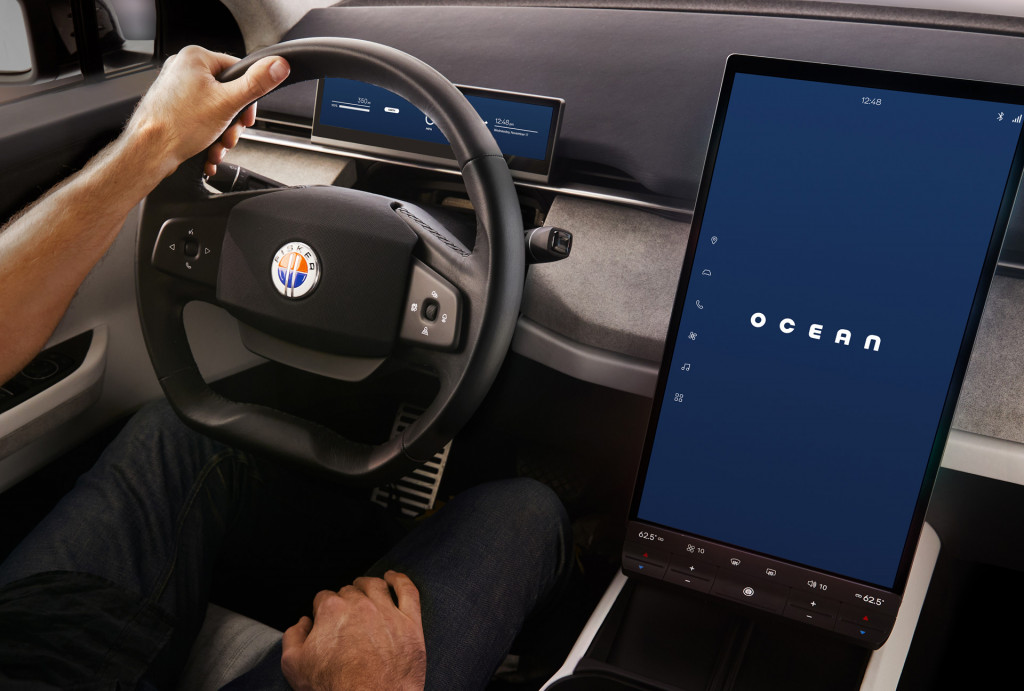
Contract manufacturing was central to the plan. In a prototype interview, Henrik explained: “we invest all our funds into the product and not into factories”. The model reduced the need for an owned assembly operation. It left the brand responsible for the wider customer experience and dependent on partners delivering their part. Founder interview
The product also depended on software after sale. In a revised recall report, Fisker described unintended vehicle movement and a remedy involving an over-the-air update. A separate water-pump recall described a component failure that could trigger restricted battery power. These are documented safety issues, not a claim that every Ocean suffered every defect. NHTSA 24V865 NHTSA 24V499
Market Position
Target Customers
The Ocean targeted drivers seeking a distinctive electric SUV, with a lower-priced entry trim and more expensive versions. Henrik's interview emphasized design and value rather than selling manufacturing expertise itself. Outsourcing was a way to offer the vehicle; it was not the customer's main purchase. Founder interview
Market Size
The relevant market was not every future EV buyer. Fisker needed customers in supported regions who would accept its price, new-brand risk, delivery arrangements, and service network. This review found no independently validated estimate of the portion it could profitably serve.
Competition
The 2020 merger announcement arrived amid strong investor interest in electric vehicles. Reuters placed Fisker alongside Tesla and other new public-market EV businesses. That financing climate gave it access to capital before vehicle sales established an operating record. A valuation reflected expectations rather than realized demand or profit. Reuters
Competition also included established manufacturers with broader distribution and service arrangements. The Ocean's differentiated design could attract attention while customers still needed confidence in repairs and support. That trade-off follows from the ownership obligations, rather than a measured ranking of competing SUVs.
Business Model
Fisker planned to earn money selling vehicles while contracting out assembly. During 2023, it produced substantially more Oceans than it delivered. Production created inventory; customer delivery and payment were separate operating tasks. The February 2024 release acknowledged difficulties establishing direct sales in North America and Europe, and proposed dealer partners as the response. Company release
The audited 2023 annual filing reported USD272.9 million in revenue and a USD939.947 million net loss. Net loss includes non-cash effects and is not the same measure as cash spent. The auditor also found ineffective internal controls over financial reporting, including weaknesses involving inventory, revenue, reconciliations, and communication between departments. 2023 Form10K
In March 2024, the company warned that delisting would trigger debt consequences and that available resources could not satisfy all the relevant notes. This links the market-listing problem to a concrete financing constraint. It does not establish a single cause for the wider collapse. Form8K
Outcome and evolution
The June filings placed the parent and several subsidiaries into jointly administered bankruptcy cases. Bankruptcy was a process, not an immediate statement that every vehicle stopped working. Form8K
Reuters reported approval preserved a roughly USD46 million sale of about 3,000 remaining Oceans to American Lease. A support-data dispute threatened the sale. The buyer agreed to USD2.5 million more over five years for support benefiting other owners too. These asset and service terms are not an investor return. Reuters
Support continued through separate organizations. Ocean Loop currently advertises connectivity, diagnostics, and updates at USD499 per year, with separately listed update charges. It labels OS 2.7 upcoming. These are current vendor offers, not independent verification of a specific car's condition or a restart of Fisker manufacturing. Ocean Loop
The original venture is inactive. Final recoveries, individual recall completion, and future support availability remain separate questions. A driver needs vehicle-specific evidence; the existence of a provider page cannot establish that every obligation has been met.
Key Lessons
- Outsourcing changes responsibilities. An assembly partner does not remove the need to coordinate the complete ownership experience.
- Separate production from delivery. A completed vehicle still needs a customer, payment, transport, and service support.
- Connect operational and financial records. Inventory and revenue controls matter while the company is trying to turn physical products into cash.
- Plan support beyond the sale. Software access, parts, diagnostics, and recalls need durable responsibilities when the manufacturer changes or closes.
- Keep values comparable. A merger valuation, annual loss, inventory sale, and creditor recovery describe different things.
Sources
- Original Fisker Inc. launch release — 2016-10-04.
- Fisker2020 Form10K — 2021-03-31.
- Reuters: Announced public-market merger — 2020-07-13.
- Discover EV: Henrik Fisker interview — 2022.
- Green Car Reports: Ocean production begins — 2022-11-18.
- Fisker2023 Form10K — 2024-04-22.
- Company preliminary2023 results release — 2024-02-29.
- Fisker March25 Form8K — 2024-03-25.
- Fisker June bankruptcy Form8K — 2024-06-24.
- Reuters: Liquidation plan approved — 2024-10-11.
- NHTSA recall24V499 — 2024-07-02.
- NHTSA recall24V865 revised report — 2025-02-12.
- Ocean Loop current service and pricing — accessed2026-10-23.
- CARFAX Car Care — accessed2026-10-23.
- Fisker Owners Association current membership terms — accessed2026-10-23.