Overview
Phantom Auto built software that let people drive vehicles from a distant desk. Founded in 2017, it shifted from supporting autonomous road vehicles toward forklifts, yard trucks, and delivery robots. Its logistics proposition was concrete: hire an operator without requiring that person to live near a warehouse. [1][2]
The company closed in March 2024 after raising $95 million, according to co-founder Shai Magzimof. ArcBest, a customer and investor, independently attributed the closure to failed financing. The technical capability remained useful after the business stopped operating. Public records do not establish whether deployments generated enough recurring gross profit. [1][3]
Serve Robotics bought Voysys and selected Phantom intellectual property in April 2025. Voysys still sells remote-operation software, including a restricted free tier. The technology continued after the original venture stopped operating. [4][5][6]
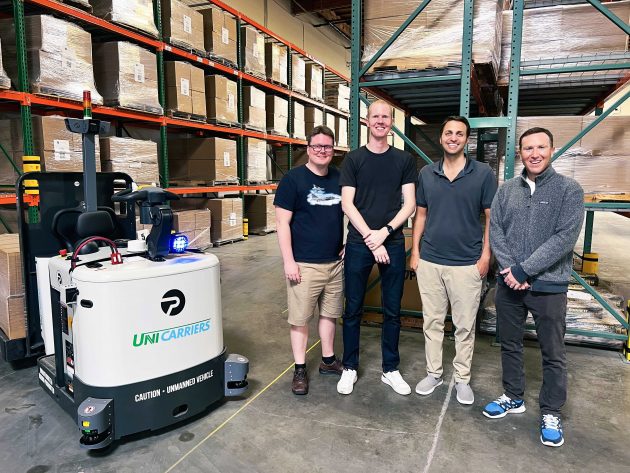
Image 1 / 1
Founding Story
Shai Magzimof, Elliot Katz, and Ohad Dvir founded Phantom Auto in 2017. By April 2019, the company had offices in Mountain View and Tel Aviv. Magzimof led the company, Katz handled business development, and Dvir was COO. Their precise founding connection is not established in the reviewed sources. A company-supplied biography identifies Magzimof’s earlier startup Nextpeer, a multiplayer mobile gaming platform, placing real-time communication in his prior work. [2][7]
The initial premise was that autonomous vehicles would still encounter situations requiring human help. A remote operator could see the surroundings and intervene without riding inside the vehicle. Magzimof’s later account describes an early demonstration involving a Lincoln MKZ in Las Vegas and operators in California. He dates the logistics pivot to 2019. Contemporary financing coverage also identified warehouses and cargo yards as nearer-term opportunities while road autonomy took longer to deploy. [1][2]
The shift changed the buyer’s problem. Warehouse operators needed workers for existing equipment and shifts. Remote driving could expand the hiring area and make the work accessible to people who could not sit in a forklift cab. In Phantom’s January 2022 announcement, Magzimof said, “We have seen an explosion in demand”. Katz described the customer need: “Logistics companies need workers to fill important jobs”. These are founders’ commercial claims; audited adoption measures were not disclosed. [8]
Timeline
- 2017: Phantom Auto began operating. [1][2]
- April 2019: Announced a $13.5 million Series A; contemporary coverage reported $19 million raised to date and a logistics expansion. [2]
- March 2021: GEODIS announced successful French tests with Phantom and Fenwick-Linde. [9]
- July 2021: Kenco announced an Innovation Labs pilot. [10]
- January 2022: Phantom announced $42 million of strategic financing and future deployment agreements with ArcBest and NFI. [8]
- 2022: Acquired Swedish video-streaming company Voysys. [11][12]
- April 2023: ArcBest’s filing records a Series B-2 financing event. [3]
- March 2024: Original operations closed. [1][3]
- April 1, 2025: Serve acquired all Voysys equity and certain Phantom IP, including registered patents. [4]
- November 2, 2026 review: Voysys offers standalone software; Phantom’s original venture remains closed. [5][6]
What They Built
Phantom connected a vehicle’s cameras and controls to a remote workstation. The operator received video and audio and used physical controls to move equipment. GEODIS described switching between vehicles and warehouses from one office. That capability pooled access to people across sites; it did not mean one person could actively drive several forklifts at once. [9]
The distinction between supervision and driving matters. A person can watch several vehicles while autonomy handles routine movement. When that person takes direct control, attention becomes a scarce resource. Magzimof’s retrospective explicitly distinguishes driving one forklift from watching several. The operational question is therefore how frequently vehicles need intervention and how long each intervention lasts. [1]
The transport layer was a substantive part of the product. Phantom acquired Voysys to improve video latency, image quality, and connection stability over changing networks. Its acquisition release described combining multiple communication links and adapting the video stream. This addressed the difference between a successful demonstration and work across imperfect warehouse or cellular networks. The release does not establish independently measured uptime or customer savings. [11]
The product also depended on equipment integration and local operations. In Phantom’s podcast, Katz discussed integrating with Mitsubishi Logisnext equipment and using its dealer network for service and maintenance. The proposed factory and dealer route could reduce bespoke installation work. The reviewed episode description does not prove how many factory-built vehicles shipped. [13]
Market Position
Target Customers
The logistics buyer was a warehouse, freight operator, or equipment manufacturer seeking access to trained labor across locations. GEODIS’s internal innovation program originated its forklift project. Kenco explicitly began with a pilot in its test facility. These relationships placed Phantom inside existing operating workflows within established business purchasing channels. [9][10]
Magzimof also names Maersk, CJ Logistics, ArcBest, and Serve as customers. Those names establish his account of commercial reach; the reviewed evidence does not quantify each deployment or independently corroborate every relationship. [1]
Market Size
A broad logistics labor problem is larger than the portion addressable through remote driving. Eligible work requires compatible equipment, suitable connectivity, trained operators, and a site willing to change its procedures. A defensible market estimate would count deployable vehicles and paid operating shifts, then subtract installation and support costs. Public fleet and revenue data are insufficient for that calculation.
Competition
Phantom competed with local hiring, vehicle automation, and customers’ own engineering teams. Its human-operated approach could address work before full autonomy was ready, but still required people and equipment integration. Strategic partners could provide access to sites while retaining control of purchasing and deployment schedules. That bargaining relationship matters more than a generic list of robotics startups.
The current software market remains occupied. Formant documents remote control with live video, joysticks, and WebRTC connections. Voysys markets standalone streaming and remote-operation software following Serve’s purchase. A new company cannot assume that Phantom’s closure left its technical category vacant. [5][14]
Business Model
Phantom sold to businesses through software and commercial deployment relationships. The January 2022 financing announcement paired investment with agreements to deploy thousands of forklifts over future years. Those agreements indicate intended demand; they are not a count of installed vehicles or recognized revenue. [8]
The public evidence does not establish contract prices, recurring revenue, deployment margins, retention, or the split between software and engineering work. Without those measures, the economic cause remains uncertain. Financing totals cannot substitute for profitable installed capacity.
ArcBest’s records provide a narrower financial anchor. It invested $25 million in November 2021. Its investment’s carrying value rose to approximately $28.7 million by December 2023, then was written off during 2024. That is an investor’s noncash accounting loss, not Phantom’s annual cash burn or total operating loss. [3]
Traction
Phantom had named customers, industrial pilots, equipment partnerships, and strategic investors. GEODIS documented tests in Levallois and Le Mans. Kenco announced an initial pilot rather than a completed fleet rollout. ArcBest and NFI announced future commercial deployment agreements. [9][10][8]
These are meaningful stages of enterprise adoption. Their economic significance remains uncertain because the reviewed sources do not connect them to delivered fleet counts, paid utilization, or recurring gross profit. Awards and launch announcements cannot resolve that gap.
Outcome and evolution
ArcBest’s 2024 annual report says Phantom stopped operating because of “liquidity concerns from failing to secure additional funding from investors or lenders”. This investor disclosure corroborates the founder’s March 2024 closure account. [3][1]
The strongest interpretation is that commercial and technical progress had not removed dependence on new capital. Integrating equipment, serving industrial sites, and expanding adoption can consume cash before deployment revenue becomes repeatable. That mechanism is an inference from the documented sales model and financing failure; public data do not prove which cost or customer delay dominated.
The strongest alternative is a financing-market shock affecting a promising business. The financing explanation is directly supported. The available records cannot determine whether another round would have produced a sustainable company. Conversely, Serve’s purchase supports continued usefulness of the technology without proving that Phantom’s original standalone economics worked.
Serve’s filing fixes the transaction date and scope: April 1, 2025, all Voysys shares plus certain Phantom intellectual property. Its September announcement reported approximately $5.75 million cash consideration and said Voysys would continue separately for customers. The announcement date is later than the transaction date. [4][12]
Current Voysys pricing offers one vehicle for non-commercial use at no charge, with a limited renewable commercial trial. Production licenses have custom enterprise pricing. Those terms are materially different from unlimited free commercial operation. As reviewed November 2, 2026, this is an available supplier, not an abandoned technology awaiting recreation. [6]
Key Lessons
- Phantom’s move into warehouses connected an existing remote-driving capability to a specific hiring problem. GEODIS and Kenco provide stronger evidence for that choice than a general forecast of autonomous vehicles. [9][10]
- Phantom’s strategic investors also controlled deployment opportunities. Future fleet agreements gave the company distribution access, but publicly disclosed orders did not establish recurring deployment margins. [8]
- The Voysys purchase addressed a real component of remote operation: reliable video across changing links. Its later independent availability shows why technical assets can retain value after the business that bought them closes. [11][12][6]
- Phantom’s funding history and ArcBest’s write-off measure different things. A founder’s $95 million raised, an investor’s carrying value, and Serve’s asset consideration cannot be combined into a single measure of operating performance. [1][3][12]
Sources
- Shai Magzimof, The Control Room, June 22, 2026
- Globes, Remote driving co Phantom Auto raises $13.5m, April 23, 2019
- ArcBest 2024 annual report, equity investment notes
- Serve Robotics 2025 annual filing, acquisition note
- Voysys current product website
- Voysys current pricing
- Equilar, company-supplied Shai Magzimof biography
- Phantom Auto, $42 million investment and commercial agreements, January 19, 2022
- GEODIS, remotely operated forklift partnership, March 31, 2021
- Kenco, remote forklift pilot, July 20, 2021
- Phantom Auto, Voysys acquisition announcement, reproduced by ProMat
- Serve Robotics, acquisition announcement, September 9, 2025
- Phantom Auto, Click Connect Drive podcast and episode descriptions
- Formant, current teleoperation documentation
- Inside Logistics, shutdown reporting and founder photograph, March 28, 2024