Overview
Segway's original transporter solved a difficult balance problem, but its buyers still needed an affordable vehicle and somewhere useful to ride it. The company found narrower uses than its launch publicity suggested. Ninebot acquired Segway in 2015, and production of the original Personal Transporter ended in July 2020. The brand continues across scooters, robotic mowers and robotics products. [1] [2]
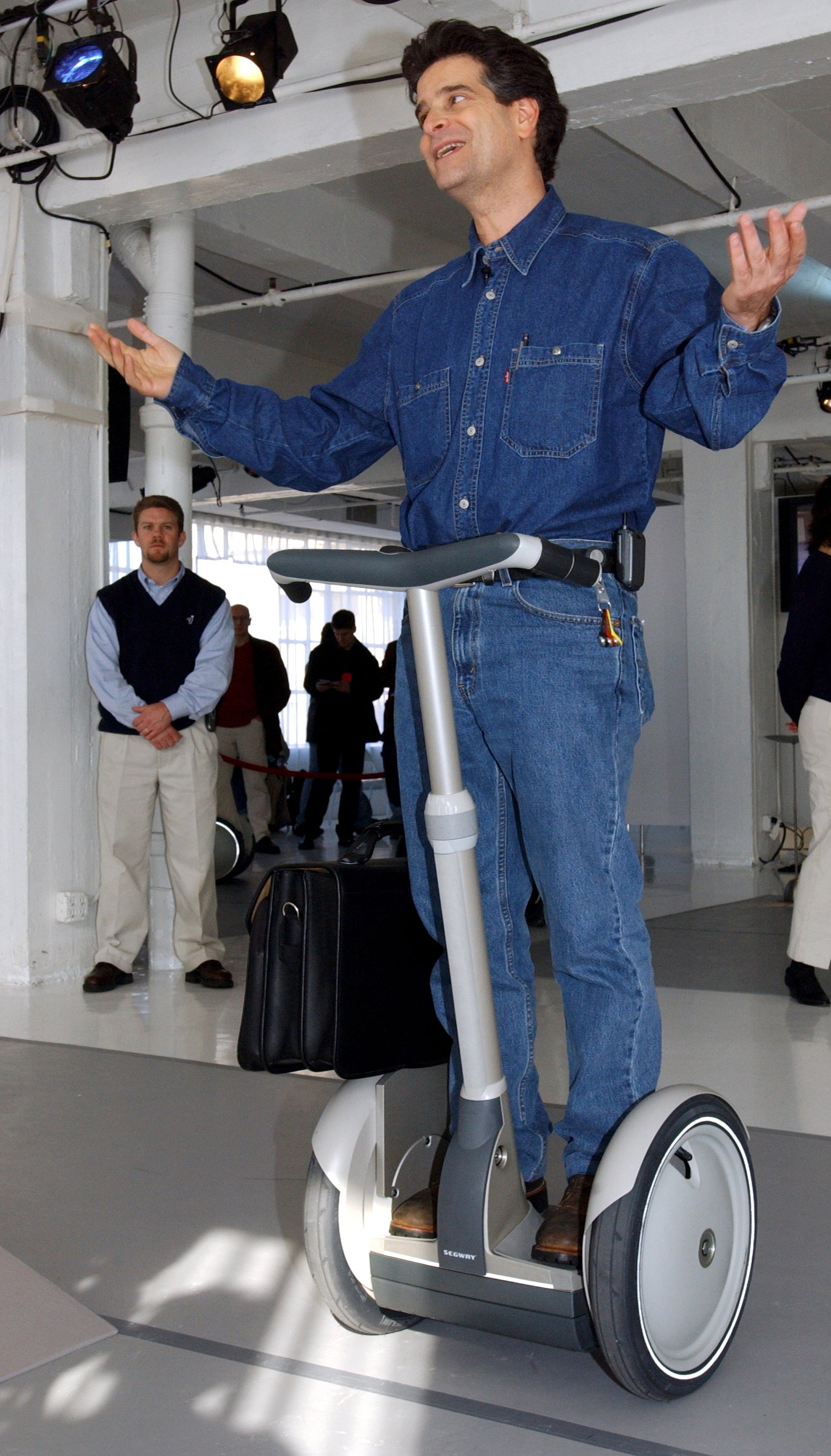
Image 1 / 1
An impressive machine still needs a repeatable purchase. The price, learning requirements and route restrictions narrowed the original transporter's appeal. Later owners pursued other vehicle forms and jobs.
A public launch before a mass market
Dean Kamen founded the company in 1999. Its Human Transporter appeared on Good Morning America in December 2001. A rider stood between two side-by-side wheels; the machine balanced as the rider shifted weight. This made standing travel possible without the shape of a bicycle or conventional scooter. [1] [3] [2]
The publicity was deliberate. Burson-Marsteller's launch account describes embargoed demonstrations, a national television reveal and references to early customers including the US Postal Service, Amazon, Delphi Automotive, GE Plastics, the National Park Service and Atlanta. The agency wanted to position the machine as a productivity tool for commercial users. This account establishes the campaign and named relationships; it does not establish large recurring orders from every organization. [4]
Public attention reached customers before routine access did. Amazon and Segway announced consumer orders in November 2002, at $4,950 with a $495 deposit. Deliveries were scheduled for March through July 2003. Amazon's reach helped discovery and ordering, but the purchase still required a substantial financial commitment. [5]
The initial commercial trials were sensible attempts to find that value. Postal carriers, security staff and tour operators have repeated routes or supervised environments. Their task is more specific than replacing urban walking. [2] The inference is that a repeatable route and an operator who can organize training made adoption easier; the evidence does not let us rank each factor's contribution to sales.
The route was part of the product
Where a vehicle may travel matters as much as whether it works. Britain's transport guidance illustrates the constraint: powered transporters cannot generally use pavements and face motor-vehicle requirements on public roads. Private land is a different case only when the public has no access and the owner permits use. These rules are specific to that jurisdiction; they do not describe every Segway market. [6]
Segway also had to service a machine that carried a standing person. The US Consumer Product Safety Commission's 2006 recall covered approximately 23,500 transporters and prescribed a software upgrade. It recorded six reports of improper operation with head and wrist injuries. The recall describes a concrete product issue. It does not establish that accidents alone caused weak adoption. [7]
The product did evolve. Segway's history records cross-terrain models, a second generation with LeanSteer in 2006, and a three-wheel SE-3 Patroller for public safety in 2014. These choices show attempts to serve particular terrain and professional uses. It would be inaccurate to describe nearly two decades as one unchanged prototype. [1]
By 2020, Fast Company's interviews put lifetime PT sales at about 140,000. President Judy Cai said durability reduced replacement purchases; executive Tony Ho contrasted the unfamiliar PT with easier-to-learn kick scooters. Those are managers' explanations, not a controlled test. They fit a business that achieved durable niche use without becoming the universal vehicle its early attention suggested. [8]
Durability also has another interpretation. A lasting machine can be valuable to customers. The business problem is whether new buyers, service income or other products support the supplier when replacement demand is slow. Making the product less durable would not resolve its price and use restrictions.
New ownership changed the portfolio
Segway changed hands before Ninebot. Contemporary reporting records a sale to Jimi Heselden in 2009; the company's own history records Summit Strategic Investments' acquisition in 2013. [9] [1]
Ninebot's 2015 acquisition joined a Chinese rival with the original Segway company. A Delaware court's later account, drawn from a complaint at the dismissal stage, describes about $35 million in annual Segway revenue in 2015. It says Segway began distributing Ninebot products while retaining separate corporate systems. That is historical case background, not an audited revenue disclosure or a finding that the acquisition failed. [10]
The distribution role became more important. Its 2018 pitch used a few customizable products for scooter operators. [11] Reuters later identified Bird and Lime among its customers. Selling vehicles to fleet operators gave the supplier a route to market through other companies' consumer services. [2]
Reuters reported that PT manufacturing would stop on July 15, 2020 as the company focused on other businesses, including shared scooters. This was a product-line decision. [2]
Outcome and evolution
As checked on November 5, 2026, Segway promotes a continuing scooter range, while its Navimow store sells robotic mowers. The US store displays the i206 AWD at a promotional $899 against a $999 regular price, and the i215 LiDAR at $1,399 against $1,599. These are dated listings, not permanent prices. [12] [13]

Segway Robotics separately markets its E1 delivery robot and the Nova Carter development platform. The latter combines a Segway drive platform with NVIDIA Jetson AGX Orin and sensors. These listings demonstrate a broader portfolio; they provide no basis for claiming that every advertised robot has large commercial deployments. [14] [15]
Operational obligations continue with the newer forms. In March 2025, the CPSC recalled about 220,000 G30P and G30LP kick scooters for a folding-mechanism hazard. It recorded 68 failure reports and 20 injuries. This is a different product and defect from the PT recall. [16]
A modern rebuild also faces current market-access rules. The FCC added foreign-produced advanced robotic devices to its Covered List in July 2026, restricting new equipment authorizations. September's conditional exemption names specific Husqvarna mower platforms. A founder cannot infer authorization for a different model from a competitor's approval. [17] [18]
Timeline
- 1999: Kamen founds the company. [1]
- 2001–2003: Public reveal, Amazon consumer ordering and scheduled deliveries. [5]
- 2006: Second-generation PT and software recall. [1] [7]
- 2013–2015: Summit acquires Segway; Ninebot subsequently acquires it. [1] [10]
- 2020: Original PT manufacturing ends. [2]
- 2026: Current stores and robotics pages show a continuing, broader business. [13] [15]
Sources
- Company history
- Reuters production-end report
- Kamen explains the intended users
- Launch campaign account
- Amazon consumer-order announcement
- British powered-transporter guidance
- Original PT recall
- Management retrospective on the PT
- Earlier ownership reporting
- Segway v Cai historical case background
- Commercial supplier pitch
- Current Segway scooter campaign
- Current Navimow US store
- Segway E1 delivery robot
- Segway Nova Carter
- Newer scooter recall
- FCC robotics Covered List notice
- FCC model-specific exemption